Archive of the Kumamoto International Facebook group, 2011–present.
Kirk here with a bit of national news that applies to Kumamoto (and Kumamoto International) as well. Facebook uses some sort of algorithm to determine what people are interested in and, conversely, what they're are not interested. The "reach" (the number of people the Facebook algorithm shows a post to) of posts I've made to this page in recent months has been consistently low, even when I've reported new records highs. So, the expression "people just couldn't be bothered" rings true to me.
https://www.facebook.com/ShingetsuNews/posts/pfbid0kGKMuDJaZNEAP7SPetCxewyqWvpkfv7pojyJC3FEx3jTmTV5bcRwrSWPzLYZcjbgl
Hello,Atsuko here. It's vacation and Obon, but difficult to go out in Corona.
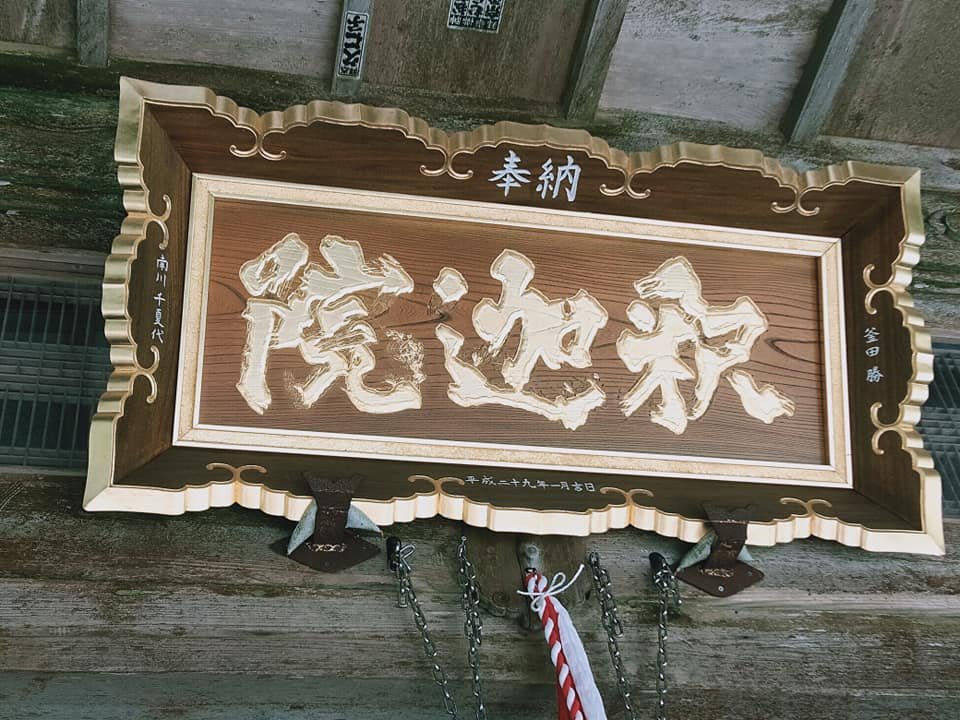
William once recommended that if you climbed the 3333 stone steps, the highest in Japan, in Misato Town, you should also go see the temple.
https://m.facebook.com/story.php?story_fbid=5970886576318058&id=123734781033296
It was not open when William and I went there before, but the other day, at the end of July, I went there and the temple was open and the priest explained lots things to me .
The temple seems to have been recently renovated and is very beautiful.
This Shaka-in temple seems to be very famous (so much so that Japan's highest stone steps were built to get there).
In the Edo period, it was the fourth most visited tourist site in Kumamoto prefecture, following Mt.Aso, Kumamoto castle, Shiranui.
If you climb up the 3333 steps, pray, draw a fortune, and ring the bell, you may feel as if something good will happen to you or your wish will come true.
Everytime,I climbed the 3333 steps on a hot day at the end of July, and the more I climbed, the cooler and fresher I felt with the sweat and the mountain breeze.
Last summer
:https://m.facebook.com/story.php?story_fbid=5762133557193362&id=123734781033296
Also, as you climb, you can enjoy the refreshing summer and shade of the trees while listening different cicadas songs : Kuma-zemi, Abura-zemi, Niinii-zemi, Tsukutukuboushi, Higurashi, and so on.
The priest of the temple at the end of the 3333 steps awaits you all.
Hoping lots happy comes to you.ଘ(੭ˊ꒳ˋ)੭✧
William Stat of the day: " The impact of heat is cumulative, and the body only starts to recover when it drops below 80F" - or 28C. It is 31C in Kumamoto today and very humid.
There are places you can seek shelter from the heat, such as a library or convenience store. Stay safe.
‘Getting harder and hotter’: Phoenix fire crews race to save lives in America’s hottest city
As temperatures soar at triple digits, heat-related 911 calls have increased 34% since 2020, with first responders facing the brunt

William My wife has been stricken by cancer, that ghastly phenomenon that took both her parents. But her month-long hospitalization was likely cheaper than if she had stayed at home (though the food wasn't as good). Remember that the next time you complain over your health insurance bill.
William A Latin culture contains the "siesta" - a mid-afternoon nap. In an energy-saving effort, this custom would be worthwhile introducing to Japan. I thought of this as I went out at 6:00 this morning to buy some dashi for my morning noodles and no stores were open (except for the convenience stores, of course).
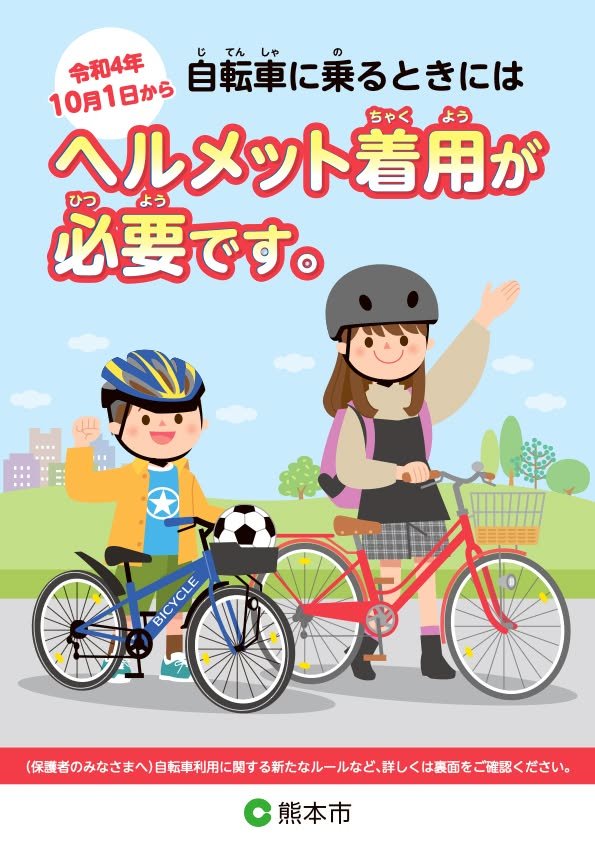
Kirk here with some news for bicyclists in Kumamoto City: "Bicycle users must wear a helmet from October." The "must" word, however, needs some explanation. Here's part of the machine translation on the website's page:
"In this revision of the ordinance, it is a duty of effort, and there is no enforcement of crackdowns or fines or penalties.
However, wearing a helmet is also for your own safety, so please work on wearing it."
So, no penalty. It's a toothless rule but a good one. I've been lax in regards to helmet wearing but I'll try to comply.
By the way, if you want to see the original, you can choose "Japanese" under "Foreign Language." I'm trying to get the Prefecture to add the functionality to their website but, alas, currently, different languages and separate universes with no direct bridges between the individual pages on the prefecture's website.
https://www.city.kumamoto.jp.e.fm.hp.transer.com/hpKiji/pub/detail.aspx?c_id=5&id=43456&class_set_id=2&class_id=71&fbclid=IwAR05QSNQlgxdQzR2fbUAa-aP-fPXsDKv_PNj-9j2uqnoJGBDsgw0boN96Ec
P.S. Thanks to Kimmie Kimmie for telling me about this. :)
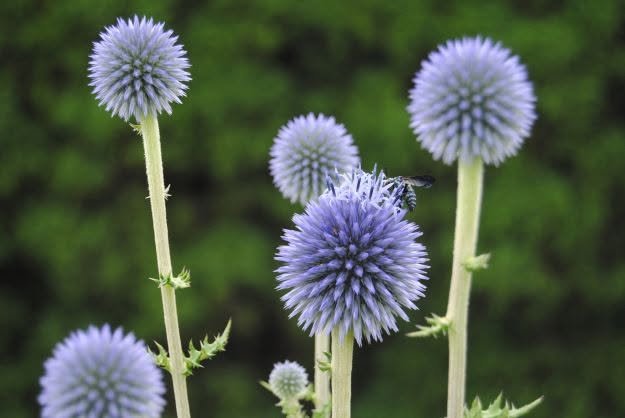
The "Higo tai" is a very rare type of thistle indigenous to and a symbol of Kumamoto. As a Californian, I am accustomed to thistles: artichokes! - though when I tried to cultivate the Higo tai, I failed. Apparently, it is very difficult. https://ubu-lab.com/spot/%E3%83%92%E3%82%B4%E3%82%BF%E3%82%A4%E5%85%AC%E5%9C%92/
Kirk here. When I comment on posts, I switch from "Kumamoto International" (the identity I use to post to and manage the page) to my individual Facebook account. Then, if I want to post to the page, I need to switch back. Sometimes (quite often, actually), I forget, as in this case.
https://www.facebook.com/Kumamotoi/posts/7688686657871366
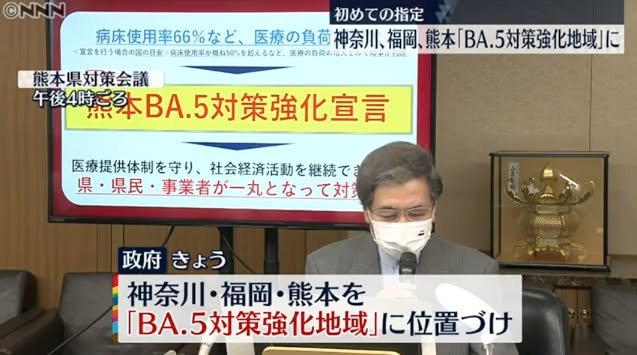
Kirk here with more about the designation of Kumamoto as a "prefecture of strengthening measures." This awkward English expression is a translation of the Japanese "BA.5対策強化地域" (BA.5 taisaku kyouka chiiki) found in the following Japanese article:
https://news.yahoo.co.jp/.../98d2e1a02e80ee9f91a85e4a5da9...
The screenshot, by the way, is from a video in that Japanese article.
The English article, published Aug. 2, is here:
Japan Designates 3 Prefectures for Measures against BA.5
https://jen.jiji.com/jc/i?g=eco&k=2022080201097
"The Japanese government said Tuesday that it has designated Kanagawa, Fukuoka and Kumamoto prefectures for strengthening measures against the now-rampant BA.5 omicron subvariant of the novel coronavirus."
Kirk here. The other day I posted about MURAKAMI Munetaka (baseball star, formerly of Kyushu Gakuin) a his younger brother Keita:
https://www.facebook.com/Kumamotoi/posts/pfbid02a7znusFVbzejtQxNsBF3wAbzF151GRE7HszRSGdJ5BpgqQCn2AUk1MQ5MgmnSeF7l
Keita and his Kyushu Gakuin teammates will play their first game in the Koshien Tournament on the 13th.
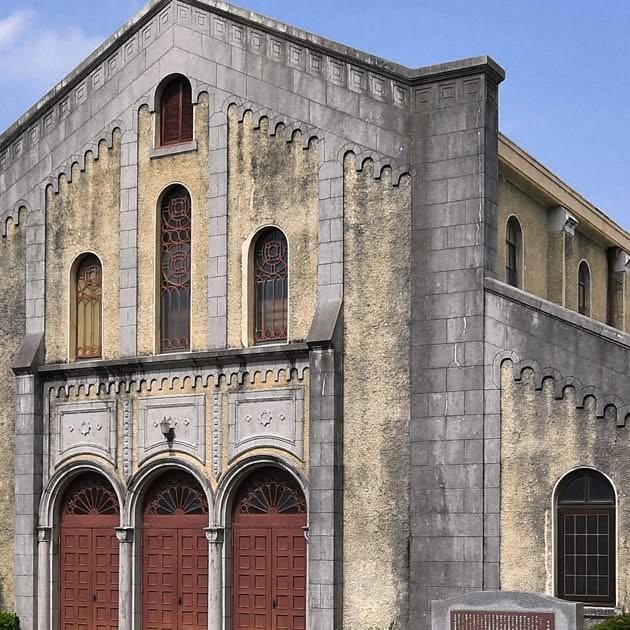
Now, for more Kyushu Gakuin news with this article from the Mainichi paper. The article says that the church on the campus was "designated as the first nationally registered tangible cultural property in Kumamoto Prefecture in 1996."
By the way, here's a reason for Japanese people to learn English: Mainichi puts its Japanese articles behind a paywall but you can read the English for free. Learn English and save money!! (The article has a like to the Japanese original but you can only read the first paragraph for free.)
Retro Japan: 1920s chapel at Kumamoto school preserved as place of solace for alumni - The Mainichi
KUMAMOTO -- An old chapel at a school in this southwestern Japan city once threatened with demolition stands to this day thanks to the efforts of an a
Carlton here. A blockbuster film is in the offing for Japan but I’m not yet sure when it will open here. But it has all the trappings of an international action film that will make Japanese promoters drool: filmed in Japan on a shinkansen and starring Brad Pitt and the shinkansen along with several Japanese actors as well and a bunch of celebrity cameos too. The Internet Movie Database (IMDB) has already annointed it with a 7.5 rating.
But, veteran critic Rex Reed who’s always had a winning way with words though maybe not with film critiques, has a rather different take on it, and I add it here for review before you drop your ¥1800 in the ticket machine: <https://observer.com/2022/08/bullet-train-might-be-the-worst-movie-ever-made/>
‘Bullet Train’ Might Be the Worst Movie Ever Made
‘Bullet Train’ features the worst assemblage of bad acting ever collected in a single film. There is also a poisonous snake.

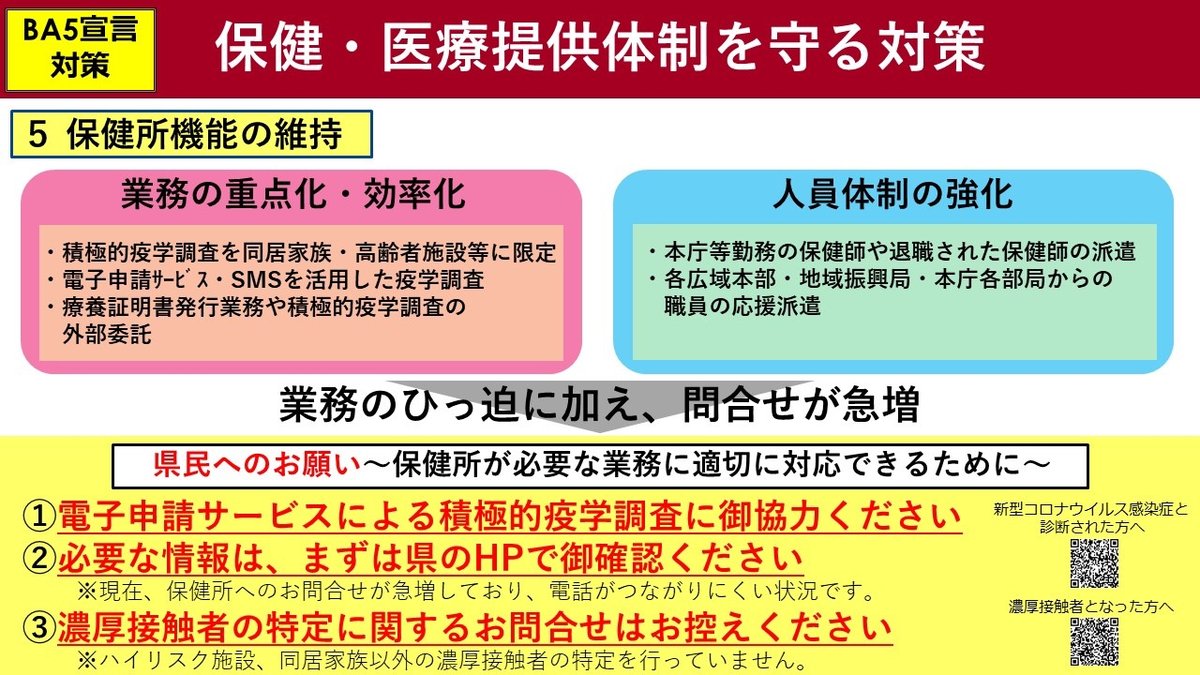
Kirk here. Recently, my university told me to check out the following page, which has an official announcement about measures we should be taking to deal with the latest and most contagious flavor of COVID-19: BA.5. Here's the page:
https://www.pref.kumamoto.jp/soshiki/30/145891.html
The site provides machine translations into English and other languages. Here's the URL for the English:
https://www.pref.kumamoto.jp.e.qp.hp.transer.com/soshiki/30/145891.html
But this particular link is pretty much useless because, in addition to the usual poor quality of the translation, most of the information is provided via JPG images, which are not translated.
To save you the time of trying to read the tiny text (another problem), or trying to get help with it if your Japanese is not at that level, I'll give you a brief summary: Be careful.
Ah, maybe that was a bit TOO brief but that's the message in a nutshell. It's not a matter of being forbidden to do A or B. Rather, there's a list of what, by this point, have become common-sense measures for reducing the risk of spreading the disease.
There's also something about free testing at Kumamoto Station but -- sigh --- no details and no link to a site with more information. Alas, an example of the sort of poor communication that I have found to be quite common on Kumamoto Prefecture's website: In order to actually be able to USE information we need to be give a complete explanation or a link to one -- not just a tantalizing headline.
Another example of poor communication is the QR codes you see (if you can see them) in the image I'm sharing. I found that the original image is 1,280 pixels wide and on that image the QR codes can be read by my phone. However, on the website itself the images are shrunk to less than half size, rendering the QR codes useless. Moreover, THIS A WEB PAGE, NOT A PIECE OF PAPER. Forgive me for shouting, but I get emotional about this stuff. If you are handing out a piece of paper and only expect people receiving the piece of paper to want to use a phone to find out more information, then, OK, a QR code is best. But, even on a smart phone, a QR code doesn't work unless you have something printed out. In other words, you can't tap on it. But, alas, no link. :(
Sorry to complain but I think it's important to point out that people who put information out on the internet often have no idea of how to communicate effectively or, more likely, just don't really care. :(
Maybe I'll call the prefecture. They'll probably ignore me but one never knows.
P.S. Yesterday Kumamoto broke it's record for most infections in one day: 4414. Today the number seems to be a bit lower: 4062.
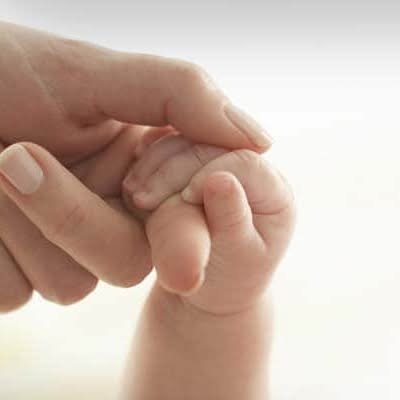
Kirk here with one old article and one new one about how the baby hatch in Kumamoto (Jikei Hospital) has been a model (to some extent at least) for similar efforts in other parts of the world. The older article (click on picture for link) includes the following sentence:
"About a dozen European countries, as well as China, Japan, Malaysia and South Korea already use similar systems."
This was as of 2015. There may be many more examples in the world now. But, both then and now, "Japan" can only be mentioned because of Jikei Hospital in Kumamoto. (Go Jikei Hospital! 😉 )
I was prompted to post about this today by the newer piece I came across on NPR (first link below, not the one linked to with the picture):
"Indiana is installing more baby boxes, where newborns can be anonymously surrendered"
https://www.npr.org/2022/08/03/1115456040/indiana-is-installing-more-baby-boxes-where-newborns-can-be-anonymously-surrende
https://www.ndtv.com/world-news/indiana-baby-box-proposal-sparks-controversy-746686
Indiana 'Baby Box' Proposal Sparks Controversy
It could easily be mistaken for a mailbox, except that one side of it is riddled with air holes.
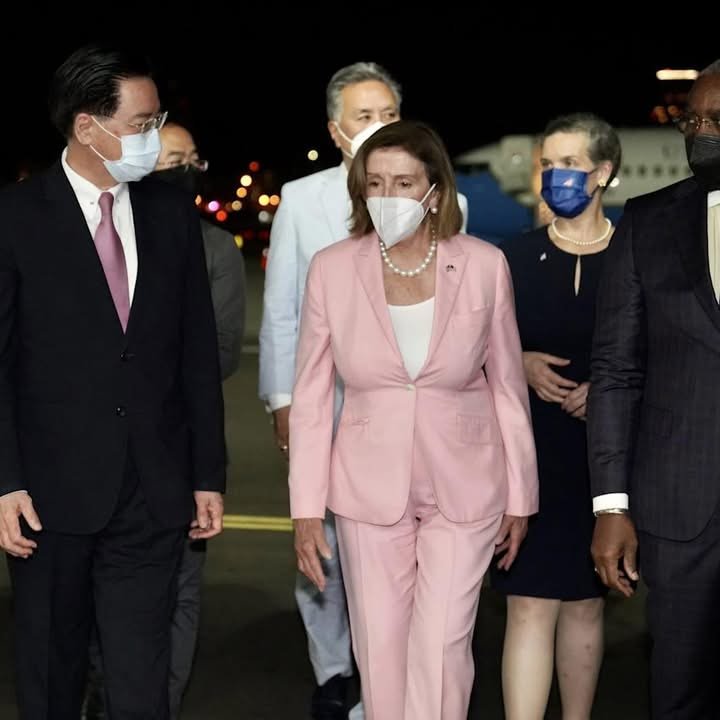
Kirk here with a note about TSMC, the company that is in the process of building a semiconductor chip factory in Kumamoto. This company got a visit from U.S. lawmaker Nancy Pelosi on her controversial (at least in mainland China) visit to Taiwan. The second article (not the article you go to by clicking on the image) says that "TSMC is now building a $12 billion fab in Arizona to help boost chip production on US soil, but it still makes the majority of its chips and all of its cutting-edge semiconductors at home." So, Kumamoto is not the only site of the company's expansion.
https://finance.yahoo.com/news/chip-stocks-plunge-nancy-pelosi-202243042.html
https://www.bloomberg.com/news/articles/2022-08-03/pelosi-visit-highlights-tsmc-and-taiwan-s-global-tech-import
Chip stocks plunge as Nancy Pelosi lands in Taiwan. Here’s why the chip sector in particular could lose big if China follows through on its threat of ‘strong countermeasures’
Taiwan plays an outsize role in the global chip supply chain, as its manufacturers are especially important suppliers of advanced chips.
Kirk here with a hometown-boy-makes-good story. MURAKAMI Munetaka, who played for Kyushu Gakuin in high school, has set a world record. Apparently, even Babe Ruth wasn't ever able to his a home run at each of five consecutive at bats, as MURAKAMI did.
By the way, Kyushu Gakuin will be playing in this year's Koshien Tournament and Munetaka's little brother Keita is an important player on the team.
I might add that Kyushu Gakuin had a few players who came down with COVID-19 so they missed the opening ceremonies and the schedule had to be adjusted but it looks like they'll be able to play
Baseball: Munetaka Murakami makes home run history in Swallows' win - The Mainichi
TOKYO (Kyodo) -- Munetaka Murakami became the first player in Japanese pro baseball to homer in five straight at-bats by going deep his first two time

It's hot, hot, ATSUI days, Atsuko here.
My name is Atsuko, which means hot hearted or passionate, not hot.
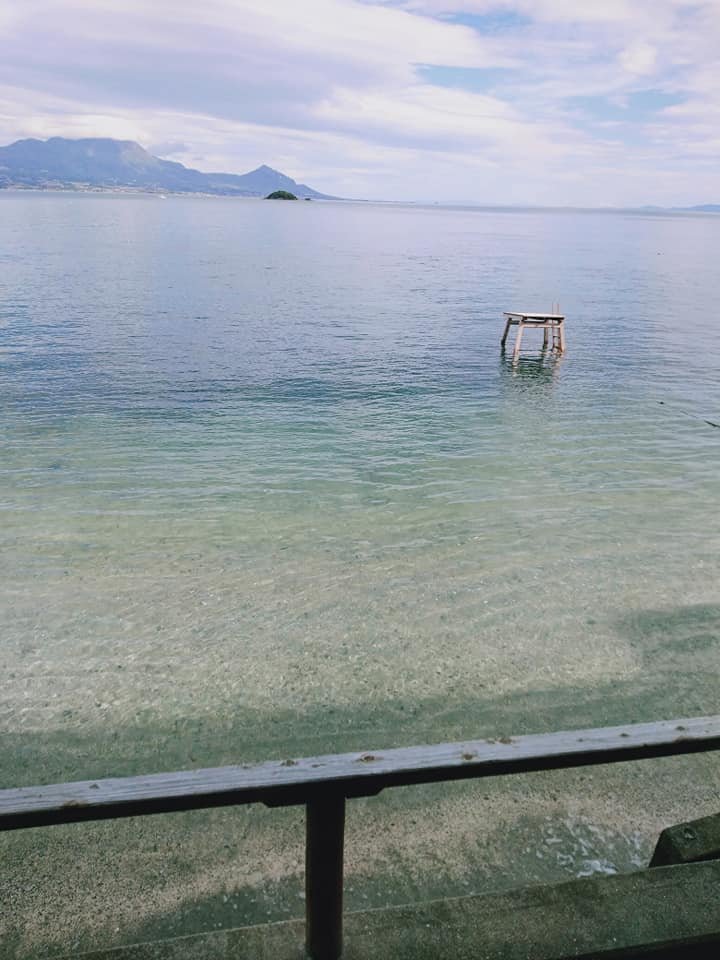
Since it's so hot, I'll secretly tell you about my special, favorite beach that I have been going to every year for 20 years.
It is 清流荘 Seiryu-so in Oyano, Amakusa. It's like a private beach, right?
https://www.google.com/travel/hotels/s/ij6bi2ZEVvw3fLsEA
The beach house faces the ocean, so it is safe to go there even with a small baby. Last Sunday, there was a family with an 8-month-old baby.
The good point of this place is that you can use one room (tatami room) for a group. We went with three people this time and we had one room. If there are a lot of people and not many reservations, you can use two rooms.
Adults 1000yen/day, elementary school students 700yen/day. (You can stay and order lunch also. You can bring your lunch and eat at there also.)It is only for rest, but it is convenient to use the shower, have lunch, rest, and take a nap for tired people, babies, the elderly, and drivers.
We played, showered, ate lunch, played, showered, ate a snack, played, showered, changed clothes, and left.
At high tide, you can jump off the diving board, and at low tide you can catch crabs, fish and hermit crabs in the tide pool.
I recommend you to call for an appointment. The owner can only speak Japanese, but you should tell them the date and number of people. Every year I take my international friends there, so I am sure they will be friendly to you too.
I also recommend you that you should visit there before OBON, middle August because you might meet jellyfish after OBON.
After visiting Amakusa, be sure to stop by the statue of Jinbee, one of One piece character, in Sumiyoshi Kaigan Park. It is recommended to go here at low tide.
https://g.co/kgs/fpNhQq
Enjoy Summer!!
Trip minimum but Enjoy maximum(๑˃ᴗ˂)و♡
William More about water - this time, not where it comes from but where goes. Mark Twain is purported to have said regarding the American West, "Whisky is for drinking; water is for fighting over." As an Angeleno, I understand this.
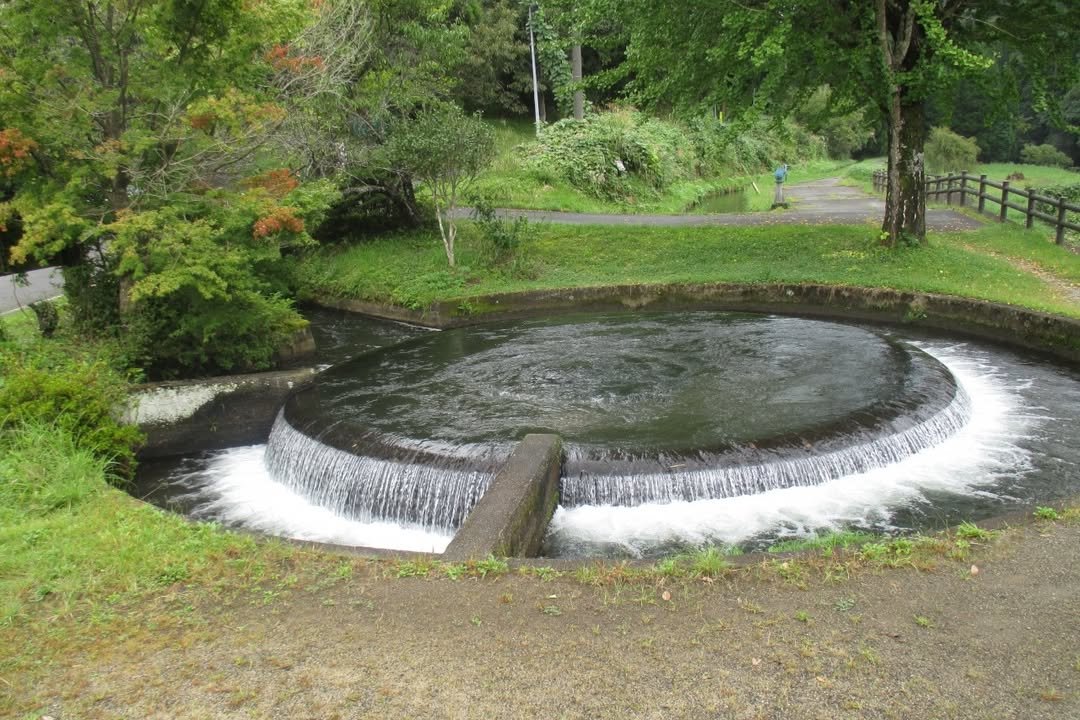
Even in water-rich Japan, when it comes to irrigation, all must be assured their fair share. Herein comes the "Enkei Bunsui" (円形分水, or cylindrical diversion). This device serves two purposes: to slow water flow by forcing a stream to surge upward into a basin; and to create a visually calculable division of water.
Several of these devices remain in Japan. Google 円形分水 for photos. One is in Yabe, to divert a stream's flow into three, two divisions into the uplands and one through Tsujunkyo, which in turn irrigates the plateau to the south. No visit to Tsujunkyo is complete without a visit to this ingenious device. I've never jumped into it, but I suppose it would not be particularly dangerous.
Photo: ①Waterflow on the left is the incoming stream, which is forced upward to slow the flow and then divided. ②A map showing diversion through Tsujunkyo to the Shiroito Plateau. ③Water flushed from Tsujunkyo to remove sediment from its center.
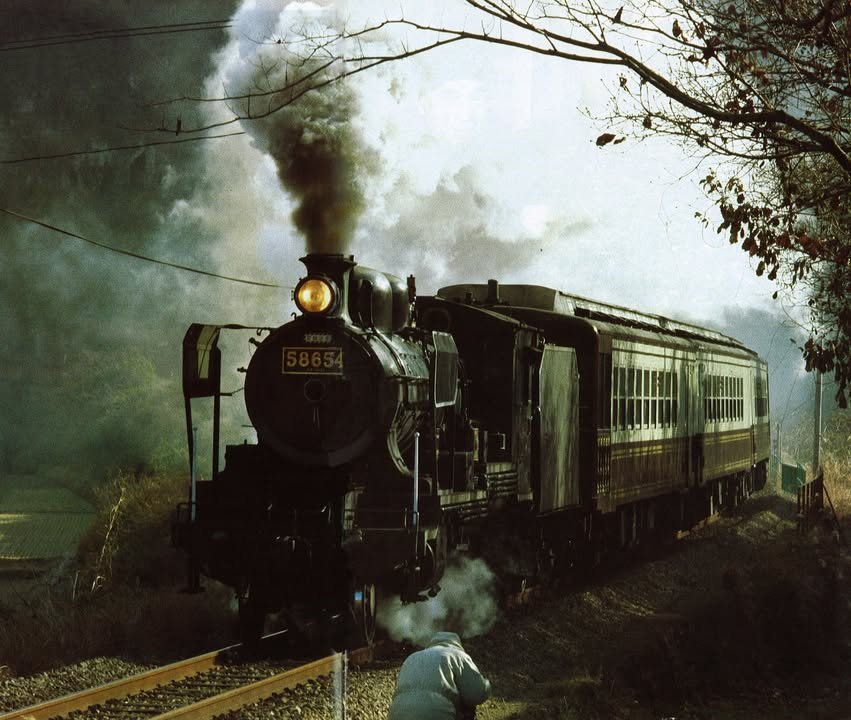
William Having acquired an interest in western China cultures, I took a month off from my junior year abroad program in Beijing and travelled almost to the border of Afghanistan. (I didn't ask permission as I knew what the answer would be; that I did my homework and mailed it to my school daily likely spared me expulsion.) Much of the trip was by steam locomotive (SL), so I grew used to their sounds. First arriving in Kumamoto, to my surprise, I often heard something I could have sworn was an SL - in 1990s Japan!
Turns out it was: JNR 8620-type steam locomotive No. 58654. Built at the Hitachi Factory in Kasado, Yamaguchi in 1922, the train has had a long history in Kyushu, mostly in Kumamoto. It was almost scrapped several times and spent the period from '75 to '88 at a museum in Hitoyoshi, when it was transported to Kokura to be completely restored and put back into service. Known colloquially depending on its route - "Aso Boy" or, currently, "SL Hitoyoshi" - the 58654 is the oldest SL in Japan that has a vehicle registration and can be operated on commercial routes.
Kumanichi reports that SL Hitoyoshi made an appearance at Kumamoto Station alongside Kumamon, dressed in an accurate fascimile of the station master's uniform, to mark the opening of "Kumamon Station," which is part of a plan to increase chances to interact with the chubby bear. Every Sunday, Kumamon appears onstage at the Metro Bookstore on the 6th floor of the station building, dressed in his station master duds.
Youtube video about the venerable 58654 with stunning Aso scenery and the Kumanichi article: https://www.youtube.com/watch?v=IkAaoVMiLE0
https://kumanichi.com/articles/744637