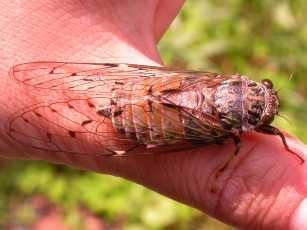
A note from the Kumamoto International entomology desk: Know your cicada.
Called "semi" in Japanese, cicada spend all but the last week of their lives as nymphs some two meters underground, sucking up tree root sap for subsistence. Most Japanese cicada species have a life cycle of two to five years, though some in North America spend 17 years as nymphs before their final glorious week in the sun. Climate cues - sudden dryness and heat following rainy season - encourage the nymphs to emerge en mass (not, as I'd originally thought, a "semi conductor"), generally at night to avoid predators as they are immobilized for a few hours while their exoskeleton and wings dry. (The link has a short video of this.) During this time, while they may snack on sap using their scary-looking but utterly harmless proboscis, their drive is to find a mate.
The males generally don't travel far, spending their time trying to out-shout each other to attract females; females do not produce sound. Unlike most noise-producing insects, cicada do not produce noise by stridulation but by noisemakers called tymbals, located below each side of the anterior abdominal region, which are basically drum-heads sounded by contracting and relaxing internal muscles - kinda like if you could attract a mate by producing a huge amount of noise flexing your abdominal muscles ten times per second.
The some 30 types of cicada in Japan are discernable by their calls; the more common types are the "minminzemi" (which goes "min min min" 「ミーンミンミンミンミー……」) and the "aburazemi" (which goes "ji ji ji" 「ジジジジジ……」) - though I suppose each call could be translated as "Hey baby! Hey baby!". The link mid-way lists different cicada types and calls - entertaining. Catching cicada is a popular past time for Japanese children (but not so popular for the sex-driven, time-constrained captives themselves), who are generally able to distinguish between these two types for you if you ask. For those unused to cicada, do not panic: they may look like flying stogies with needle-like proboscis, but they are completely harmless. - William
https://ja.wikipedia.org/wiki/%E3%82%BB%E3%83%9F#.E3.81.8A.E3.82.82.E3.81.AA.E7.A8.AE