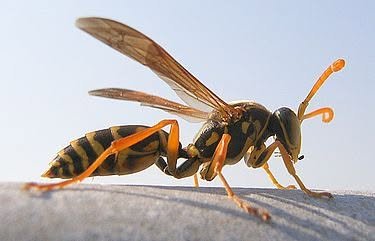
The Kumamoto International entomology desk presents this week: Know your Wasp!
Some wasps (the more aggressive types are known as hornets in English but still "hachi" in Japanese) you want to run away from as if they were the Devil's spawn itself - particularly the giant Asian hornet (suzumebachi スズメバチ) - due to their aggressiveness. The humble paper wasp (called "long-legged wasp" - ashinagabachi あしなが蜂 probably because it has long legs), though, is a friendly little guy, considered a beneficial insect as it gobbles up all sorts of crop pests.
Ashinagabachi create nests by masticating pulp gathered from decayed wood, dried stems, and even posters adhered to walls and poles (they particularly like the latter probably due to the adhesive already attached - look for long furrows dug into posters or park benches and you'll know a wasp has been there), then deposit dumplings of chewed-up insects (known as "mushidango" 虫団子 - eww) into each chamber, onto which they lay a single egg and then seal.
They're social, with up to a dozen unrelated females cooperating to create a nest, and will not bother humans unless they are directly threatened (one can approach a nest within even a meter without triggering alarm). Japanese hold a positive image of ashinagabachi, but children don't try to collect them for an obvious reason (they have a stinger on their butt).
Etymologically, they are a member of the Vespus family, from which the Italian scooter Vespa gets its name due to their resemblance - truly one of the most elegant animals nature has ever created, as the photo below demonstrates. Enjoy observing them as they work to build and stock their nests for another generation, and do not fear them. - William
https://ja.wikipedia.org/wiki/%E3%82%A2%E3%82%B7%E3%83%8A%E3%82%AC%E3%83%90%E3%83%81