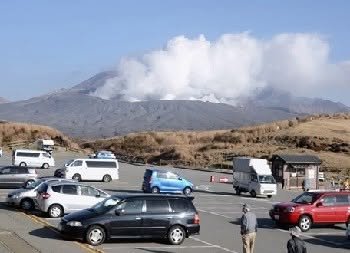
A note from the Kumamoto International Volcanology and Seismology Desks (merged due to budget cuts): Kumanichi offered an update on Mount Aso's mood on the second month anniversary of it's 36-year record-breaking burp. Apparently - nobody knows. Its gas output is fluctuating between 1,000 (normal) and 3,000 (lots) tons per day, and it continues to vent much heat (these conditions are how my wife normally describes me).
Of particular concern is the prevalence of what the article called 「B型地震」, something I correctly guessed would be expressed in English as "B type earthquake"; apparently, these are very low-frequency, shallow (>1km) quakes (in reference, the Tokai quake depth was around 600km, while most of the Kumamoto quakes have been at 10km) thought to be caused by expansion and contraction of magma or gas bubbles and are occuring at a rate of several dozen daily not just at the peak but in surrounding areas. The science is still out on this, so maybe we'll all die tomorrow, but probably not.
Below are two links, the first to the Kumanichi article (Japanese) and the second to an introduction to volcano seismology (English - nothing impresses your friends more than stating with confidence, "Nah, that was just a B型地震"). Enjoy! - William
http://kumanichi.com/news/local/main/20161206006.xhtml
http://kiska.giseis.alaska.edu/input/sanchez/volcseis.html#HighFreq