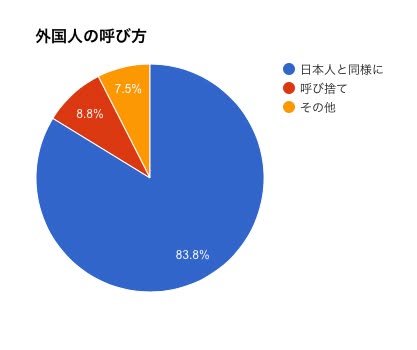
A while back I asked about whether, when addressing a foreigner in Japanese, one should add "-san" or not. しばらく前に、外国人と日本語で話す場合に呼び捨てにすべきかどうかについて聞きました。The results were clear. 明確な答えが出ました。90% of the foreigners who responded that they are "fairly or quite fluent" in Japanese think that the norms that Japanese people follow when speaking to other Japanese people should apply when they speak in Japanese with foreigners. 今回、「割と、あるいはかなり日本語ができる」と答えた外国人の9割は外国人であっても、日本語で話しているなら、日本人と話す場合と同じような基準で呼び方を決めるべきだと答えました。Simply put, the vast majority of foreigners who responded rejected the notion that it's OK to apply "yobisute" (address without a polite suffix like "-san") to foreigners merely because they are foreigners. 簡単に言えば、「外国人だから呼び捨てでいい」という発想は、アンケートに答えた圧倒的多数の外国人によって否定されました。
Here are the results. 結果は次の通りです。
Primary question / 中心的な質問
When conversing in Japanese with a foreigner (particularly, a Westerner), some Japanese people address the person as they would another Japanese person (that is, adding honorific suffixes such as -san) while others leave such suffixes off. 日本語で外国人(特に西洋人)と会話する際、日本人と会話している時と同じく「さん」などの敬称を使う日本人もいれば、使わない日本人もいます。In situations where you don't know the person's preference, which approach do you think is better as a general rule of thumb? 相手の希望がわからない場合には、一般論として、どちらのやり方が望ましいでしょうか。
Answer choices / 選択肢
1. When speaking Japanese, follow the norms of Japanese (use suffixes like -san) when addressing foreigners / 日本語で話している場合には、日本語の慣例に従って「さん」などの敬称を名前につける
2. Even if you are speaking Japanese, if you are speaking with a foreigner, follow the norms of English by not using honorific suffixes such as -san / 日本語で話していても、相手が外国人であれば英語の習慣に従って呼び捨てにする
3. Other / その他
Results / 結果
All 80 respondents / すべての回答者(80人)
- 67 (84%)
- 7 (9%)
- 6 (8%)
Foreigners [lower-level Japanese / high-level Japanese] / 外国人 [低日本語能力 / 高日本語能力]
- 58 (89%) [11 (85%) / 47 (90%)]
- 4 (6%) [0 (0%) / 4 (6%)]
- 3 (5%) [2 (15%) / 1 (2%)]
Here are the responses that were typed in the "Other" category / "その他"への書き込みは次のとおり
(a) Either way is fine. Dont make it too complicated.
(b) Ask the foreigner what they prefer.
(c) I don't speak Japanese enough to converse fluently, however, if people using the honorific "san" is an issue for them, why are they here. Go home. I mean really? It is a matter of respect. I don't understand why something so trivial would be an issue for anyone.
Foreigners [native English speakers / non-native English speakers] / 外国人 [英語母語 / 英語非母語]
1. 58 (89%) [55 (89%) / 8 (89%)]
2. 4 (6%) [4 (7%) / 0 (0%)]
3. 3 (5%) [2 (4%) / 1 (11%)]
Japanese / 日本人
- 9 (60%)
- 3 (20%)
- 3 (20%)
Here are the responses that were typed in the "Other" category / "その他"への書き込みは次のとおり
(a) 初対面の方は敬称で、友達は呼び捨て又はちゃん付け
(b) 相手の年齢やキャラクターによる。
(c) 場所、状況、人間関係によりますが、例えば、友だちであっても仕事中にその友だちの事を話す場合は"さん"をつけます。初対面で初めて名前を呼ぶ時も付けるでしょう。友だちなったらcasualなsituationならつけないと思います。
At the end of there survey, respondents could type any comments they wished. Here are the comments organized by response to the main question. アンケートの最後に、自由記述の欄を入れました。中心的な問いへの答え別に整理した書き込みは次の通りです。
1. Treat foreigners like Japanese / 外国人であっても日本人と同じように
(a) Personally, I don't mind if people I'm fairly close with, like my friends and coworkers, leave off the -san. But if strangers do it, it feels really rude, because why are you treating me different from anyone else? Also, strangers don't know where I'm from and what my first language is - it's entirely possible that I could have grown up in Japan and have Japanese citizenship. Just because I look different isn't a reason to treat me different. If we're speaking Japanese, we should follow the rules of Japanese. If we're speaking English, we should follow the rules of English.
(b) Addressing foreigners without the san or Mr. /Ms. shows not only lack of respect, but also discrimination (referring to them as something lower than a pet animal that would get a - chan)
(c) You should follow the rules of the language you are speaking regardless of the nationality or race of the interlocutor. Would you refer to another human as an 'it', if they were different to you?
(d) If speaking Japanese, they should also follow the custom of [family name]san and not assume that because a stranger is a foreigner, they want to be called [given name]san. (Which would never be done with native speakers of Japanese)
(e) I think some people are operating under the assumption that the foreigner wants to be called by his/her first name. Of course, this is not always true. They need to be aware that even among native speakers, people say, "Oh, call me (first name or nickname)" which is granting permission as some people don't really like being called by their first names by strangers. It can be off-putting and too familiar-- and without the "-san" come off as rather rude.
(f) 私は日本語を習った時、授業で"さん"を使うのが普通でした。なので、相手が初対面に使わないとちょっと不思議に思います。別に怒るわけじゃありませんが、相手との距離とか、相手の希望とかは分からないこともあるから、使うと助かります。友達同士に呼び捨てしても構いませんが。
(g) It depends on the situation, relationship, or how the person call me. If the person call me with -san, I don't think it's good idea that I call them without -san. And if the relationship is not that close, we had better call them with suffix.
(h) I employ and expect people, when speaking Japanese, to employ the conventions of the language and culture when using it. I employ and expect people, when speaking English, to employ the conventions of the language and culture when using it.
I feel Japanese conventions should be followed, as it is the host nation, but I feel the speakers should address each other using the conventions associated with communicating with Japanese people. (ie. not treating non-Japanese as exceptional in the language used, I feel this is more likely to cause offence). The individuals can then agree amongst themselves as to how casual the conversation can become. (ie. Just "Tom" is ok from here in, rather than "Tom-san or Tom-sensei".)
(i) 私は日本人ですが、敬称をつけるかつけないかは、仮に日本人に対してであってもケースバイケースです。外国人に対しても、ケースバイケースだと思います
(j) Japanese cultural traditions instruct to present respect to others who are not exactly well known to the speaker, a stranger for example. Depends of the person, if they want to show tremendous respect.
(k) Go by the conventions of the language you are speaking regardless of your conversation partner. Your assumptions about who they are and how they prefer to communicate in their native language may not be correct. Why would you deviate from the convention of what is considered polite just because the person you are talking to is Japanese? Moderating language for understanding is fine but omitting a key way of being polite is not.
(l) May be just me but I also find it irritating when Japanese people are referred to by their surname (plus -san) which is polite, whereas they'll refer to the non-Japanese person by first name. Maybe they are using what they think is a western convention however I feel like I'm being treated like a child. It often happens at the doctors or eye clinic they'll call out my first name but everyone else is by surname. Makes me feel like it's just one more way to make me "different".
(m) 現在私は通訳の仕事をしています。相手のファーストネームに「さん」を付けるのは余り親しく無い相手或いは敬意を表すべき相手で親しくなったら年上でも「さん」を付けないで呼びます。日本では基本的に年上の人には「さん」を付けます。
今私が接するような外国の人達、日本在住かそうで無いに拘わらず、同じです。
(n) Exception to be added for fellow students at university. In Kumadai and Sojo, no foreigners I know used an honorific to talk to one another.
But it's not part of the survey, is it?
2. OK to omit "-san" if the person is a foreigner / 外国人なら呼び捨てはOK
(a) 外国人の方が呼び捨てで呼ばれる事に抵抗感を抱くほどに日本の生活に馴染み(生まれが日本、幼少期から日本で生活した、日本以外の学校を卒業後日本に関心を持ち日本へ来て生活している人)、日本語に長けている方を日本人は"みなし日本人"として接する必要がある。敬語の存在は知っているが使い分けがわからない外国人の方には敢えて使う必要はないと思う。
3. Other / その他
(a) (from person who wrote "Go home") Hope I didn't come across too harsh. I nod my head in disbelief at some of the pettiness that time is wasted on. :-)
Note about language skill / 日本語能力に関するメモ
In regard to the skill level of the non-native speakers of English all respondents fell into one of two categories: 1) little or no Japanese or 2) fairly or quite fluent. Two respondents said they were between these two categories. As I interpreted this to mean "not yet 'fairly fluent'", I put them in the "little or no Japanese" category. 外国人の日本語能力については「
割とできる」に達していない人と「割とできる」以上の二つに分類しました。アンケートの中にあった二つの選択肢の中間ぐらいのレベルであると書いた回答者は二人いましたが、まだ「割とできる」に達していないということで、低い方のカテゴリに入れました。
P.S. I'll add some comments in another post. This post contains the basic results. / 改めて他の投稿で結果についてコメントします。まず、ここで基本的なデータや結果を投稿したいと思い、以上のことを書きました。
Kirk