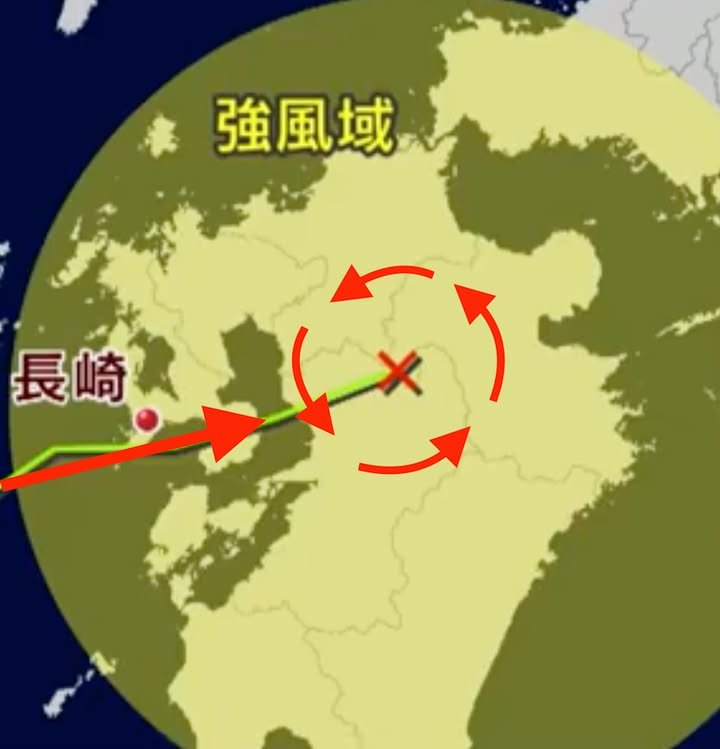
This is my mea culpa. I wrote that I didn't think the winds would be too strong but, well, we all know that wasn't exactly how things played out. It seems to be true that the system wasn't particularly powerful as typhoons go. The RKK evening news report cited two factors for the strength of the winds in Kumamoto City, despite the relative weakness of the system. The first was the angle at which it hit Kumamoto. In the northern hemisphere tropical systems spin counterclockwise. So, if you look at the image, the area south of the eye of the storm was blowing to the east. The second factor was that the storm was moving very quickly to the east, adding to the speed of the easterly winds that were blowing to the south of the storm center. Kumamoto City was just south of the center of the storm so we experienced high winds, as did Amakusa and Aso.
Though it wasn't mentioned in the RKK broadcast, another factor is that, if my understanding is correct, winds coming off of flat seas tend to be stronger than winds that are buffered by mountains and forests. So, it seems that, despite the relative weakness of the system, various factors conspired to maximize the damage caused by this storm in Kumamoto.
Over the years, I've occasionally been accused of being rather alarmist . . . even of "crying wolf" when putting out storm information. This time, I was a bit too sanguine. It really is hard to know just what to expect ahead of time.
Though it sounds like a hackneyed truism, I guess "hope for the best but prepare for the worst" sums up the lesson I've gotten from this storm. :(
-- Kirk