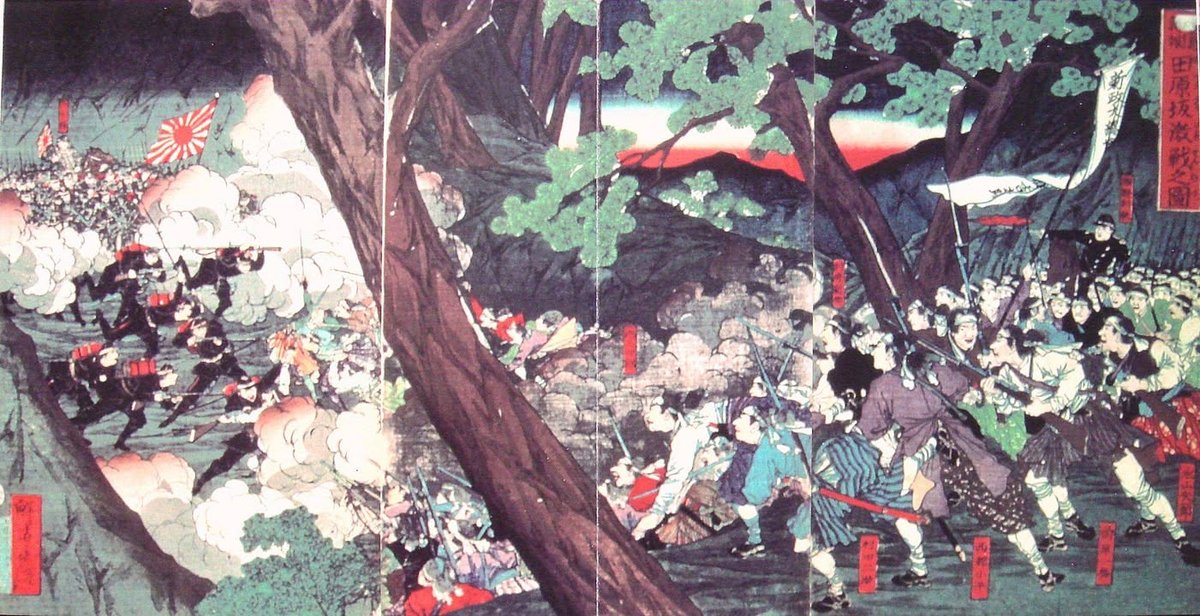
Notwithstanding World War Two, war-wise, Kumamoto is most noted as the point where Saigo Takamori's Satsuma army was turned back by government forces between February and April, 1877 during the Seinan Senso (aka Satsuma Rebellion). Saigo's hope to easily seize Kumamoto Castle had deteriorated into a winter siege when, in March, government forces attacked and routed Satsuma forces guarding the northern approach to the castle at Tabaruzuka near present-day Ueki. It was all downhill for Saigo from there (figuratively - the Satsuma forces fled back south via Hitoyoshi to avoid government troops which had landed to their rear in Yatsushiro, implying plenty of uphill climbing), and Saigo eventually committed seppuku in August near today's Kagoshima City.
Tabaruzaka has a museum displaying artifacts from the war and with a preserved battlefield very much worth visiting, but distance is a problem (say us modern, lazy folk, conveniently ignoring that Satsuma troops hiked there from Kagoshima in the depths of winter). To mark the 140th anniversary of the battle, the museum has organized an exhibition at Kumamoto Shintoshin (that big building near the station) centered on contemporary clothing: government uniforms were modeled on those used by France, and the Satsuma forces wore a mixture of western and Japanese items. The exhibition is free and will run through October 27. The museum director noted the purpose to draw attention to Tabaruzaka as the "Genkan of Kumamoto" and attract more visitors to the museum. (The below painting from 1877 shows the Battle of Tabaruzaka with government troops on the left and Satsuma troops on the right.) - William