If you live in Japan, chances are you have a tatami (「畳」)or several. Tatami are constructed in a set size of 3尺×6尺; with a 尺 (shyaku) equal to 30.3 centimeters, this means a normal-sized tatami will be 91cm×182cm, or 1.6562 m², a unit which is called a "jyo" (「帖」 or 「畳」, with the first kanji indicating area and the second actual dimensions, and, yes the second is the same kanji as "tatami" but is pronounced "jyo" when discussing area in given dimension terms - got it?) - though there are regional and historical variances, which you can read about here if you're really into this: https://ja.wikipedia.org/wiki/%E7%95%B3 . This unit is often used to describe the area of a room (e.g., "My living room is eight jyo"). Half-jyos are also common, with a four-and-a-half jyo (yon jyo han) room being a typical size for a bedroom.
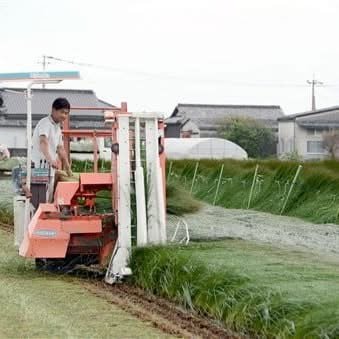
I mention this because tatami are made from the igusa plant (「イグサ」、「藺草」、or most often 「い草」or「イ草」), and almost 100% of Japanese igusa is grown in Yatsushiro. Kumanichi points out that now is igusa harvesting season. This does not mean that all tatami come from Yatsushiro as about 80% of igusa is imported, mostly from China. The article notes that 420 households (down 17 from last year) farm 505 hectares (or 3,055,250帖 - yes, online calculators exist for such conversions) for igusa production, half compared with a decade ago due to the aging of the farmers and the reluctance of their offspring to continue such work. This year's crop looks good; one farmer with a cool name, Kitahashi Ryumi (北橋龍美さん) was quoted: "The color is good and it is a satisfying crop. We hope to continue the tradition of producing high-quality igusa in Yatsushiro."
Many other, more highly value-added products are made using Yatsushiro igusa such as pillows and zabuton. If you see a product made from local igusa and purchase it, remember that you are supporting the farmers of Yatsushiro. - William