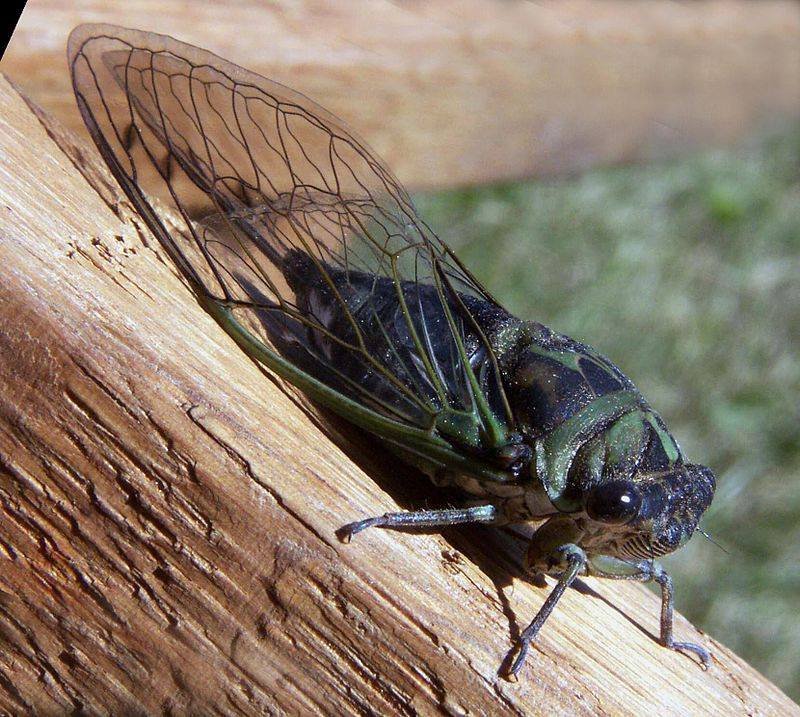
Hemiptera, or true bugs (though why one would pretend to be a bug if one were actually not is beyond me), are an order of insects comprising some 50,000 to 80,000 species, most of which likely live under your pillow. The cicada accounts among them.
Cicada are numerous in Japan and are here a symbol of summer. As with most insects, their adult stage is quite short, only about a week, compared with some seven years of larval stage, during which they subsist on tree sap obtained from roots of the very trees they will eventually climb to metamorphose (though any wooden structure will do - Shinto shrines, typically surrounded by trees, are generally masked by cicada husks by mid-summer), leaving nickle-sized holes as they egress. Females continue to feed on tree sap during their adult life using a prong-shaped proboscis, while the males fast (that fellow below is likely male). Neither sex will harm you - which, generally speaking, is more than can be said regarding humans. The males emit a vibrating sound that is surprisingly loud considering their size. Deafening, even, by August. Kids here delight in catching them with nets and containing them in plastic boxes, which must be quite a bummer after having lived subterranially for seven years waiting for this one week during which to reproduce. Cicada exoskeletons litter wooden structures long after summer has ended. Most exoskeletons disappear due to weather or old women wielding brooms, but some remain petrified where their former inhabitants discarded them and can be seen even in the depths of winter. For a human observer, this is a reminder in February that July is imminent.
Somehow, cicada are able to discern the end of the rainy season - they will not emerge until the weather dries. You have likely heard the calls of the males today, an indication more accurate than any meteorologist can provide that the rainy season has ended and summer has begun. - William