In 1876, Japan abandoned the Chinese lunar calendar for the Gregorian, and the populace, being mostly concerned with basic survival issues, were mostly like, "meh." Some holidays were switched to a fixed date, notably New Years, while some were not - and to add to the complexity is local custom; as a result, many holidays are celebrated at different times in different locations.
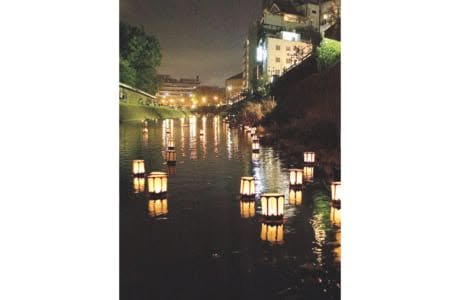
Which brings us to Obon (お盆), which rivals New Years as the most important Japanese holiday. Most Kumamoto people residing on the plains celebrate Obon from July 13, while those in mountain regions do so in early August. The holiday's purpose is to welcome home the spirits of one's ancestors and is often accompanied by sweets placed on the family alter (butsudan, 仏壇 - apparently, deceased spirits like sweets) and lanterns to help guide them home. Three days following, celebrations are often held to see off the departed. These are often conducted by placing candles on floating objects which are placed in a river or in the ocean; the event is called "lantern-floating" (とうろうながし、灯篭流し, though the tradition has faded as concern over resulting pollution has arisen).
As such, July 15 will see a progression of candle-lit objects down Tsuboi River, and August 15 the same in Kawashiri. The scene is quite touching, and if you're a photographer, you should head out. Below is an example shot snatched from the Web. - William