The Amaryllidaceae, more commonly known as the "spider lily," is in Japanese known as the "higanbana" 「彼岸花」. They flower in a beautiful crimson, but do not bring them in your house. I will tell you why.
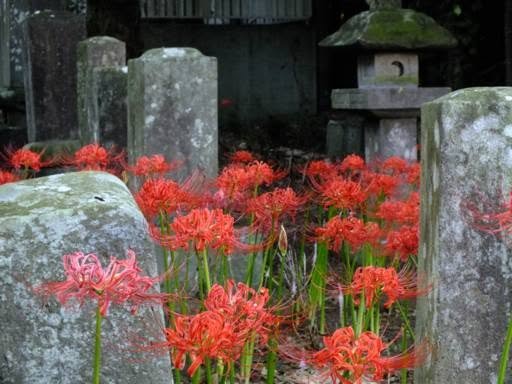
Higan is a Buddhist ceremony celebrated twice, at the spring and autumn equinoxes. Its etymology derives from "the far shore of the Sanzu River" 「三途の川」, similar to the River Styx, which separates this life from the afterlife in Buddhist tradition. Higanbana often bloom near cemeteries around the autumnal equinox and thus are described in Japanese translations of the Lotus Sutra as ominous flowers that grow in Jigoku (「地獄」, hell) to guide the dead into the next reincarnation. That's why you don't want to keep them in your house - and never, ever offer them as a gift.
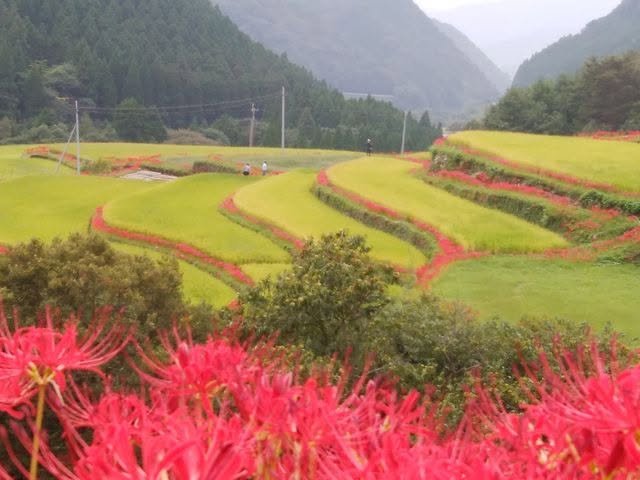
Their bulb and root systems are extensive, which is why they are often planted to stabilize aze dikes protecting rice paddies. This is also due to a unique feature: they flower before their leaves appear, which generally happens after the harvest. Their roots are also toxic to moles. If you have a camera, head out to the countryside for a splash of gorgeous autumn scarlet. Below is a photo of higanbana blooming on aze dikes in Yabe, and some growing amongst the graves on Hanaokayama. - William
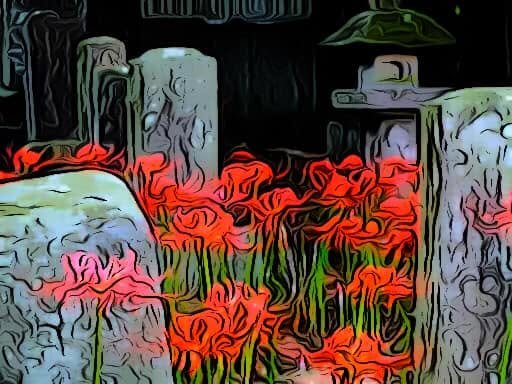
Post Script: Our friend Suzanne Hayasaki has run the second photo through some kind of photoy thing whose secrets are withheld from people my age (both photos were simply nabbed from the Web, BTW) and has delivered this gorgeous Piccasscoesque rendition.