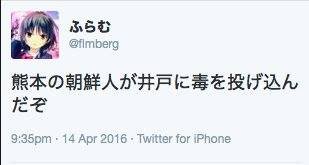
William posted about the recent hate speech incident:
https://www.facebook.com/Kumamotoi/posts/2208507395889347
I was a bit surprised to read that this was the first confirmed instance of hate speech in Kumamoto. Perhaps it's the first instance of a public demonstration by a political group that was stopped because it was deemed to constitute hate speech. It was certainly not the first instance of a word or phrase being uttered in Kumamoto that could reasonably be thought to constitute hate speech.
I was interested in previous examples of hate speech so I did a little Google search. That search led me to reports of comments like the one in the attached image, which reads "Koreans in Kumamoto have poisoned the wells." This is a particularly vile tweet because the accusation of well poisoning was one of several false claims that led to the massacre of an estimated 6,000 Koreans after the 1923 Kanto earthquake:
Regarding the Kanto Massacre
https://en.wikipedia.org/wiki/Kantō_Massacre
https://harvard-yenching.org/the-great-kanto-earthquake
Source of hateful tweets after 2016 Kumamoto quake:
https://togetter.com/li/962668
Now, before I go on, I'd like to point out that my own personal experience and all indications I've received on this page are that, after the earthquake, hate of any kind was definitely NOT the norm in Kumamoto -- the people of Kumamoto (Japanese and non-Japanese) came together to help each other. Still, I think it's worth noting that there were some people outside of Kumamoto who tried to use the disaster to foment hate.
Also, recent events in the States have caused me to recall an instance of hateful speech I heard while in the Shiyakusho (city office building) several years ago. I was there to renew my foreign registration card when a women came in to complain about how Japanese people were being discriminated against because foreigners (for her, Koreans seemed to be of particular concern) were "unfairly" receiving the benefits of the national healthcare system. I just happened to be sitting next to her so I was forced to listen to her rant. I never learned where she had gotten her information but, at the time (2012 or so), Katayama Satsuki was making such arguments in the Diet, so she might have been picking up on that. (By the way, Katayama is now the only female member of the Abe cabinet and is facing corruption charges -- poetic justice?)
The notion that providing basic social services to "foreigners" (the so-called "Zainichi Koreans" -- who were considered to be Japanese citizens and even able to vote until their citizenship was revoked after Japan's defeat in WWII) constitutes "discrimination" toward Japanese is very similar to accusations of "discrimination" toward Japanese made by the Zaitokukai (在日特権を許さない市民の会). See,for example, the Zaitokukai flier "日本人差別をなくそう" (Let's stop discrimination against Japanese) on the following page:
https://column.tokyo/sakurai-hatespeech/
I was reminded of this incident by recent events in the U.S. because I perceived a similarity in the thought process. The motivation behind the slaughter of 11 Jewish worshipers seems to have been that Jews are helping "inferior races" come to US and that this constitutes "White genocide." In both cases the language of victimization is reversed such that the dominant majority becomes the "victim" of the demonized other. See "Eli Saslow Traces 'Straight Line' From White Nationalism To Alleged Synagogue Shooter" for an explication of the phenomenon I've just referred to:
Again, I find hateful speech to be quite rare in Kumamoto. Still, since recent events had reminded me of my first direct exposure to the hate speech akin to that of the Zaitokukai in Kumamoto, and since the incident near Kumamoto station was described as the "first" such instance, I thought I put this little essay together. Thanks for reading.
-- Kirk