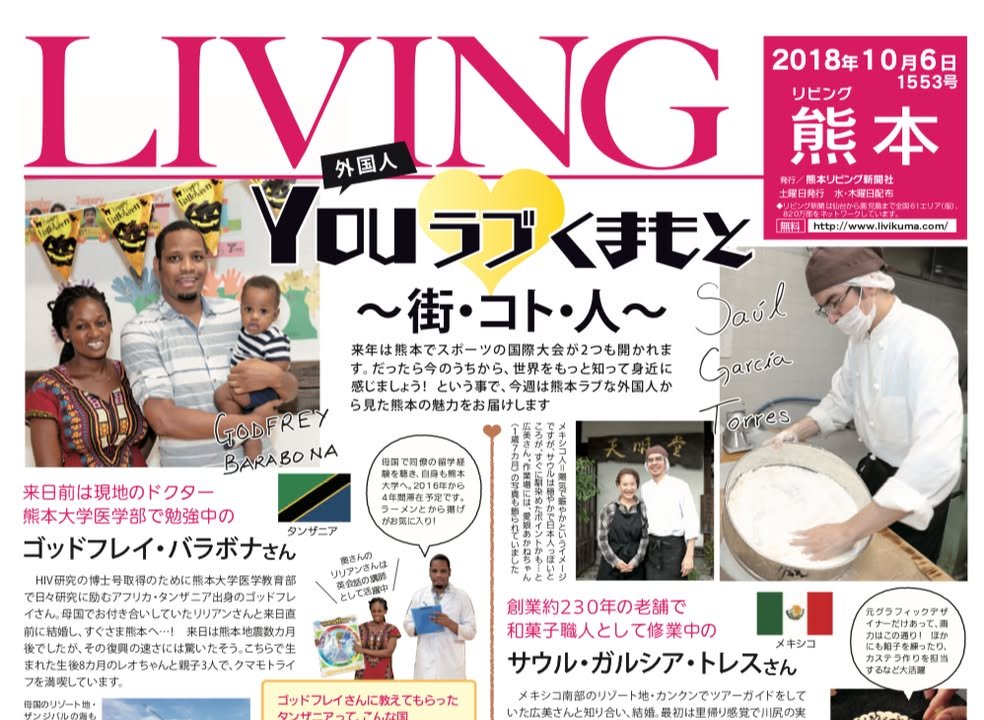
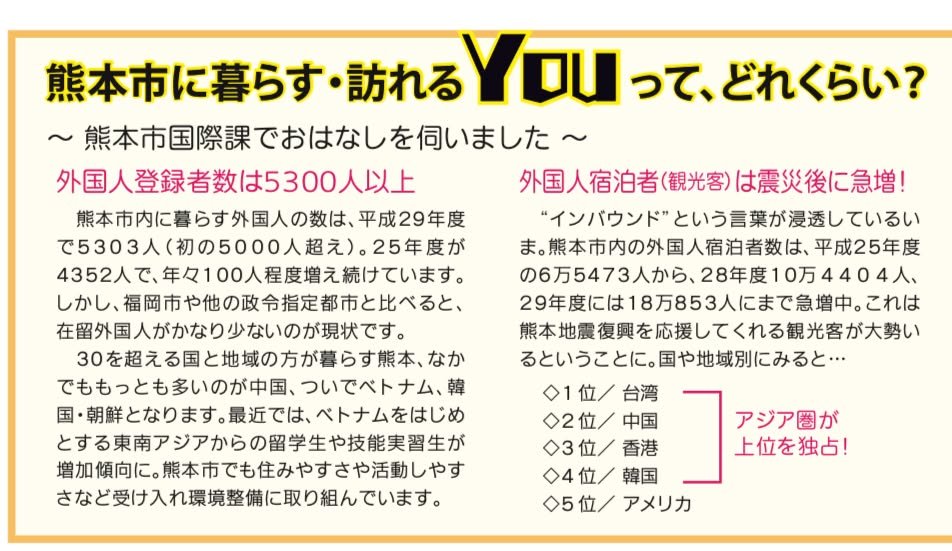
Kirk here. I was bundling up some old newspapers yesterday when I noticed that the cover story of the October 6th edition of "Living Kumamoto" was about foreign residents. I've attached some photos but they don't show all of the articles. If you'd like to have pdfs of the two pages that contain the relevant pictures and articles go to
http://www.livikuma.com/2018年10月6日号/
The first two pages of the publication are what you need to look at or download.
By the way, I have some misgivings about the use of the word "YOU" in the article. The word is used to mean "foreigner" and the usage follows the TV Tokyo program "YOUは何しに日本へ?":
http://www.tv-tokyo.co.jp/youhananishini/
At best, this program is a light, humorous approach to learning about people who come to Japan while, at worst, the "light humor" devolves into looking for opportunities to laugh at crazy foreigners.
The use of the word "YOU" on the program has its origins in a quirk of the famous talent producer, Johnny Kitagawa. Mr. Kitagawa is known for using the English "you" when speaking Japanese in order to avoid having to choose between the various second person pronouns that one finds in the Japanese language (あなた、君、お前、お宅など).
https://www.excite.co.jp/news/article/Real_Live_32492/
Regardless of the gag's origins, however, on the TV Tokyo program, "YOU" means "gaikokujin" and is used in a light, playful and/or comedic way.
Now, here's where I start to have a problem. Are there similarly light, comedic expressions that can be used to refer to other ethnic identities? Would "ANTA" or "ANATA" be acceptable ways to refer to Japanese people on an English-language TV program (e.g. "Look! I think I see an ANTA coming this way!")? That is exactly what is being done here. The second image asks "How many YOUs are there in Kumamoto?" and such usages are very common on the TV Tokyo show.
The articles themselves are very innocuous and I'm sure that no harm is meant. I just wish that they would not have followed in TV Tokyo's practice of using "YOU" as a "light" way to refer to foreigners. In my life in Japan, I have generally not enjoyed situations where people (usually young people or drunks) took my foreign identity as their cue to try to be funny and so I'd prefer that my identity as a foreigner not be tied to some low-level comedy show.
I suspect that my discomfort with this may not be shared by many others. I'll be curious to see what, if any, thoughts you have about this. Feel free to tell me if you think I'm making a mountain out of a mole hill, so to speak.
Thanks for reading. :)