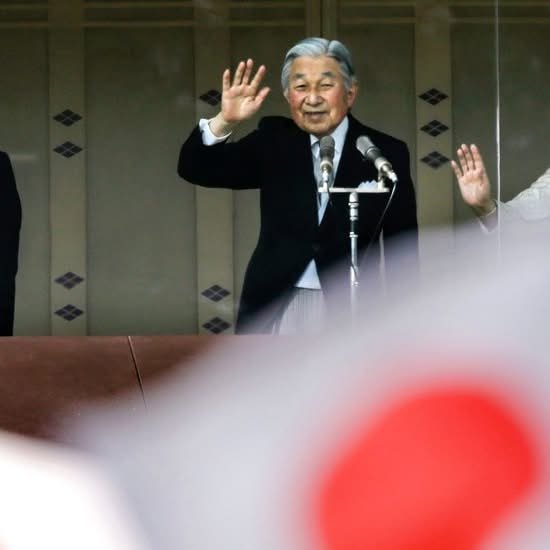
Kirk here with a fairly long discussion of the exclusion of Masako-sama and other royal women from the enthronement ceremony. This is probably too long for a Facebook post but, if you're interested in the topic, I hope you'll keep reading.
The pictured article is from the New York Times but I heard an NPR story with a similar headline:
Japan's New Emperor Naruhito Ascends Throne, But His Wife Wasn't Allowed In The Room
https://www.npr.org/2019/05/01/719157947/japans-new-emperor-naruhito-ascends-but-his-wife-wasnt-allowed-in-the-room
Both reports point to the exclusion of all women of the imperial household from the enthronement ceremony. This exclusion was also reported in English by NHK but without a note of criticism:
"Among the Imperial family members, only male adults will be in attendance. That will be Crown Prince Akishino and Prince Hitachi, the younger brother of Emperor Emeritus Akihito."
https://www3.nhk.or.jp/nhkworld/en/news/20190501_10/
Based on what I have seen on TV and what I have been able to find in Japanese on the internet, Japanese media reports that question the exclusion of the royal women are few and far between. Here's one that I was able to find, however, the does present a critical perspective:
天皇即位儀式に片山さつき大臣出席、皇后・雅子さま同席許されず…国民から疑問続出
https://biz-journal.jp/2019/05/post_27750.html
The headline indicates that many Japanese people question the exclusion of Masako-sama. According to the article, Masako-sama's exclusion has been particularly hard for people to stomach because a controversial female cabinet minister, Katayama Satsuki, was allowed at the ceremony. Katayama is controversial in part because accusations of improper political funding, which she denied at first, but for which she later issued "corrections":
Minister Katayama hit with more corrections to political funding reports
https://mainichi.jp/english/articles/20181201/p2a/00m/0na/023000c
"Three political groups headed by regional revitalization minister Satsuki Katayama have corrected entries in their political funding reports for 2017 by a total of more than 6 million yen, according to reports released on Nov. 30."
For most Japanese people, the biggest strike agains Katayama is probably the corruption charges. I, however, hold a grudge against her because she has tried to when points with her xenophobic base by engaging in foreigner-bashing:
http://www.debito.org/?p=11970
and
https://ameblo.jp/funnyfunnynews/entry-12217357850.html
At any rate, a scandal-ridden, xenophobic minister can attend but the Her Highness the Royal Empresses can't. That's one point of discussion for some Japanese.
However, I suspect that most Japanese people haven't been made aware of any controversy about the decision. Most media reports I've seen give the impression that those responsible for determining the content and tone of the reports believe that -- on this occasion, at least -- the role of the media should be closer to that of a cheerleader than to a watchdog. One approach is to pass over unsavory topics like the exclusion of women all together. The vast majority of reports falls into this category. Another approach might be termed "glass-half-full" reporting. Reports such as the following, which laud Katayama's breaking of the glass ceiling as the first woman to attend such an event, while glossing over Masako-sama's exclusion, constitute examples:
https://headlines.yahoo.co.jp/hl?a=20190501-00000045-jij-pol
and
https://www.nikkansports.com/general/nikkan/news/201905010000398.html
The last way of dealing with the matter is to report about it as a "foreign" perspective:
女性皇族出席できない儀式に批判も ご即位、韓国で大きく報道
https://www.fnn.jp/posts/00417014CX/201905011225_CX_CX
「新天皇即位、妻は見られず」 海外報道、反応様々
https://www.asahi.com/articles/ASM515G6TM51UHBI01T.html
This may be better than not bring the matter up at all. However, perhaps by design, the approach reduces the likelihood that readers/viewers will be led to think deeply about the rectitude of the decision to exclude imperial women precisely because the criticism is presented as "foreign." People who are so inclined can simply dismiss the critiques as the "misunderstandings" of people who can't really comprehend how wonderful Japan is. Or, the critics can can be dismissed as persons who suffer from that all-too-common disease of the mind called "anti-Japanese emotion" (反日感情).
In that sense, I think the first Japanese article I quoted is particularly noteworthy because it talks about discussion among those in charge of the preparations for the ceremony. In other words, whether or not female royalty should be allowed to be present wasn't a foregone conclusion. It is also noteworthy because dissatisfaction among ordinary Japanese people, not just foreigners, is described.
One final note: This occurred in the context of discussion about whether or not a woman might someday be allowed to become Emperor. This is not just a hypothetical question because, as you can see by the tiny contingent of male royalty that WERE allowed to attend, male royalty are in short supply. One way to keep the question of female accession to the throne open might have been to allow female royalty to be present at an accession ceremony. Conversely, not allowing attendance seems to say that such accession is out of the question. And, that's something about which a lot of Japanese have other ideas. The following Japanese news article reports that 70% of poll respondents were in favor of allowing a woman at the top of the imperial hierarchy:
https://www.jiji.com/jc/article?k=2019041200827&g=soc
So, it would seem that questioning the exclusion of women from such a ceremony is probably a matter about which a good number of Japanese have qualms -- not just befuddled and/or anti-Japanese foreigners.
https://www.nytimes.com/2019/04/29/world/asia/japan-emperor-women.html