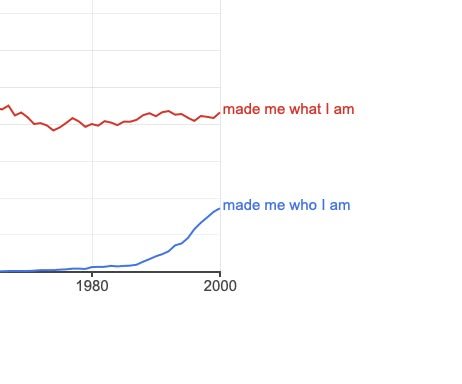
Here's something that's not specific to Kumamoto but that I hope will be of interest to those interested in the English language -- either as a teacher or as a student. I recently got a question about the difference between something that "made me who I am today" and something that "made me what I am today." My first reaction was that the two expressions are pretty much the same. Instead of trusting my instincts as a native speaker, however, I decided to go on line with the student and use Google to search for the two phrases. As your may know, on the Google search engine, if you put a phrase inside quotation marks Google will narrow your search to that exact phrase. Well, searching for "made me what I am today" and "made me who I am today" led to the following page:
https://www.englishforums.com/English/ThePersonThatIAmToday/bkqgdl/post.htm
What was REALLY interesting to me, was the link to this page:
Apparently, you can search Google's corpus of books to see when phrases came to be used and which phrases have been more popular over the decades. Personally, I thought this was really cool and, potentially a great tool for students of the English language. If, for example, a student is considering two ways of expressing something in a paper, this tool can be used to see which of the two collocations has been and is more popular.
-- Kirk