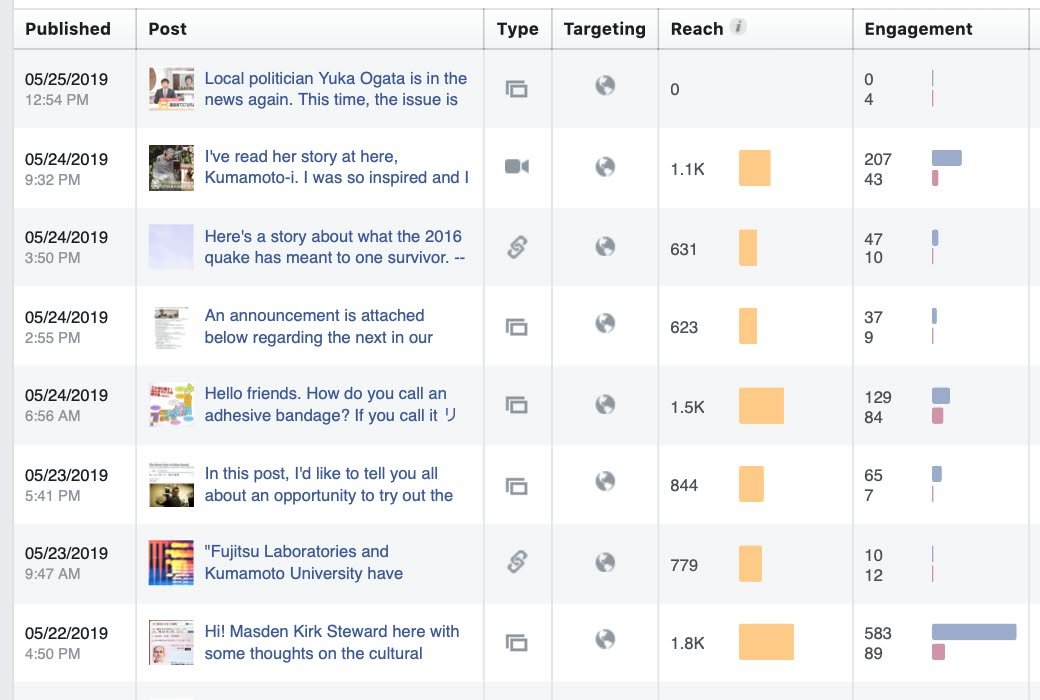
Regardless of whether or not people agreed with my perspective, Kumamoto International statistics (which can be accessed directly by moderators of this page but not by most participants) demonstrate that there was a lot of interest in my post about names on Japanese IDs. There have been posts with bigger "reach" (that is, number eyeballs that fell upon the post) numbers but the "reach" to "engagement" (clicking to read more, liking, commenting, etc.) ratio was way above the norm for this page.
That post (which can be found at
https://www.facebook.com/Kumamotoi/photos/a.129499733790134/2639886286084787/?type=3&theater )
and a post about the exclusion of female royalty from a recent ceremony (https://www.facebook.com/Kumamotoi/posts/2591914154215334?__tn__=-R )
both generated much more discussion than is normal for this page. One thing I find to be interesting and somewhat ironic, though, is that "not important" came up as a criticism in both instances. The critics implied that even bothering to write about the matter was a waste of time because the it was "unimportant" and that there were better things to talk about.
There's a sense in which I can understand that criticism and even find it partially convincing. It's true that how my name appears on an ID card or whether or not female royalty attend a ceremony is of no consequence in comparison to truly important issues like famine, war, and eggregious social injustices. But, at the same time, it intrigues me that people feel motivated to stand up and say "UNIMPORTANT!" in regard to such issues. Truly, unimportant posts, like posts about a statue of Luffy in front of the Prefectural Office building, don't elicit the "waste of time" response. People who are interested look at them and those who are not, move on. Some "unimportant" issues, however, move people to try to discourage any more posting on the topic. Ironically, I think the impulse to say "bad topic" to me when I post something someone doesn't like, is pretty much the same as my own impulse to post in the first place. Something doesn't sit right with me and that moves me to say something.
I'm not sure exactly what doesn't sit right with the individuals who try to discourage me by saying that I'm making a mountain out of a mole hill. Perhaps some are genuinely concerned that I'm not spending my time well. And some see a flaw in my logic and point that out to me. But in quite a few cases, I think Nobel Laureate Daniel Kahneman is on the right track as to what is happening:
"When I ask you about something that you believe in — whether you believe or don’t believe in climate change or whether you believe in some political position or other — as soon as I raise the question why, you have answers. Reasons come to your mind. But the reasons may have very little to do with the real causes of your beliefs. And we take the reasons that people give for their actions and beliefs and our own reasons for our actions and beliefs much too seriously."
In other words, according to Kahneman's logic the conclusion ("I don't like what this guy is posting") comes first and the reason to be offered as a criticism ("unimportant issue" etc) comes afterward, even if it isn't what "caused" the feeling in the first place.
Admittedly, this post is also pretty darn unimportant in the big picture of our lives here on this planet. ;) However, if you find something in it that upsets you enough to complain about, my only request is that, after you voice your opinion, you stick around to discuss it a little. If you feel the issue is important enough to comment on, I hope you will agree that it's important enough to have a little back-and-forth about as well.
Thanks for reading. :)
-- Kirk