Joe Tomei here, passing on the email update from JET advisors (Bilal Khan & Lily McDermott) at kencho. My sincere thanks to them.
●Three additional cases in Kumamoto City
Three additional cases have been reported in Kumamoto City, two today and one yesterday. Today’s cases are two males, both residing in Chuo-ku, one in their 40s and the other in their 30s. https://kumanichi.com/news/1428800/
On Monday, 13 April a woman in her 20s living in Nishi-ku and employed in the dining/hospitality sector tested positive. An investigation into her recent movements and contacts is ongoing. https://this.kiji.is/622319828012876897?c=92619697908483575
The total number of confirmed cases in Kumamoto is now 30.
●Patients and staff at Kuma Hospital test negative for COVID-19
Kumamoto Prefecture has been conducting tests on the people suspected of being in contact with the male physician employed at Kuma Hospital, who tested positive over the weekend. All 154 people who were suspected of being in contact have been tested, and all have been negative. The prefecture is now investigating whether or not there are any remaining contacts who need to be tested. https://this.kiji.is/622688757866906721
●Kumamoto City close to running out of specialised beds for severe cases
At a press conference on 13 April, Mayor Onishi said that medical facilities designated for handling patients with infectious diseases in Kumamoto City are almost at full capacity (currently, all confirmed cases of COVID-19 in Kumamoto are still being treated at government-designated facilities and not in the general medical system/privately run hospitals and clinics).
The city classifies patients into four categories; "asymptomatic", "mild", "moderate" and "severe". There are currently a total of 8 specialised beds with intensive care capability to be used for severely and moderately ill patients. However, as of March 13, a total of 6 people, including one outside the city, are being treated in these beds. (Mild or asymptomatic patients are currently being accommodated separately, with 28 beds available.)
Mayor Onishi explained to the public that as the designated facilities are currently operating at their limit, it will be very difficult to respond if new severe cases come to light. There have been 22 confirmed cases in the city (28 for the prefecture as a whole). In the city, 3 are classified as severe, 2 moderate, 5 mild, and 7 asymptomatic. Four have been discharged and one death has been reported so far. https://this.kiji.is/622612589509117025?c=92619697908483575
●On the situation in other parts of the country
Tokyo has seen an increasing confirmed cases in one week since the national government declared a state of emergency. Cases have been confirmed across a broad spectrum of society, including judo and sumo wrestlers, TV newscasters and recently, the family of a Japanese Member of Parliament, who happen to live in official housing provided to members of the House of Representatives.
Particularly concerning are the large numbers of hospital outbreaks, as well as outbreaks at elderly care centres which are currently coming to light across the country. You can read an article in English about this here: http://www.asahi.com/ajw/articles/13293873
One particular hospital in Tokyo located near Ueno Station called "Eiju General Hospital" which describes itself as "a regional flagship hospital" reported over 160 cases in a mass breakout at the hopsital, and 20 patients have died. A public apology has been posted on their official website. https://news.tbs.co.jp/newseye/tbs_newseye3953699.html
Nakano Egota Hospital, also in Tokyo, is reporting 92 cases. http://www.asahi.com/ajw/articles/13293542
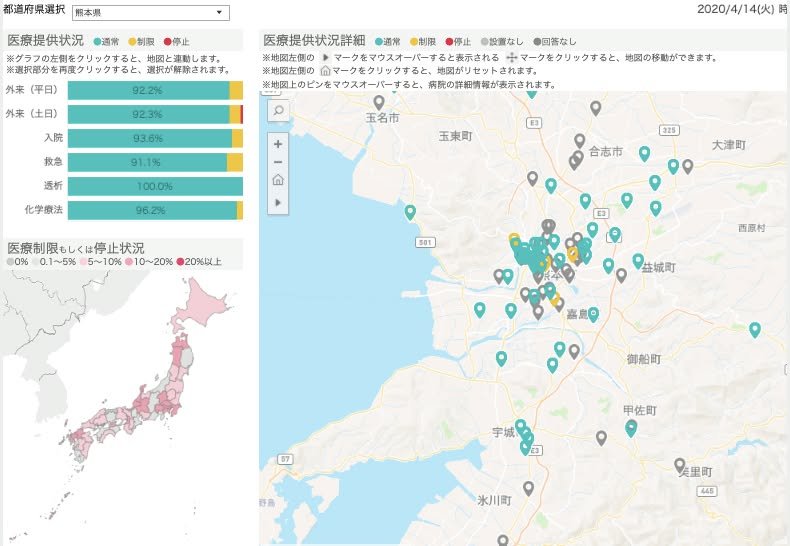
Ministry of Health Labour and Welfare's Nationwide Hospital Map
Some hospitals and clinics caught up in the situation are limiting or shutting down new patient intake. The government has released a map of hospitals across the country and their situation with respect to patient intake. https://cio.go.jp/hosp_monitoring_c19
Using this map you can confirm which hospitals are operating as usual, have introduced restrictions on patient intake, or have closed all new intake entirely. Hospitals that have not responded are in grey. Here is a screenshot of the map surrounding Kumamoto City:
[attached below]
State of emergency business closures in effect:
After being implemented in Tokyo earlier this week, official requests for business closures have now been implemented in all 7 prefectures where a state of emergency was called, including Fukuoka, which largely follow the same agreement which was reached between the national government and the Tokyo Metropolitan Government. In Fukuoka, from today until 6 May, over 12,000 non-essential business are expected to close, including cabarets, bars, internet cafes, karaoke boxes, gyms, pools and sports clubs, pachinko parlours, game centres, theatres and cinemas, exhibition halls, museums, and libraries.
Where the state of emergency applies, business hours for restaurants, izakaya and cafes are restricted from 5:00 am to 8:00 pm, except for home delivery and take-out services. Izakaya may only serve drinks for one hour, between 7:00 pm and 8:00 pm. https://www3.nhk.or.jp/news/html/20200413/k10012384221000.html