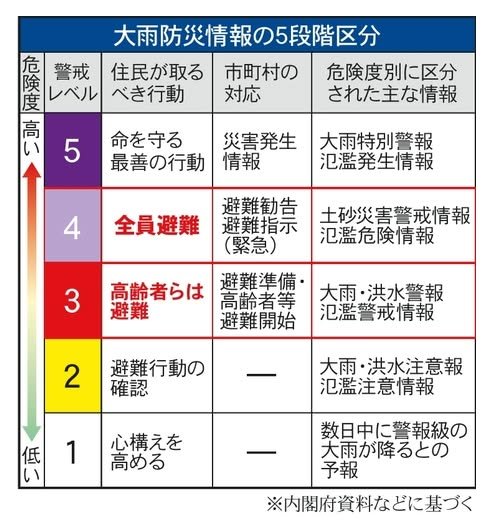
Kirk again. One aspect of the recent rain disasters in the Kyushu area is that "level 5" warnings on the JMA's (Japan Meteorological Agency's) relatively new scale (came out last year, I think) have been issued. Last year, I complained that the JMA neglected to publish an official description of the scale in English. I even called them to point out how providing an English explanation of the relatively clear scale would be helpful. Alas, no change. NHK has a pretty good page in English about the scale:
https://www3.nhk.or.jp/nhkworld/en/news/backstories/587/
It's worth looking at but it shares a problem with the Japanese explanation found on the JMA site:
https://www.jma.go.jp/jma/kishou/know/bosai/alertlevel.html
The only sentence that "explains" what you should do at level 5 is the following:
命を守るための最善の行動をとってください。
Do your best to protect lives.
NHK translates this vaguely frightening (or frighteningly vague?) advice as follows:
"People should make every effort to save themselves."
One thing NHK does a better job of outlining on it's Japanese page about the scale is that by the time you get to level 5, it's probably too late to evacuate:
https://www3.nhk.or.jp/news/special/saigai/basic-knowledge/basic-knowledge_20190529_07.html
So, my take on what you should do at level 5 is as follows:
"Probably too late to call for help or evacuate. So, I think you're on your own now, kid. If you're in a building with several floors, it might be a good idea to move up a floor or two. Umm, other than that, umm . . . you wouldn't happen to have a boat, would you?"
It's not very scientific or official sounding but perhaps a bit clearer than "make every effort to save yourself."
There are a lot of things I like about Japan but "clarity of expression" is not on my list of Japanese strengths.