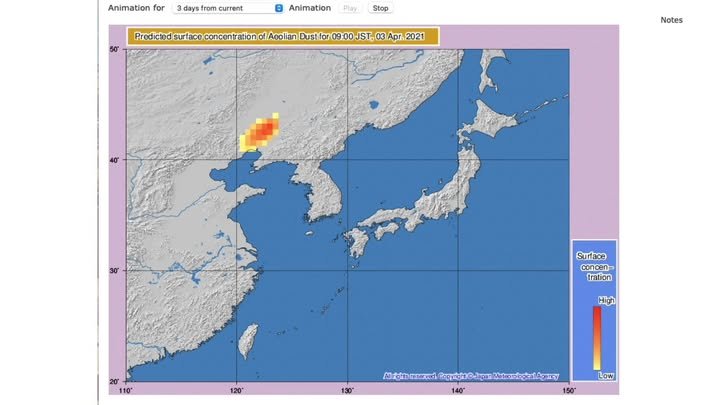
Kirk here with something that may come in handy when we have more "yellow dust" (also known as kosa, 黄砂, Asian dust, yellow sand, aeolian dust, or China dust storms).
I should have introduced this a few days ago, when it was actually a problem here in Kumamoto, but I don't think we've seen the last of the dusty yellow stuff this year so I'm putting this up for future reference.
http://www.data.jma.go.jp/gmd/env/kosa/fcst/en/
You can see from the animation that there's no dust coming our way at the moment.
By the way, I'd like to add a note about a problem with how the JMA and other government agencies put out information in English. Even when English is technically correct, it may not be easily understood but the community of English speakers (native and non-native) in Japan. I think this is one such example. As I indicated above, the Japanese kosa (黄砂) can be translated in many ways. One expression that is not found of the Wikipedia page for Asian dust is "aeolian dust." I checked and, though I didn't know the term until today, aeolian dust is atmospheric or wind-borne fugitive dust that "comes from arid and dry regions where high velocity winds are able to remove mostly silt-sized material, deflating susceptible surfaces." (Wikipedia's "dust" article) Apparently, the term is used in scholarly articles but it is clearly far from common knowledge. Yet, this is the only term you find on the Japan Meteorological Agency's web page (URL above). No other explanation or terms help one understand that this is indeed the kosa that has been in the news. Moreover, the lack of such terms make it that much less likely that this page will come up in a Google search for one of the other terms. I found it by searching the JMA's site for "dust."
End of rant.