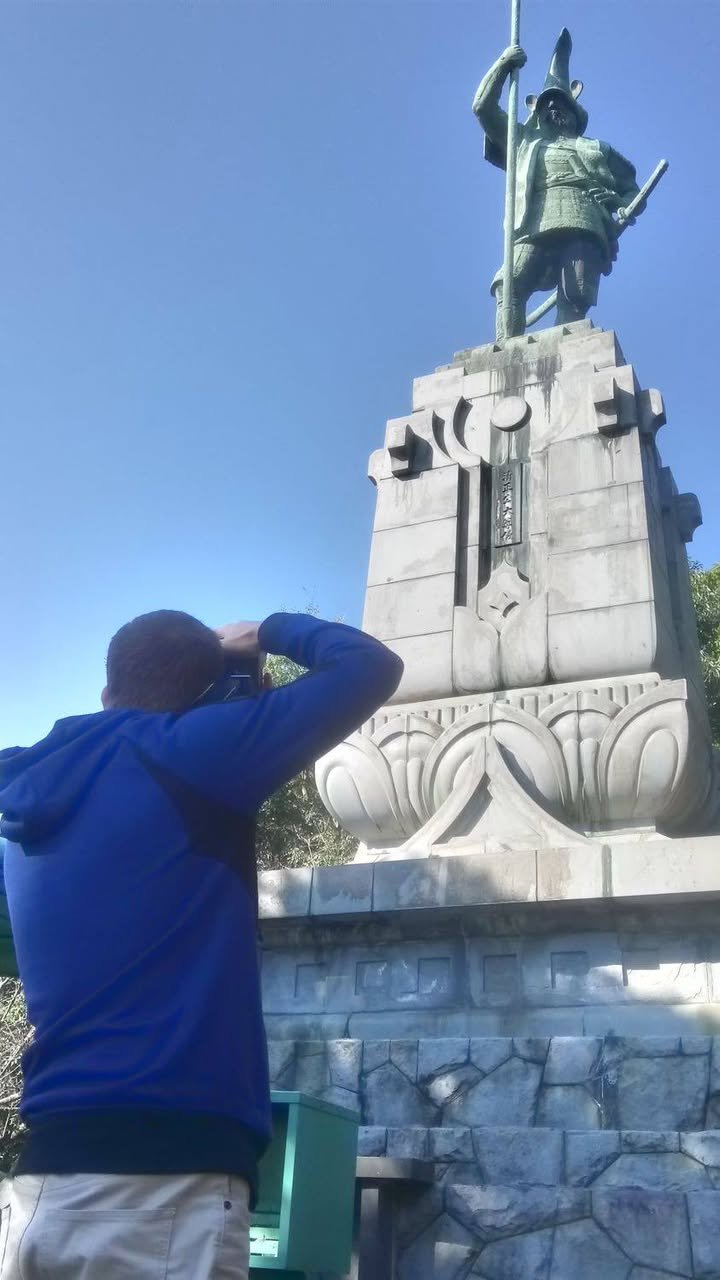


Our friend, Stuart Iles from Hakata, provided this fine photo of a statue of Kato Kiyomasa. If you live in Kumamoto, he's a must-know-about guy. A few facts that you can drop in casual conversation:
- He lived from 1562 to 1611;
- He's not from Kumamoto but Nagoya;
- His life spanned the Azuchi–Momoyama and Edo periods (the former being a stepchild of Japanese eras, when all the warlords were still in the process of outdoing each other);
- It's either a very bad or very good idea to live when eras change;
- He was one of the "Seven Spears of Shizugatake" (賤ヶ岳の七本槍, Shizugatake no shichi-hon-yari), mounted bodyguards for Toyotomi Hideyoshi at the battle of Shizugatake in 1583, crucial in Hideyoshi's rise to power;
- Hideyoshi was clearly terrified of Kato, so sent him off to invade Korea, evidently hoping that he wouldn't return, but he did;
- Hideyoshi made Kato the lord of the Higo fief in way, way south Kyushu as a way to contain him;
- Higo was not united at the time, and there was an epic feud between Kato and the lord of southern Higo, https://en.wikipedia.org/wiki/Konishi_Yukinaga. Guess who prevailed.
- He almost invaded Satsuma, unusual among Japanese fiefs as it wasn't actually a fief: it was the ancestral domain of the Shimazu clan, but was called off (good call: if you've ever been to Kagoshima, you'll quickly learn it is not a good place to invade);
- He is buried at Honmyō-ji temple;
- His son, Katō Tadahiro, seceded him but was quickly deposed by the Shogun Hideyoshi, likely as Higo was earned by his clan, not dispensed, and thus the clan had no obligatory allegiance to the Shogun;
- His family crest was a simple circle, shown below, which is still the symbol of Kumamoto City;
- His successors, the Hosokawa clan, has a family crest which, ironically, means "defend Kato";
- He was famous for his really tall hat, also pictured below;
- When he built Kumamoto Castle, he had it planted with ginko trees as the leaves could be used for horse fodder and the wood for fuel in the case of siege; even today, the castle is known as the "銀杏城” (Ginnanjyo);
- He died en-route from Edo to Higo, whether from natural causes or poisoning - the latter is suspected, again, due to the threat that his position posed to the emerging powers in Edo.
So that's about all I've got. If I've made mistakes or omissions, please add them to the comments below. - William