Kirk here with a note about the full moon and the lunar calendar. Tomorrow (9/21) we should be able to see the full moon (though there may be some clouds) -- and it's free! According to the old lunar calendar (kyureki / 旧暦 or taiinreki / 太陰暦), this particular full moon appears on August 15 (which, again, is 9/21 this year in our modern calendar). "Jugoya" in the explanation from the Kumamoto International Foundation that I quote below refers to the 15th (jugo / 十五) evening (ya / 夜) of the month. Since it was a lunar calendar, the 15th was always a full moon. The correspondence with the harvest season gave it special significance as a time to give thanks.
There's a song about "jugoya" that I think most Japanese people are familiar with from their childhood:
https://www.youtube.com/watch?v=JYZl86wD6Q4
The following is the explanation from the Kumamoto International Foundation. It came to me in a mailing list I'm subscribed to ("Anshin-Anzen disaster prevention and daily life information e-mail magazine"). I think it's great that they send the original Japanese text along with the English translation. If you're studying Japanese, you can refer to the English as you read the Japanese.
----- text from the International Foundation -----
【Moon Viewing 】
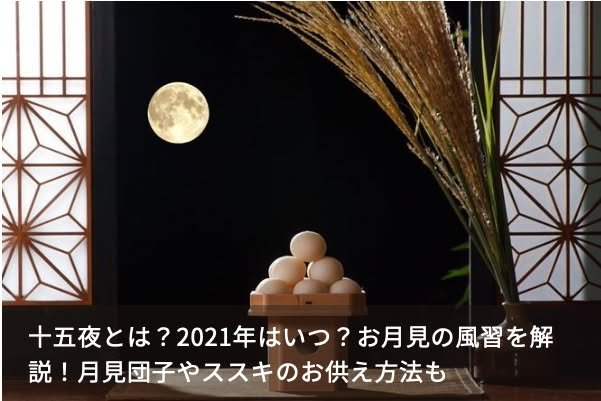
Jugoya is an event that we appreciate for harvesting in fall, enjoying the beautiful moon at Full Moon Night. The moon that night is called “the harvest moon”, and it is said to be the most beautiful of the year. It is customary to offer Japanese pampas grass, dumplings, and crops.
Japanese pampas grass : We think of them as ears of rice and pray for a good harvest. They have sharp cuts, so they are said to be amulets.
Dumplings : Their round shapes describe the full moon. 。
Crops : We offer farm products that were just harvested, for example, taros, chestnuts, and young soybean pods to thank for the harvest.
It is said that we are able to take good health and happiness by eating dumplings and crops that we offered after viewing the moon. There are some similar events in other countries in Asia. People eat mooncakes in China and Songpyeonin Korea.
【お月見について】
十五夜は秋の美しい月を観賞しながら、秋の収穫に感謝をする行事です。この時の月を「中秋の名月」と呼び、一年で最も美しい月だと言われています。お月見には「ススキ」、「お団子」、「農作物」を供える習慣があります。
ススキ・・・稲に見立てて、豊作を祈念します。また、切り口が鋭いので魔除けになると言われています。
お団子・・・丸い形が満月を表します。
農産物・・・里芋や栗、枝前といった収穫したばかりの農産物をお供えして収穫に感謝します。
お供えしたお団子や農産物はお月見の後に食べることによって健康と幸福を取り入れると言われます。
お月見は他のアジアの国でもあります。中国では「月餅」を、韓国では「松餅」を食べます。