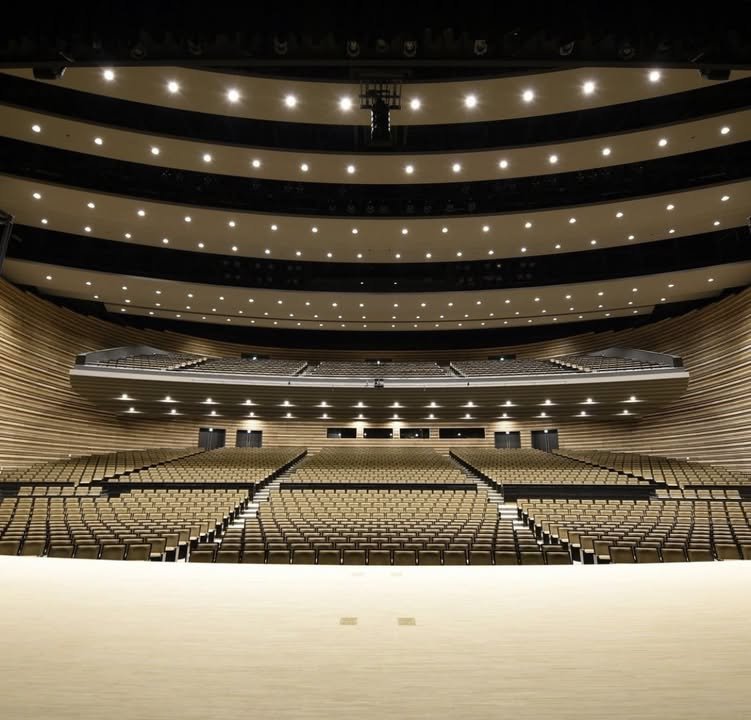
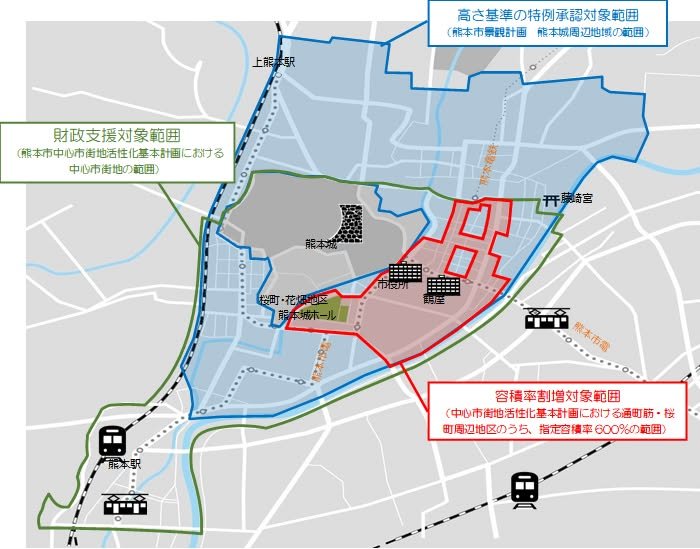
William Kumanichi has an informative article on the revitalization of downtown (Japanese, but Google Translate is your friend, so I have done so and pasted it below, unedited). The article discusses the new Kumamoto Castle Hall (熊本城ホール), located at Sakuramachi; a link to the facility is below. All of this activity is attributed to what is termed the "straw affect", which apparently is a result of improved transportation (in this case, the Shinkansen Kumamoto Station) resulting in business relocating to that hub. On the positive side, Kumamotoites need no longer travel to Fukuoka for good shopping; on the other, these new shopping facilities siphon off business from neighboring areas, including Kamitori and Shimotori. Pictured at bottom: Kumamoto Castle Hall and a map of the planned revitalization area.
Kumamoto Castle Hall site: https://www.kumamoto-jo-hall.jp/
Kumanichi article: https://kumanichi.com/articles/611657
(From the Kumanichi)
Kumamoto City celebrated its 10th anniversary on the 1st, becoming a government-designated city in April 2012. How has the prefectural capital, which has come to occupy one of the 20 "big cities" nationwide, promoted town development under the new system such as the authority transferred from the prefecture and the administrative districts? Report on the 10-year history and changes in the city.
◇ ◇ ◇ ◇
"If there is a plaza, the city will be lively." Saya Kimura (29), who visited from Kita Ward, smiled at the Hanabata Square venue (Chuo Ward) of the "National Urban Greening Fair" held in Kumamoto City. The 1.5-hectare plaza was developed by the city for about 2.4 billion yen as a place for citizens and tourists to interact, and became available in the fall of last year. Katori Yokoo, a 72-year-old housewife from Higashi Ward, hopes that the new coronavirus will settle down quickly and that many people from all over the country will come.
■ Straw phenomenon ■
Behind Kumamoto City's aim to become an ordinance-designated city, there was a sense of crisis about the "straw phenomenon" in which people, goods, and money were absorbed by other cities due to the opening of the entire Kyushu Shinkansen line. The aim was to be a "city of choice" in terms of tourism and economy. In order to enhance the city's comprehensive strength, the city has promoted multiple development projects in collaboration with the public and private sectors.
The redevelopment of Sakuramachi and Hanabata districts in Chuo Ward was particularly emphasized as the "face of the city". Kyushu Sangyo Kotsu Holdings (HD)'s commercial complex "Sakuramachi Kumamoto" opened in September 2019 in the area adjacent to the plaza and became one of Kumamoto's landmarks. Of the total project cost of about 79 billion yen for the redevelopment building including the bus terminal, the city paid 12.6 billion yen including half the national subsidy.
The large-scale customer attraction facility "Kumamoto Castle Hall" in the redevelopment building is a new base for tourism strategies that attract academic societies and international conferences. After completion, the city bought it separately for about 30 billion yen.
On the other hand, around JR Kumamoto Station in Nishi-ku, the prefecture has elevated the conventional line along with the development of the Shinkansen. Condominiums, hotels, national joint government buildings, etc. were built, and in April last year, JR Kyushu's commercial facility "Amu Plaza Kumamoto", which can be said to be a complete finish, opened. Along with the Shirakawaguchi station square, where the city cost about 9.6 billion yen, the "entrance" of the prefectural capital, which had a lonely impression, has been transformed into an orderly subcenter.
■ Bitter start ■
However, the creation of liveliness through redevelopment did not go as planned due to the corona. The number of visitors to Sakuramachi in the first year was about 13 million, which is almost half of the pre-opening target of 25 million. Keisuke Mori, president of Kyushu Sangyo HD, complains, "Due to the drastic decrease in tourists and refraining from going out, we could not take advantage of the location near Kumamoto Castle and the bus terminal."
Kumamoto Castle Hall was also closed and reservations were canceled one after another, resulting in a deficit of nearly 150 million yen in FY2009 (as of the end of December). It was a bitter start for the city to make up for the deficit to the designated manager who runs the hall.
On the other hand, there is also the aspect that the "city of choice" has progressed. Due to the effect of the Shinkansen, the number of annual guests in the city increased by 720,000 from 10 years before the opening of the Shinkansen to 19 years before the Corona disaster. The number of business locations, which was 2 in FY2011 before the government-designated city, increased to 16 in FY2012, and has remained in the 10s per year since then.
■ Machinaka reproduction ■
Following the Sakuramachi / Hanabata district, we will also work to improve the attractiveness of the central area. The city has started the "Machinaka Revitalization Project", which encourages the rebuilding of dilapidated buildings through deregulation and financial support, mainly in the Shimotori area. With similar efforts, Fukuoka City's "Tenjin Big Bang" is also conscious of the move, aiming to rebuild 100 projects by FY2017.
Urban development in Kumamoto City has been accelerated by the Shinkansen and government-designated cities. Hideki Miyano, General Manager of the Business Cooperation Department of the Regional Economic Research Institute (the same city), said, "Amid the declining population and competition between cities, coexistence with Fukuoka will continue to be an issue for Kumamoto. Need to increase. "