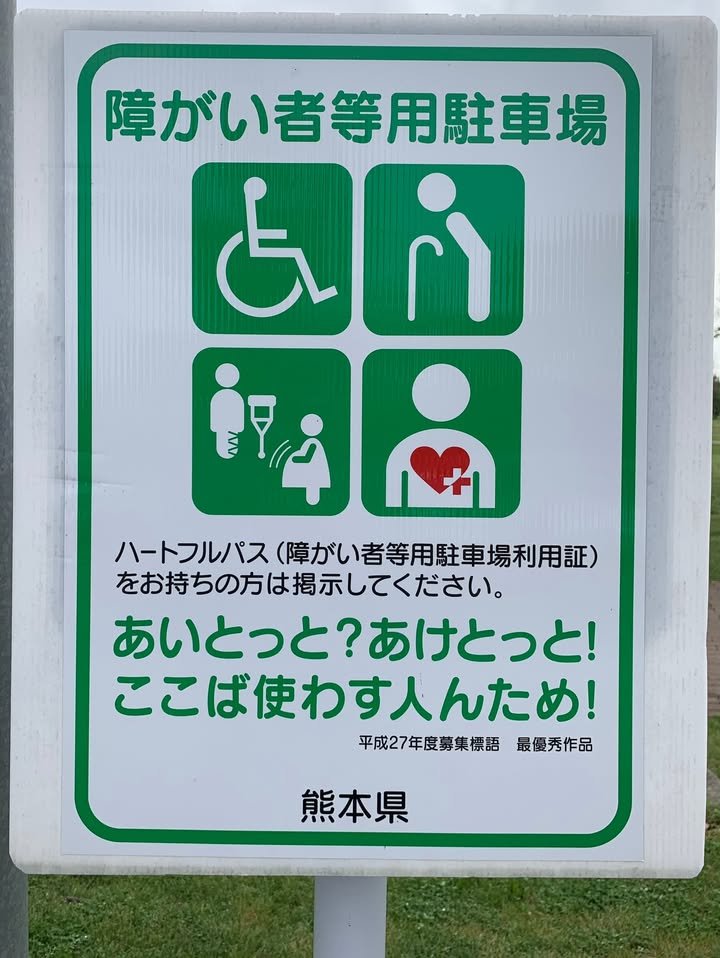
Kirk here with a "handicapped parking" sign in Kumamoto-ben (dialect). The top part is standard Japanese meaning: "This parking spot is for people with handicaps." The bottom is in Kumamoto dialect. I'll do my best to translate each phrase from the dialect to standard Japanese and then to English. My Kumamoto-ben is even worse than my standard Japanese so I hope native speakers of Kumamoto-ben will let me know if I've gotten something wrong:
あいとっと?
空(あ)いているの?
Is this parking spot open?
あけとっと!
空(あ)けてあるよ!
It has been left open (intentionally) --
ここば使わす人んため!
ここをお使いになる人のために!
-- for those who need it!
The fine print says that this was the winning submission in a contest held in 2015.
I took the picture in the parking lot of Shimo Ezuko. And, of course, this is NOT where I parked that day. :)
Grammatical points:
1.「と」is often used in a way that is very similar to 「の」in standard Japanese. However, they may not be exactly the same. I'd need some help from native speakers of Kumamoto-ben in that regard.
2. 「を」in standard Japanese becomes「ば」in Kumamoto dialect.