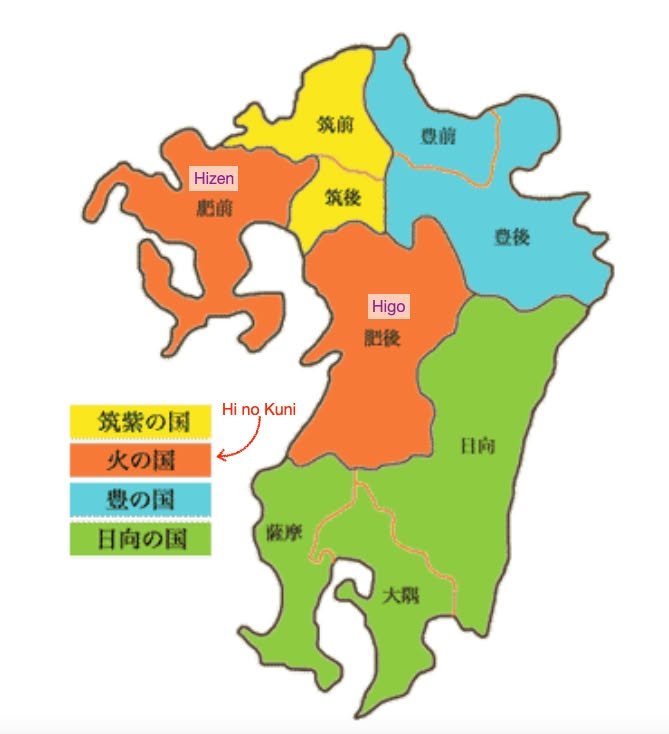
Kirk here with more about names for Kumamoto. This time I'd like to write a little about the name "Hi no Kuni" (火の国 or 火国).
First a little background. Yesterday, I posted about Kumamoto vs. Higo and, to my surprise, the post got over a thousand pairs of eyeballs (many more than the normal number):
https://www.facebook.com/Kumamotoi/posts/7262781397128563
So this is a "if they liked THAT, maybe they'll like THIS" sort of post.
According to Wikipedia "Hi no Kuni" is the oldest name for this neck of Japan's woods, with references in Nihon Shoki (日本書紀) and other ancient texts.
https://ja.wikipedia.org/wiki/火国
But, as the map shows, the old conception of Hi no Kuni included what is now Nagasaki. (By the way, this map was stolen from the following page: https://artworks-inter.net/ebook/?p=63)
And, just as Kumamoto was changed from 隈本 (origin of the nook) to the homophone 熊本 (origin of the bear), 火 (fire), which is read "hi", was changed (or transmogrified?) into the homophone 肥 (fertility and/or fat). In my view, "land of fat" was not an improvement on "land of fire," but I wasn't consulted.
At any rate, if you look at the map, you see that the old "countries" of "Higo" (Kumamoto) and "Hizen" (Nagasaki) together comprised the even older region of "Hi no Kuni." The split into Higo and Hizen seems to have occurred in the 8th century.
Quite a few areas in Japan were divided into "front" (zen; 前) and "back" (go; 後) in this way. It seems that the area thought to be closer to Kyoto would get the "front" character (前) and the area deemed farther from Kyoto would get the "back" character. The map shows that Hi no Kuni was just one of three areas in Kyushu that got subdivided into "front" and "back" parts. The question is "Why is Kumamoto 'Higo' and not 'Hizen'?" In other words, Kumamoto would seem to be closer to Kyoto that Nagasaki so isn't "Higo" a sort of misnomer? As far as I can tell, the answer seems to be that back then, most people didn't know how to use Google maps to check distances. (Postscript: See the comments for better, more historically plausible explanations regarding why Kumamoto could reasonably be considered to be in "back" of Hizen. Thanks, everyone, for the great feedback!)
The old meaning of Hi no Kuni included Nagasaki but today it seems to refer primarily to Kumamoto and is written 火の国, because Kumamoto has a big volcano and because people didn't want Kumamoto to be known as "the land of fat."
P.S. My comment about "land of fat" is somewhat tongue-in-cheek but I think the thrust of this little post is accurate. In other words, there is a historical connection between 火国 (Hi no Kuni) and 肥後 (Higo) and 火国 is the oldest name for this part of Kyushu. And, to the best of my knowledge, what I wrote about the 前後 division of areas is accurate. :)