William We're about a month from the cherry blossom front (or "sakura zensen, 桜前線," as it's known), so preparing strategy now would be timely.
One could kill a few birds with one stone - well, a whole lotta stones, as that is what the stairs are made of - by climbing the temple route (参道, sandou) to visit Honmyouji (本妙寺), a temple of the Nichiren sect. As Wikipedia has it, "In 1585 (Tensho 13), it was founded in Osaka by the founder of Nisshin to pray for the repose of the soul of Kiyomasa Kato's father, Kiyotada. In 1600 (Keicho 5), after Kiyomasa became the lord of Kumamoto Castle, it was moved to Zuiryu-in, which had been built near Kumamoto Castle. Kiyomasa died in 1611, and in accordance with his will, the statue of Kiyomasa was enshrined in Jochi Mausoleum on Mt. Nakao. In 1614 (Keicho 19), Honmyo-ji Temple, which was destroyed in a fire, was moved to its current location under Jochi Mausoleum."
Apparently, its popularity among worshippers drew those suffering from leprosy (or "hansenbyo", as it's known in Japanese) to its steps to beg for alms. Temples were established along the route to care for the lepers (and also to take advantage of alms-givers), many of which remain to this day.
A visit should be a full-day trip if one plans to visit temples along the way as well as walk the steps behind the temple to the mount peak, on which stands a large statue of Kato Kiyomasa.
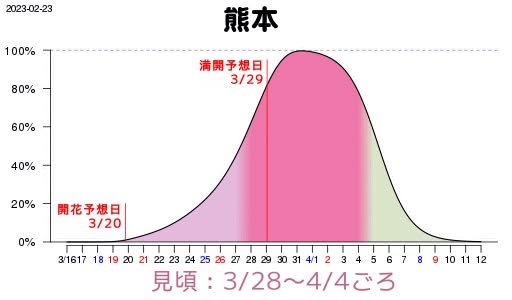
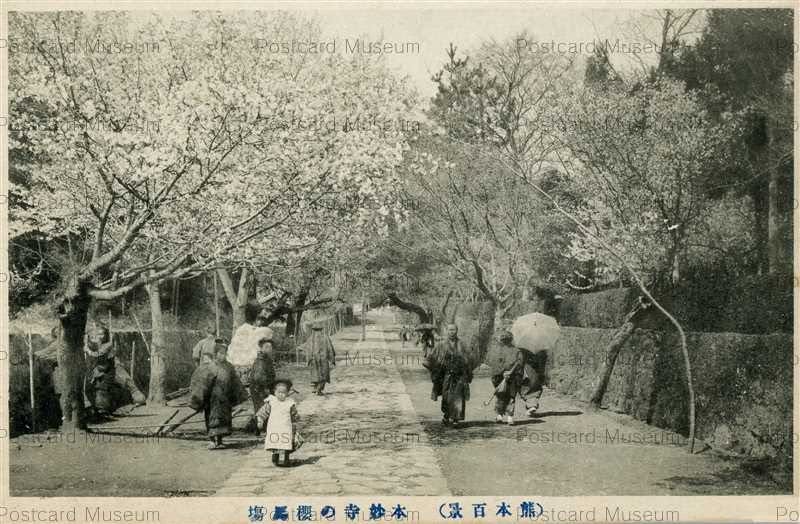
A chart of expected cherry blossom development in Kumamoto is below, as well as a photo of the Honmyouji sandou. One could do it three times: while the cherries are in bud, during full bloom, and a few days later, when the petals are swept by the breeze through the air and along the ground, known as "sakura fubuki" (桜吹雪).