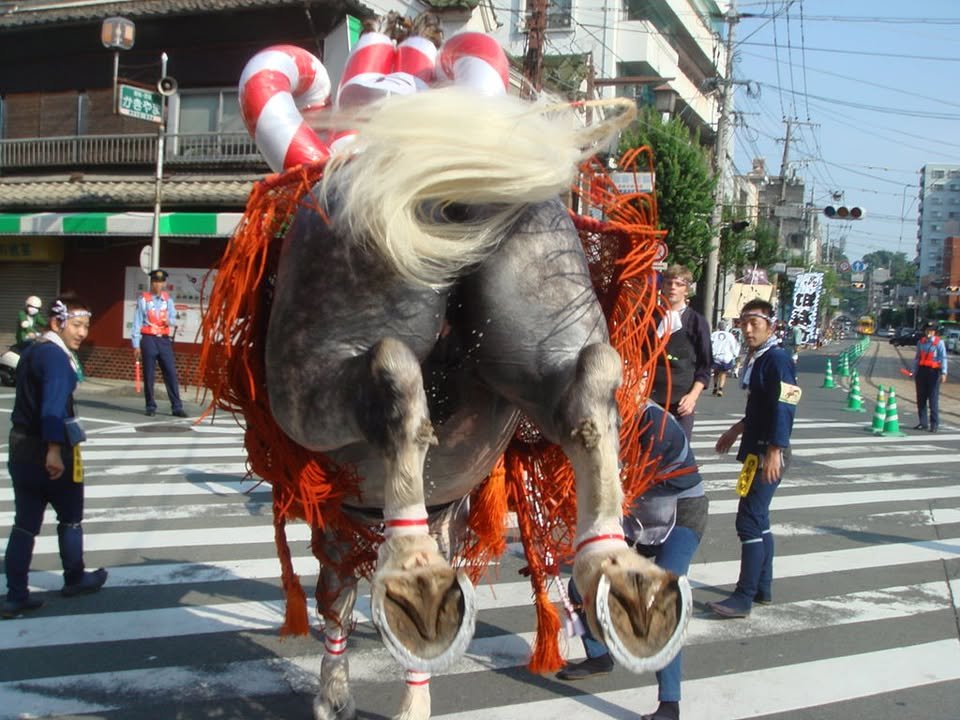
Kirk again with the last in my three-part series on the treatment of horses in the upcoming festival. The picture you see is from the Wikipedia page about the festival:
The placement of a picture of a horse kicking up its hind legs (with someone at the horse's side doing who knows what) on the Wikipedia page fits with my contention that making horses kick like this is a feature of the festival, not something that a few "bad apples" make their horses do. This photo seems to have been chosen by editors of the Wikipedia page with pride, not as an indictment.
But, the local police have been quoted as follows:「馬に後ろ蹴りさせるという行為はどの場所であれ不適切な行為にあたる。」(My translation: Making a horse kick up its hind legs inappropriate in any location.)
https://ameblo.jp/momokohime7/entry-12113399705.html
Moreover, on February 2 of 2019, police filed charges related to three cases of abuse that occurred in 2018 festival and were reported by Japan's Animal Rights Center.
https://arcj.org/issues/entertainment/festival/fujisakihachimangu/
These 2018 incidents received considerable media attention in 2018. In response, Mayor Onishi issued the following statement: "藤崎八旛宮秋季例大祭において一部で馬の虐待行為が行われていると報道されましたが、いかなる場合でもそうした行為があってはなりません。今後神社等の主催者側で検証されると思いますが、参加者はルールやマナーを守り伝統ある祭りが健全なものとなることを強く願っています。" (My translation: It was reported that some horses were abused during the Fujisaki Hachimangu Autumn Festival. Such behavior must not be allowed under any circumstances. I am sure that the organizers of the festival will investigate the matter. I strongly hope that participants will observe the rules and manners and that this traditional festival will be a wholesome one.)
According to Japan's Animal Rights Center, part of the problem is that the "rules" are unclear because the 奉賛会 (Hosankai), the body the runs the festival, has not (at least as of 2018) responded to requests to make a clear body of rules. Moreover, while Mayor Onishi recognized the egregious nature of the treatment of the horses in 2018, a member of the Hosankai defended an incident of whipping (one of the three incidents about which police filed charges) as follows: "馬にムチを打つ行為は虐待ではなく調教." (DeepL translation: Whipping a horse is not abuse, but training.) So, one key problem is that the Hosankai, the main governing body for the festival doesn't seem to be bothered enough by bad behavior to try to reign it in.
https://arcj.org/issues/entertainment/festival/event1376/
The same post on the Animal Rights Center website indicates that there is a group in Minami Aso called "OPEN SESAME FARM (animal sanctuary)" (南阿蘇の余生馬牧場 オープンセサミ) that has been working to improve the treatment of the horses. There are indications that the number of groups who lead their horses through the parade in a quite, dignified manner that minimizes the stress experienced by the horses has been increasing.
To conclude, here are some takeaways from my recent study of this issue.
-
It's not just foreigns who are concerned about it. There are significant numbers of Japanese people, including the mayor, who have expressed concern.
-
There are people who are trying to change the culture of the festival so that horses do not experience any more stress than absolutely necessary.
-
But (and this is important), the leadership of the festival has failed to impose strict rules that would prevent such bad behavior and many people who love the festival want to see agitated horses. So, I think problems will continue.
P.S. My previous post on this issue are
and