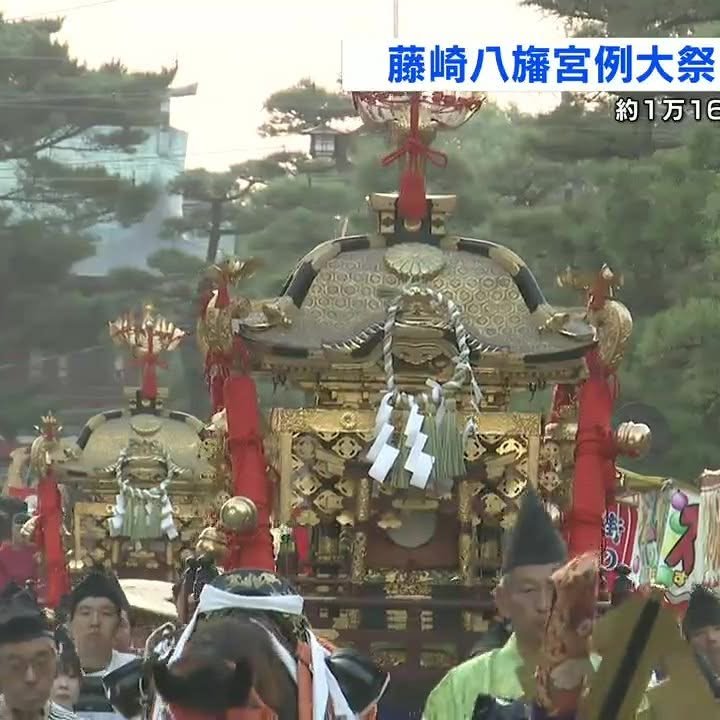
Kirk here with a video showing the early morning festivities today:
2023-09-17 21:25 JST 2023 Kirk here with a video showing the early morning festivities today: 藤崎八旛宮例大祭 神幸行列 | 熊本のニュース|RKK熊本放送藤崎八旛宮例大祭のハイライト神幸行列が行われ熊本市中心部は朝からお祭りムードに包まれています。17日午前6時過ぎ、神幸行列が御旅所を目指し藤崎八旛宮を出発しました。厳かな雰囲気が漂う中、甲冑を身にまと… https://newsdig.tbs.co.jp/articles/rkk/727376?display=1 ↗ View original post on Facebook For a link to the original post on Facebook, open this page on a computer. Reactions: 11 ← 2023-09-17 21:05 JST 2023-09-18 10:03 JST → Around this time … 2023-09-19 09:55 JSTHere's a share from the Kumanichi (local newspaper): https://www.facebook.com/KUMANICHIs/posts/pfbid02oR2pH2XNAg6NyeSf8DJ4ZjjwYPUfmb6wNq9Kmooy6hhxx1qSHK3WhYFwsURRmTkvlIf you follow the links to the main page, you'll find a montage video of many different horses in the festival:https://www.youtube.com/watch?v=C_-BtoNeRjk&t=1sThey're beautiful animals but as I watched, the English phrase "getting jerked around" came to mind. Most of the Japanese-language comments I see on the Facebook post now are positive but one person does express concern about the treatment of the horses.At the top of the Kumanichi page that has the video is the phrase "飾り馬勇壮" (Kazari uma yuusou) which might be translated very roughly as "decorated horses, bravery." Personally, I think that the pursuit of this 勇壮 (brave, soul-stirring, heroic) atmosphere leads inevitably to jerking the horses around. It may not rise to the level of "abuse" but, nonetheless, I wouldn't want to be in the festival if I were a horse. 2023-09-19 08:50 JSTKirk here with a share from Explore Kumamoto for One Piece fans:https://www.facebook.com/explorekumamoto/posts/pfbid07D4vQyeccDDvYixEvXvpbFB8p9YLnzFqVX669mh8VyZUZCia4TAad6qWMxn2VifQl 2023-09-18 20:00 JSTKirk here with a note about a rock festival to be held in Aso on the weekend of September 30 to October 1. There's an English website (click on EN toward the top right) but the list of performers hasn't been translated.ASO ROCK FESTIVAL FIRE 2023 2023-09-18 14:50 JSTPhoto showing the end of the Corona era.This is the Kumamon air play equipment, inflatable play equipment seen at the Ryutsu Danchi Festival流通団地バザー on Saturday.Jumping and playing in closed, enclosed and confined spaces, which was forbidden in the Corona era.In the Corona era, KUMAMON wore mask at Sakura Machi. When the masks were taken off, the mask of KUMAMON was also taken off, and then there was this fluffy KUMAMON playground equipment.Ah, it was impressive to see that the Corona era is really over now.ദ്ദി ˃ ᵕ ˂ )Atsuko. 2023-09-18 10:03 JSTKirk here. This article from the Kumanichi reports that the Kumamoto chapter of Buraku Liberation Studies Association (my translation of 部落解放研究会) is reminding people not to refer to the festival as the "Boshita festival" because, according to the group, "boshita" is an abbreviation of the word "horoboshita" (滅ぼした; "we destroyed them") and refers to Kato Kiyomasa's participation in the invasion of Korea. https://news.yahoo.co.jp/articles/9bfbae5e8ac77839211f88d83b8993e3dc9f5acbIn the past, participants in the festival would shout "Boshita, boshita" over and over. Now they shout "Doukai, doukai" (which I can't explain the meaning of). But, a few decades ago, due to lobbying from the Buraku Liberation Studies Association and other human rights activists, "Boshita" was removed from all official references to the festival and the word shouted was changed to "Doukai" because "Boshita" was considered to celebrate the invasion of Korea. The complaint from the human rights group referred to in this article is that ordinary citizens continue to use the term "Boshita." They are calling on people not to do so.Coincidentally, I've been looking into this matter again in recent weeks. I was prompted to do so by the following explanation in the English Wikipedia page about the festival:--- start quote ---The phrase "Boshita Boshita" originated in the Korean language. A book entitled History of Kumamoto city, published in 1932, wrote that "Ehekoroboshita" was used as the shouting phrase which came from the Korean language. A Korean association in Kumamoto said that it might mean a great man (Toyotomi Hideyoshi) died.--- end quote ---https://en.wikipedia.org/wiki/The_Great_Festival_of_Fujisaki_Hachimangu_Shrine(The same idea is expressed in the Japanese page about the festival.)To state my conclusion at the beginning, I think this is an example of intellectually dishonest cherry picking (Note for non-native speakers: 'Cherry picking' is when you choose facts or evidence that support your position and ignore facts or evidence that don't.) The source cited to support the Korean-origin hypothesis is Tetsuro Ashida. Prof. Ashida, a scholar of religious studies, used to teach at Kumamoto University and took an academic interest in the "Boshita" controversy. He introduces the Korean hypothesis in two of his writings but doesn't endorse it. Rather, the conclusion he comes to is that the origin in unclear and that "Boshita" is just a meaningless word that's fun to shout.Prof. Ashida, does, however, point out that during the first half of the 20th century, when Japan was at its most militaristic, the expression "Boshita" was explicitly associated with Kato Kiyomasa's invasion of Korean. The sentiment seemed to be "Wasn't what Kato Kiyomasa did cool?! Let's do that again!"As I indicated above, Ashida's position is that "Boshita" was originally a nonsense word, something that was just fun to say in a festival, and that the association with the invasion of the Korea came later. For this reason, he expresses displeasure with the decision to ban the use of the word "Boshita." But, after reading Ashida's writings, I still come down on the side of the Buraku Liberation Studies Association: I think it's better to avoid the word for two reasons.1. At the height of Japanese militarism, the word was indeed associated with the celebration of Kato Kiyomasa's participation in the Korean invasion. That makes it's use ambiguous. In other words, it's hard to know if people who insist on using "Boshita" just like the sound of the meaningless word or insist on using it because they like the idea of celebrating the Korean invasion. 2. The festival begins will a reenactment of a procession of Kato Kiyomasa's soldiers. The soldiers were taken to the shrine by Kato to express their gratitude for having been safely returned to Japan after the war. So, the festival already has a strong connection with Kato Kiyomasa and the invasion of Korea. That association makes the "it's just a meaningless word -- don't worry about it -- we're not thinking about what Kato Kiyomasa did" claim that much harder to swallow in my view.「ボシタ」使わないで 熊本・藤崎宮例大祭の呼称 人権団体が注意呼びかけ(熊本日日新聞) - Yahoo!ニュース 2023-09-17 21:25 JSTKirk here with a video showing the early morning festivities …藤崎八旛宮例大祭 神幸行列 | 熊本のニュース|RKK熊本放送 (this post) 2023-09-17 21:05 JSTKirk here with a short news article about the Janes' Residence:https://japannews.yomiuri.co.jp/features/travel-spots/20230916-136596/Though the article doesn't mention it, Janes had a profound effect on his students, several of whom became quite famous. For more information, see the following two Wikipedia articles:The Kumamoto Band (a group of his students)https://en.wikipedia.org/wiki/Kumamoto_BandTokutomi Soho (perhaps his most famous student)https://en.wikipedia.org/wiki/Tokutomi_Soh%C5%8DKumamoto: 19th Century American Teacher’s House Open to Public after Quake 2023-09-17 10:07 JSTJoe here, I'd like to pass on some good news from a teacher in Nagasaki but first give a bit of background.This list was originally a Yahoo groups and was started 25 years ago to support foreigners in a labor dispute with the Prefectural University. When you talk about labor disputes, especially in Japan, it is often difficult to count clear victories: It's more provisional decisions that may help people in the future, but usually, the stronger side will simply wait out the weaker side and this was the case with the foreign teachers who struck at the prefectural university some 25 years ago. However, I'm happy to report what seems to be a clear victory in Luc Loosveldt's case against Nagasaki University. Below is his message about the case.=====Good afternoon to you all.The labor dispute with Nagasaki University has finally been resolved for about five years. But did they really work it out?�As you may know, in 2019 Nagasaki University illegally terminated my employment. In January of this year, the Nagasaki District Court made it clear that the university's decision not to renew my contract and its basis is illegal. Court also ruled that I should be returned to duty and the uni be punished accordingly. The Nagasaki Court did not clearly mention whether Nagasaki University violated the 2013 amendment to the Labor Act implemented in 2014, but their interpretation was incorrect and ordered the University to change the previous fixed employment contract to a permanent employment contract.Nagasaki University has handed over to the Fukushima High Court and a conciliation agreement was proposed in accordance with Japanese law. During the initial discussion, the Fukuoka judge was happy to agree that the settlement money should exceed the long-term ruling. To my surprise, Nagasaki University was very cooperative.On Friday the 15th, just before the press conference in Nagasaki, we reached an agreement with the university side. The university has slightly relaxed some requirements, but the judge has supported our demands and urged to include provisions that ensure the university adheres to the conciliation agreement in good faith. There may be a bit of sweat on universities, but lawyers on the college side say they're committed to a settlement agreement.Overall we had a good result. The result is said to bring hope to staff in similar circumstances and shows a potential pathway forward. Not perfect, but an important step in the right direction.�A big thank you to all who supported us silently or publicly. Everyone's support was very important. I've learned a lot about the value of unconditional friendship and compassion from friends, former students, colleagues, and family. Thank you so much! It's been a long journey, but the result of a great lawyer, a tireless union leader, and a strong, smart, beautiful wife all working tirelessly towards this great outcome. Attached are links to articles reporting our case. Please share to as many people as possible. It is very important for people to be aware of issues related to Japanese Fixed Employment Agreements and measures taken by the Japanese Government to prevent abuse by specific employers.[note: I include the links in the first comment. If this topic is important to you, I recommend downloading the articles and saving them, Japanese articles are often moved behind a paywall after a short period of time] 2023-09-17 08:30 JSTKirk here. Circus performers in Sakuramachi today. The video is of yesterday's performance:サクラマチ クマモトで『天草サーカス』がマジックやアクロバットなど披露【熊本】 (23/09/16 17:30) 2023-09-16 17:58 JSTHere's a map showing the route for tomorrow's parade:https://www.facebook.com/kumavisit/posts/pfbid033F52ix22SGBB3RTTa55SynbMZnsfmDfytqdc3twYL2VvEVnJRMYLNgCrqCeRes5AlFor details about the schedule in English, please see the previous post from the Kuma Visit page:https://www.facebook.com/kumavisit/posts/pfbid0nWPivrircGyfV2vjTtSjjzGvVPP2ofpdpuuDZiRNDrb3BNhADW6o7iyWXzAy1M11l-- Kirk 2023-09-16 17:43 JSTKirk with an update regarding the rules that govern the treatment of horses in tomorrow's festival (Sunday, the 17th). This is part of a document called "藤崎八旛宮例大祭の注意事項" (Rules pertaining to the Fujisaki Hachimangu Reitaisai) and it was issued last year by the "藤崎八旛宮飾馬奉納団体奉賛会" (Committee to Support the Presentation of Decorated Horses to Fujisaki Hachimangu).In regard to the question of how one cannot treat the horses, it says that they cannot be abused under any circumstances (zettai ni) and, in parentheses, lists hitting a horse and hanging from a horse's mane as prohibited kinds of treatment. My personal opinion is that it's good that people are told that the horses may not be abused but this strikes me as rather weak. One problem is that this statement is prefaced with something that means "Agreements made with the police and animal rights groups." Well, I understand that there have been discussions with animal rights groups and the police but is it really necessary to include words indicating that such-and-such is in response to complaints from these two entities? It gives me the impression that they are saying "this isn't coming from us." Another problem I see is that the issue of making horses kick their rear legs (後ろ蹴り) isn't mentioned. The statement is so brief that there's a good deal of room, in my view, for interpretation.What I have written here are my views alone. I would like to recognize that I've gotten help from a friend who had a copy of the rules, which are not on the internet. Thanks! I haven't named that person here because I don't want to cause them any trouble ("Why'd you show that guy the rules?" etc). Nonetheless, I'm very appreciative.