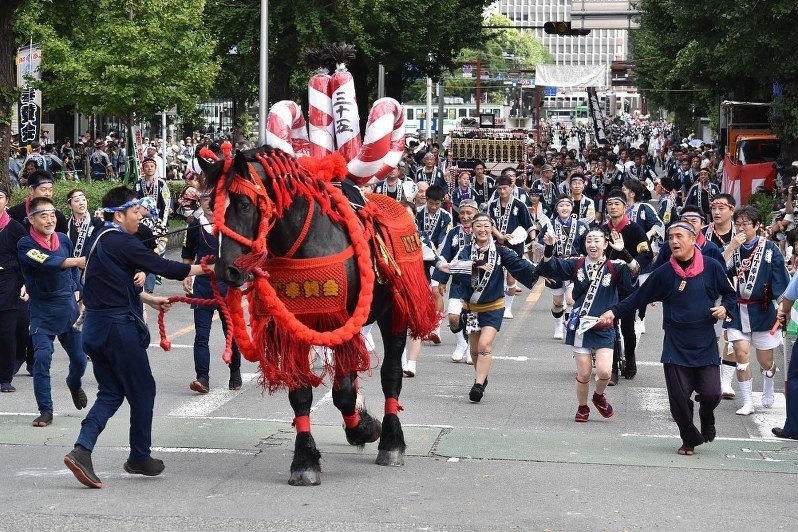
William A bit more about the Kumamoto Autumn Festival (colloquially known as "Boshita Matsuri": The festival originated in Ho-jo-e (the ritual for releasing living beings), a festival of letting wild animals go into the fields, a Buddhist custom (many local shrines are called "放牛" for this reason). The Zuibyo, or parade of following samurai, originated from the returning samurai of Katō Kiyomasa from Korea during the Japanese invasions of Korea (1592-1598). The decorated horses were originally those for Shinto priests (kannushi), twelve in number, and in the Hosokawa clan period, only upper-class samurai families presented horses. Neighborhoods or trade associations bond to create the groups, which have ballooned to more than 50.
The festival has undergone many alterations since its inception. In particular, following Kato Kiyomasa's invasion of Korea (1592-1598), the phrase "Boshita! Boshita! Horo boshita!" (We destroyed! We completely destroyed!" was introduced. Due to completely understandable reasons, this was replaced in the '80s with the (lame) "Dokai dokai!", which is Kumamoto dialect for "How's it going?"
The procession winds through city streets to the castle, where participants take a break, and then back to Fujisaki shrine in the evening. In my opinion, the evening return is the best time to watch: the participants, particularly the horses, are exhaust, and one can easily mingle with the throng.
Many valid complaints regarding cruelty towards the horses are presented. It is, though, just one day, and the horses are treated as humanely as possible given the situation. Perhaps it is better than eating them (though I do so love basashi!) Photo ripped from the Web.
https://en.wikipedia.org/wiki/The_Great_Festival_of_Fujisaki_Hachimangu_Shrine