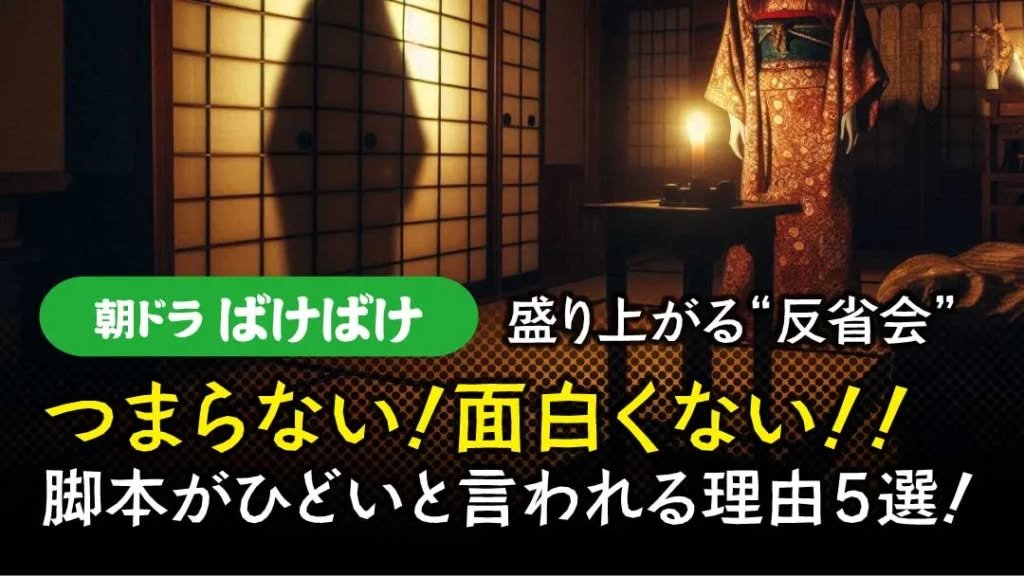
Kirk here. A fan of Japanese dramas I know has stopped watching NHK's "Bakebake" (the drama about Hearn and his wife) since the story moved to Kumamoto. Her complaints were primarily about the meaningless, dramatically inane series of Kumamoto tropes and stereotypes. I wondered if this was a criticism shared by many viewers and apparently it is. I am presenting an image from one article and the translation of the Japanese text from another article in this post. I'll provide the URLs in a comment.
--- Claude translation ---
"The Screen Is Hell" — NHK Morning Drama Bakebake's Kumamoto Arc Sees Ratings Slump… What Is the "Biggest Cause" of the Decline?
Weekly Josei Prime / March 4, 2026, 7:00 AM
NHK morning drama Bakebake heroine Takaishi Akari
"It's like watching a comedy troupe with no star power"
"Ever since they moved to Kumamoto, the screen has been hell"
Such voices are leaking out on social media about the NHK serial drama Bakebake. Now that the story is approaching its final stretch, ratings are apparently in decline.
What Is Causing Bakebake's Ratings Drop?
"The weekly average ratings fell to 14.2% in the first week of February, and the show has been stuck in a low-altitude flight ever since. The previous series, Anpan, actually gained viewers in its second half and maintained ratings above 16% from week 20 onward — so the contrast is stark." (TV magazine writer)
Since the real-life models for the drama, Koizumi Yakumo and his wife Setsu, had their child in Kumamoto, the story should be approaching its climax — and yet. Drama writer Tsuda Haruko says:
"After the move to the Kumamoto arc, there's been a string of 'do we really need this?' episodes — like the drawn-out detective-game storyline over a missing grill net involving the new maid Kuma (Natsume Tsumuha), and the deadbeat father Shinnosuke (Okabe Takashi) stealing money from Heaven (Tommy Bastow)."
Not only is the story failing to move forward, but the biggest reason viewers have been tuning out is:
"'Nishikori withdrawal.' Nishikori, played by Yoshizawa Ryo, always had Heaven's back no matter what, and functioned more as the 'heroine' than the actual protagonist Toki (Takaishi Akari). Visually too, there were legendary scenes — like a full 20-second close-up of Yoshizawa's profile — that were genuinely compelling to watch.
Such a magnetic character has now exited the show, so you'd think they would introduce an equally compelling new figure for the Kumamoto arc. Instead, all we get are a pushy maid and a gloomy cast of supporting players." (Tsuda, same throughout)
She continues:
"All we ever see is Toki and the Matsuno family sponging off Heaven, with no sense of gratitude — they just come across as shameless. They're supposed to be a samurai household, yet the only one with any sense of honor or duty is Lady Tae (Kitagawa Keiko). It's like watching a parasite family.
The Matsue arc had so many vivid characters — Toki's best friend Sawa (Maru-i Wan), the courtesan Nami (Sato Honami) and others. By comparison the Kumamoto arc just feels thin. It's fine to cast less well-known actors, but then at least make them likable characters — otherwise it's unfair to Natsume-san, who plays Okuma."
In episode 104 (aired February 26), the curse drama surrounding Ise (Imou Yu) finally unfolded, and Yakumo's supernatural literary work The Doll's Grave made its long-awaited appearance — but:
"Toki's 'A curse? How fun!' reaction felt like it went too far as a joke. They may have wanted to show her warmth in taking Ise's curse upon herself, but many viewers probably found it unpleasant to see her gleefully exclaim 'Being cursed gives me a thrill!'
We want to watch the story of Yakumo and Setsu as a couple, yet all we're shown, week after week, is the Matsuno family's slapstick chaos. If the show can't even treat the ghost story works with respect, how on earth will they handle something like Hoichi the Earless?"
Four weeks left. How will this show yet 'transform'?
--- end of translation ---
Note about translation from Claude: The closing line plays on the drama's title — bakebake means "to transform/morph" — asking whether the show can still pull off a meaningful change in its final stretch.