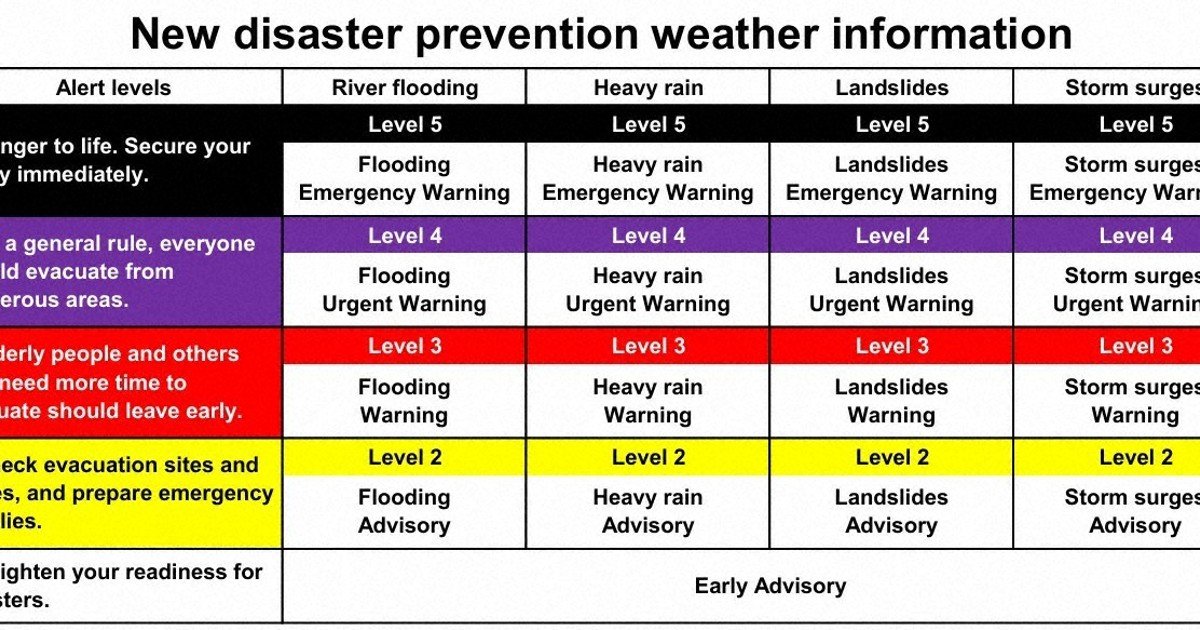
Kirk here. The Japan Meteorological Agency (JMA; Kishocho) has come out with a new, 5-level warning system that clarifies "the link to evacuation information." The Mainichi Shimbun translation of the scale is particularly good, in my view, because it avoids simply translating 避難 (hinan) as "evacuate." "Hinan" literally means "avoid danger" and you can "hinan" just by staying at home (if your home is in a safe place) but, of course, you can't "evacuate" at home. This has caused confusion here in Kumamoto in the past when large portions of the city received "hinan" orders. What this really meant was, "evacuate" from dangerous areas (such as near a river that might flood or near a steep slope that might be the site of a landslide). The "dangerous areas" should be understood as a subset of places within the larger areas that receive the "hinan orders." As I say, this Mainichi translation handles that well. My one point of disappointment is that there is no single "official" translation. The JMA has published a Japanese version on its website but the message to foreigners who don't read Japanese seems to be "figure it out yourself" or "we don't care -- we put out notices for Japanese people (but we have an English website for show)."
Japanese JMA page:
https://www.jma.go.jp/jma/kishou/know/bosai/keiho-update2026/index.html
Mainichi article
https://mainichi.jp/english/articles/20260528/p2a/00m/0na/007000c