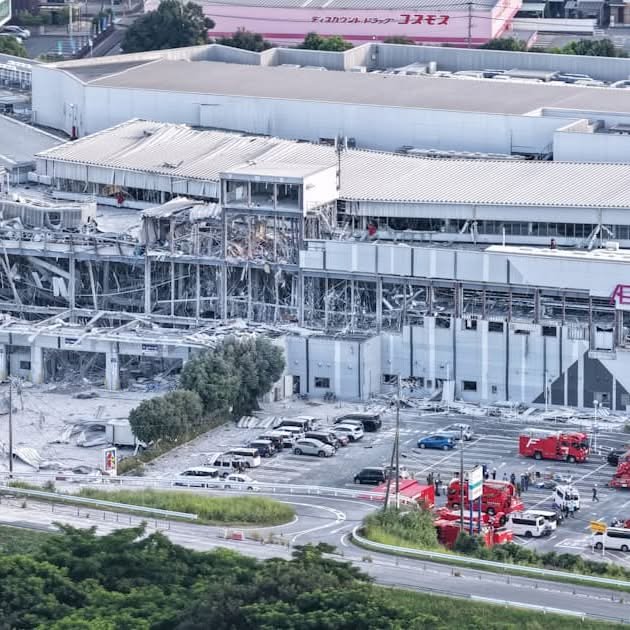
Here's a ChatGPT translation of this article. It mentions people in “cardiopulmonary arrest.” If you've been in Japan for a while, you may know that only physicians are qualified to formally certify a death, and journalists hesitate to report someone as having been found dead without such formal confirmation. So, when an emergency worker or police officer finds a person with no vital signs, the person is reported as being in “cardiopulmonary arrest” until a physician can officially declare them dead. :(
--- start translation ---
Three Dead at AEON Mall Following Explosion After Kumamoto Earthquake; Search for Missing People Continues
Magnitude-7 shaking recorded in Kumamoto Prefecture
July 29, 2026, 6:11 a.m.
Updated July 29, 2026, 7:35 a.m.
Police, firefighters, and other emergency personnel continued searching through the night for people whose safety remained unconfirmed following the earthquake that registered a maximum intensity of 7 on the Japanese seismic intensity scale in Kumamoto Prefecture.
According to the local fire department, three people, including a woman in her twenties, have been confirmed dead at AEON Mall Kumamoto in Kashima, where an explosion occurred after the earthquake.
One employee and four customers were also taken to the hospital. They were reportedly conscious. Authorities have received information that other employees may still be trapped inside the building. A senior government official said on the night of July 28 that a gas leak may have caused the explosion.
At the Nippon Paper Industries Yatsushiro Mill in Yatsushiro, part of a smokestack broke off and collapsed, trapping 11 people. Two were rescued but were in cardiopulmonary arrest. The condition of the remaining nine people is unknown.
The effects on infrastructure are also spreading across the prefecture, including water outages, power failures, and disruptions to transportation.
The Japan Meteorological Agency is urging people to remain alert for earthquakes of a similar magnitude for approximately one week.
According to the Fire and Disaster Management Agency, as of 7:00 a.m. on July 29, “Emergency Safety Measures,” the highest-level evacuation alert, had been issued for more than 90,000 people in two cities in Kumamoto Prefecture. Evacuation orders had also been issued for more than 260,000 people in Kumamoto and Nagasaki prefectures.
The Japan Meteorological Agency said the earthquake had characteristics similar to the 2016 Kumamoto earthquakes, which also produced shaking of intensity 7.
“People should remain alert for earthquakes producing shaking as strong as intensity 7 for approximately one week,” the agency said. “Strong earthquakes occur particularly frequently during the first two or three days after the initial earthquake.”
By 11:00 p.m. on July 28, 12 earthquakes producing shaking of intensity 4 or greater had been recorded.
The earthquake has also caused extensive disruption to essential services.
According to the Ministry of Land, Infrastructure, Transport and Tourism, approximately 140,000 households in 17 municipalities in Kumamoto Prefecture had lost their water supply. In Yatsushiro, all 60,000 households in the city were affected. The ministry asked the Japan Water Works Association to dispatch water-supply trucks to the disaster area.
Kyushu Electric Power reported that 41,730 households in Kumamoto Prefecture were without electricity as of the early hours of July 29.
Transportation operators have also been forced to suspend services.
The Kyushu Shinkansen will remain suspended along its entire route on July 29. According to the Kumamoto City Transportation Bureau, streetcars will operate on all routes from the beginning of service, but will travel more slowly than usual to ensure safety.
Japan Airlines has cancelled 11 flights arriving at or departing from Kumamoto Airport, while All Nippon Airways has cancelled two flights.
The Japan Meteorological Agency forecasts a high of 34°C in the Kumamoto region on July 29. Beginning on July 30, the area is expected to come under a high-pressure system, bringing several consecutive days with temperatures of 35°C or higher. The agency is urging people to stay hydrated and take precautions against heatstroke.
This was the first earthquake in Japan to produce shaking of intensity 7 since the 2024 Noto Peninsula earthquake.
On July 28, the Japan Meteorological Agency officially named the disaster the “2026 Kumamoto Earthquake.”
-- end translation ---
--- Kirk