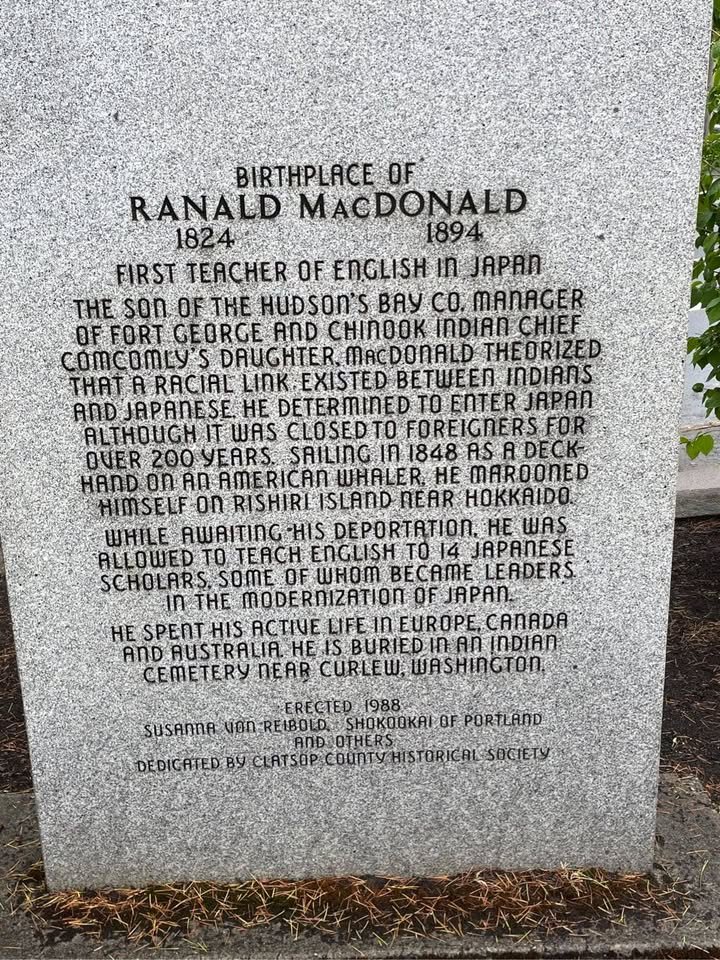
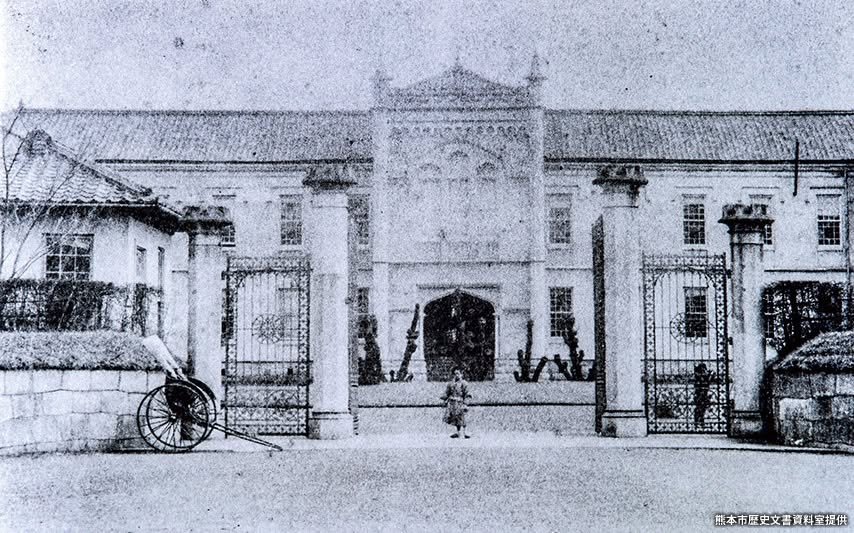
My daughter has returned to Kumamoto so had to change her residency status. I accompanied her to City Hall. It took about half the eternity that I had expected (y'know half an eternity?) I killed time by asking strangers strange questions (a huge map noted, "You are here," and I got in a deeply philosophical discussion regarding this). But did you know that Kumamoto City Hall used to be where what is now Shirakawa Koen? It's true! (Don't mess with the guy holding the katana at the gate.) Fascinating info at the link. https://smtrc.jp/town-archives/city/kumamoto/p05.html - William
2021-06-22 16:02 JST

Good morning, Monday.
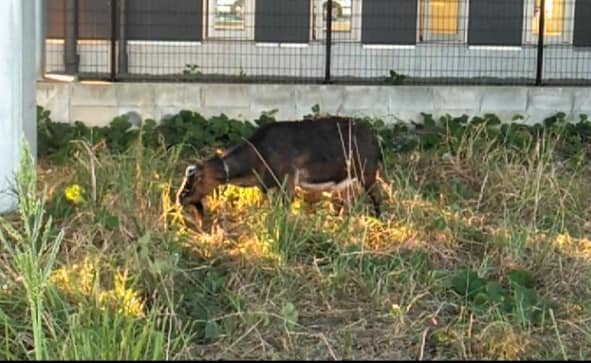
I met 3 goats working early morning.
They eat weeds and clean under the railway near Nishikumamoto station.
Kumamon is a civil servant employed by prefectural government.
The 3goats might be JR staffs.ーAtsuko(*Ü*)

2021-06-21 06:14 JST

A note from the Kumamoto International Desk of Weird News: Kids put stuff in their mouths. There is a biophysiological reason for this: kids are much better at recovering from illness than us older folk, so getting sick a lot as a kid is a good thing - better than than later, as it allows the body to develop the antibodies required for healthy adulthood. Scientists also have it that this is where kissing comes from, and the habit of mothers chewing food and passing it on to their children. Recent reports suggest that parents cooping their children indoors during the pandemic may reduce their opportunities to confront viruses and develop immunity. Suggestion for our readers with young children: release them in the park and let them eat dirt. They will thank you for this later. - William
Are We Too Clean? Letting Kids Get Dirty and Germy
Should you let your kids get dirty and be exposed to germs? WebMD discusses this idea and the benefits and risks associated with it.

2021-06-20 13:44 JST

Kirk here with an inquiry we received: "Does anyone know of a podiatrist in Kumamoto City?"
Well, I didn't expect to be able to recommend a "podiatrist" (foot doctor) because, generally speaking, "podiatry" isn't a big thing in Japan. I'll comment below on why I think podiatry is a thing in English speaking countries but not in Japan but first let me introduce the website I found.
I searched for "熊本" (Kumamoto) and "足病医" (sokubyoui), a word that is not used very much in Japanese but is sometimes given as the translation for "podiatrist" or "foot doctor." This site looks good (and the hospital, Hotakubo Seikeigeka, is not far from my home) but I don't know anything about it.
My impression is that, generally speaking, Japanese people with foot problems go to a 整形外科 (seikeigeka; orthopedic ward) in a big hospital. I think such doctors are familiar with the sorts of problems that a podiatrist deals with. However, I've been told that orthopedic surgeons tend to specialize in particular joints or parts of the body. So, levels of familiarity and skill in dealing with foot problems must differ from doctor to doctor.
Now, I'l like to address the cultural background behind the relative lack of "podiatry," at least as a popularly recognize area of medical practice, in Japan. If you'd like to check to see what I'm talking about, ask a Japanese friend if they know of or have been to a 足病医 (sokubyoui; podiatrist/foot doctor). I doubt that you'll get many positive responses. My theory about why this is the case is that the Japanese language doesn't distinguish clearly between "leg" and "foot." "Arm" and "hand" are distinguished between as "ude" and "te" but "leg" and "foot" both come out as "ashi". So, whereas it's very easy to explain "podiatrist" with the phrase "foot doctor" in English, it's a bit harder to describe that part of the body in Japanese clearly and concisely.
My little theory comes under the heading of linguistic relativity or the Sapir–Whorf hypothesis. The idea, according to the Wikipedia page on the topic, is that "the structure of a language affects its speakers' worldview or cognition."
Back to the original question: Where to go for medical help with your feet. I've gotten good help in the past at the Shintoshin Hospital (used to be NTT) near Kumamoto Gakuen University. If others of you can recommend a good foot specialist, please write a note in the comments. Otherwise, the hospital I link to below might be worth checking out.

熊本足の外科センター|(医)保田窪会 保田窪整形外科病院
患者様に寄り添った治療で足首から下の怪我や病気を診療する、熊本市東区保田窪にある熊本足の外科センターのWEBサイトです。

2021-06-20 13:11 JST

When you walk around your neighborhood, you may often come across stone monuments. Usually, they were built to commemorate people or events in the past but Koshi City has interesting ones, which are called Kinshu (禁酒, No-drinking) stone monuments. They are very unique on a nationwide level and we can see No-drinking stone monuments only in Koshi City and one small village in Ishikawa Prefecture.
Exploring the world of stone monuments is just like time traveling. They tell us local stories and history in the area.
For further information, check out the link below and I hope you will enjoy the world of stone monuments!
- Chieko

2021-06-20 12:41 JST

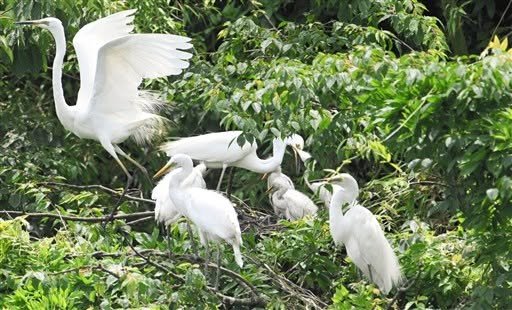
Budding ornithologists must distinguish between herons, storks, egrets, and ibises (egrets, I've had a few...). Look them up. Kumanichi reports that that snowy herons are flocking to a reservoir adjoining route 57 in Aso's Nagakusa (阿蘇市永草). I Googled "heron chicks" to see if there was some special word for them, but apparently, it's only "chicks," so I'll go out on a limb and call them "heronettes." Camera people, get going! - William
https://kumanichi.com/articles/278709

2021-06-20 12:13 JST

We have a friend, Urabe-san, 76, who is as Higo-ko as one can get. He came over today as he knew I had a "computer" which can access the "internet" - he has no idea what these are but he does know what they can do. He wanted to look up the history of a certain politician - particularly, genealogical history. This did not surprise me. When I first arrived on these shores, in Osaka, during a job interview, I was asked where I was from, and I answered "America," and the interviewer said, "No - I mean, your ancestors." Being aware of this fascination of ancestry is important for non-Japanese here in Kumamoto. (Hint: make it up. I am nephew of the Earl of Noughtstuff.) - William

2021-06-20 11:35 JST

Good morning friends.
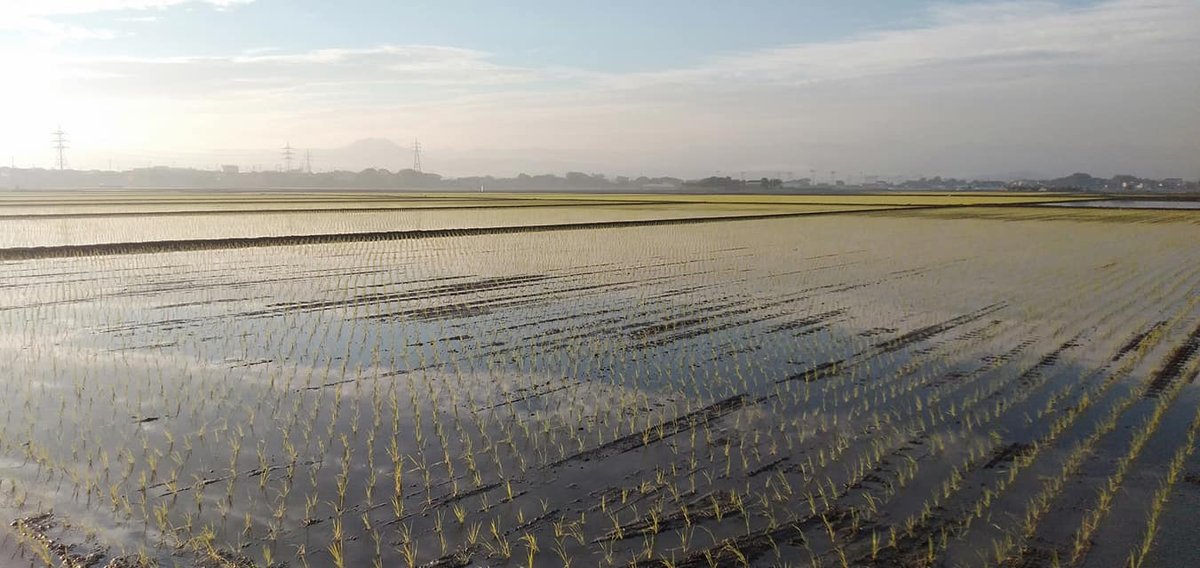
It's the rice planting season, this weekend @Kumamoto city, near 画図小.
I go through these rice fields every morning.
These paddy fields keep and bring us Kumamoto rich natural water also.
It's a beautiful and fresh scenery.
Enjoy and feel them you too!ー Atsuko(*´▿`*)

2021-06-20 06:24 JST

When I first washed up on these shores, my wife's FIL's neighboring house was furnitureless. Rather than ready-made stuff, I sought to build my own to customize use of space (man, I had energy then). But I was also penniless, so I sourced my wood straight from the source, a mill in Mifune, which has long been a source of wood due to its river. I used my FIL's measuring tape to plan things, belatedly realizing that it was based on the "shaku," which looks deceptively like an inch but is a bit longer (better to be too long than too short - the former can be rectified.) A new wall is being built alongside my local shrine, and I heard the craftsman call out "shaku." A list of Japanese measurements for volume, distance, and dimensions can be found at the link. - William
Japanese units of measurement - Wikipedia
Traditional Japanese units of measurement or the shakkanhō (尺貫法, "shaku–kan system") is the traditional system of measurement used by the people of the Japanese archipelago. It is largely based on the Chinese system, which spread to Japan and the rest of the Sinosphere in antiquity. It has ...

2021-06-19 18:26 JST

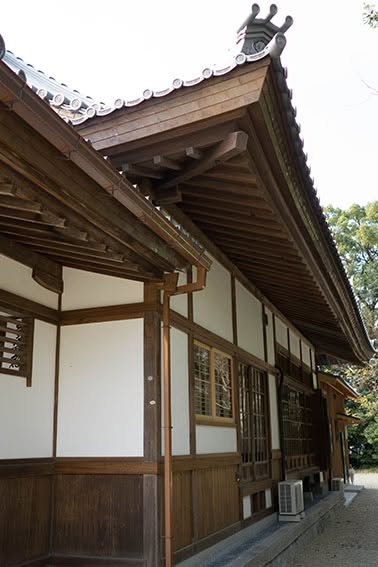
The shrine adjoining my house has a retaining wall which encroaches a bit on the lane. The city and the shrine have gone back and forth regarding what to do about this. Cleverly, the shrine is doubling down by building a very fancy wall atop the concrete retaining wall. It is being built using a traditional method with a wood-paneled base and a white stucco upper part, as shown in the photo. I've tried to find the Japanese expression for this type of construction but to no avail. If anyone knows, please inform us. However, I did find the kanji for stucco - 漆喰 (shikkui), so it was not all for naught. - William

2021-06-19 12:25 JST

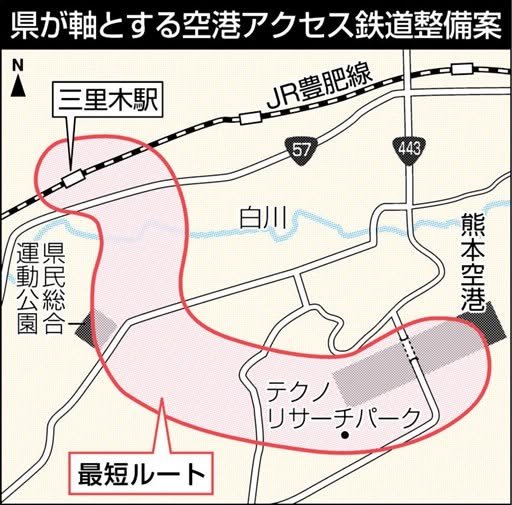
Authorities are looking into the best route for a rail line from JR's Sanrigi station to the airport. I don't have skin in this game as I have easy access to the airport bus, but for the vast majority in the greater Kumamoto area who don't, it's a game-changer. (There is currently access via bus from Ozu Station.) A plan under consideration is to tunnel under the populated area around the station (and, I suppose, Shirakawa) to resurface at a proposed station at Undo Koen before continuing on to the airport. Sounds cool! Perhaps we'll see it realized in our lifetime. - William https://kumanichi.com/articles/277225

2021-06-19 08:41 JST

The Azuchi-Momyama period (安土桃山時代, 1568 to 1600) was not so much a "period" as the final phase of the Sengoku period (戦国時代, 1467 to 1615), as Oda Nobunaga entered Kyoto in 1568 and Tokugawa clinched victory at the Battle of Sekigahara in 1600, establishing the Tokugawa Shogunate and beginning the Edo period.
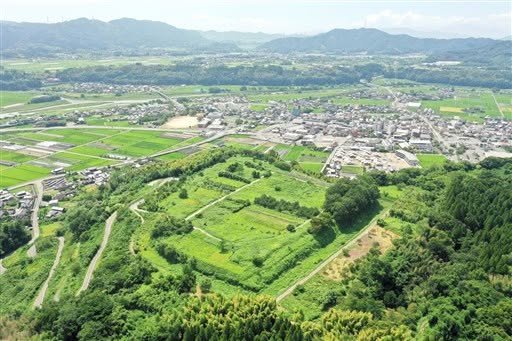
Ruins of a 16th c. castle in Kosa Machi (甲佐, which literally means "armored support") Jinnochijyouato「陣ノ内城跡[じんのうちじょうあと] have been nominated as a National Historic Site. I can't imagine how Kosa would have figured into the fighting far north; perhaps I'll look into it. Kosa is a lovely, often overlooked town. I'll write more about it later. Let's hope this brings more tourists to their oft-overlooked town, a gateway to central Kyushu; it will certainly bring me. - William
https://kumanichi.com/articles/277160

2021-06-18 19:48 JST

On the 7th (Monday of last week), it seems that a sun halo was visible in Kumamoto and other parts of Kyushu. I didn't see it but saw something about it on a news program I had recorded and wound up looking at today. A halo is "the name for a family of optical phenomena produced by light (typically from the Sun or Moon) interacting with ice crystals suspended in the atmosphere." Even in the summer, I guess that very high (and thin) clouds can produce this kind of effect. -- Kirk
https://en.wikipedia.org/wiki/Halo_(optical_phenomenon)
P.S. The photo is from the following page:
http://weathernews.jp/s/curation/detail.html?cuid=202106070055

2021-06-17 21:01 JST

Joe Tomei here. The 2021 Spring YOKA, a publication of Kumamoto JET program participants is available at
https://kumamotojet.com/documents/YOKAs/2021SpringYOKA.pdf
Back issues are here
https://kumamotojet.com/reiwa/category/yoka/
Thanks to Lily McDermott & Chase Sutherland for allowing me to share it here.

2021-06-17 18:57 JST

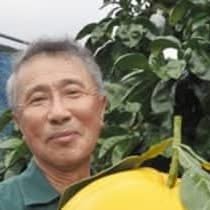
Looking up the English translation of 晩白柚 (banpeiyu), I came up with "Citrus maxima" and "Citrus grandis." I suppose either would do if viewed from the outside, but once peeled, it's no bigger than a grapefruit. A farmer in Yatsushiro came up with a 5.4-kilogram (about 12 pounds) maximus Citrus maxima. Without the rind, though, it's probably a pound. - William
重さ5キロ超、バンペイユがギネス認定 熊本県八代市の前田さん栽培 | 熊本日日新聞
熊本県八代市東陽町の前田一喜さん(70)が育てた重さ5・386キロのバンペイユが、最も重いザボンとし...

2021-06-17 17:13 JST

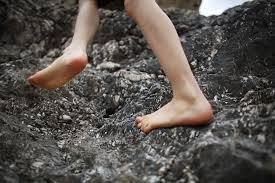
When I go for quick errands during rainy season, I often go barefoot (裸足, hadashi). Part of it is cultural - Californians regard bare feet as a sacred right - but part of it is practical: it's much easier to dry off bare feet than to dry off shoes. Those who notice look at me strangely as if I weren't wearing pants, which have an entirely different function. What is your opinion about going barefoot in Japan? - William

2021-06-15 18:25 JST

Post

2021-06-15 13:30 JST

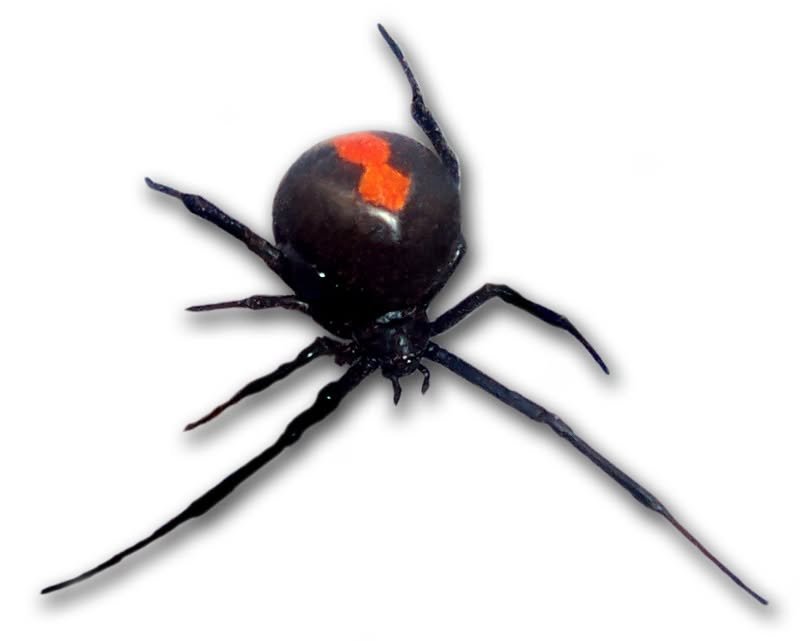
Web spiders are good at what's call "ballooning," in which they allow gusts of wind to send the aloft in the hope of meeting mates elsewhere. Apparently, they can reach the stratosphere and return to earth, saying, "'Sup, dude?" on a different continent. But hunting spiders are not capable of this. Long ago, they had to walk, but human transportation has given them a, uh, lift? The black widow spider, a hybrid of web and hunting spiders, is know for hitchhiking its way from its native Australian to various locations via lumber trade. They are known for their hourglass-shaped abdomen and for residing in dark, dank places. My grandfather, a famous etymologist, had one bite him once and had to be hospitalized (that's how they studied spider toxicity in the day). Apparently, they've shown up in Kumamoto. If you see any spider that looks like this, call the authorities. - William
https://kumanichi.com/articles/271471

2021-06-15 00:28 JST

I haven't been there for a long time but I'm fairly sure this is Dazaifu Tenmangu (太宰府天満宮), a Shinto shrine in Fukuoka. Every time I visited in the past, I remember lots of people being there. The weather is nice and the shrine looks beautiful in this little smartphone video but the area is eerily empty, presumedly because of the pandemic. -- KIrk
https://www.facebook.com/watch/live/?v=822159455078028&ref=watch_permalink

2021-06-13 23:11 JST

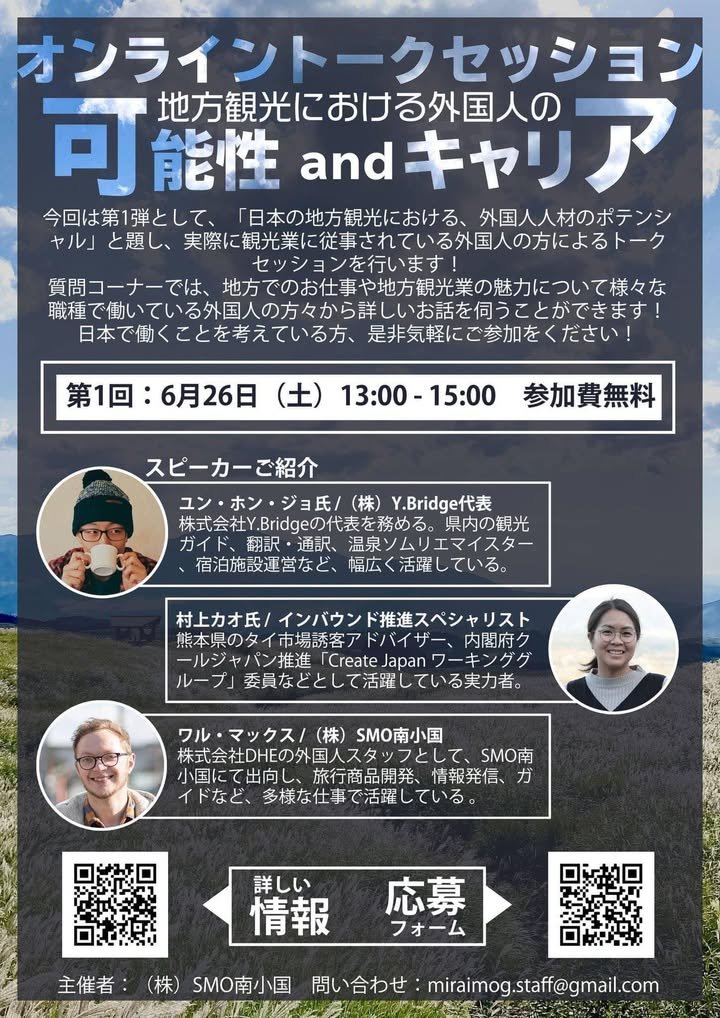
Here's something that came to me via a friend on Facebook. It's about a free, online event on the topic of career opportunities for foreigners in the regional tourism industry. Be aware, though, that everything will be in Japanese. -- Kirk
P.S. Here's the link represented by the QR code on the left. A link to the form (the QR code on the right) is in that page.
https://minamioguni.jp/archives/206751

2021-06-13 17:06 JST