Archive of the Kumamoto International Facebook group, 2011–present.
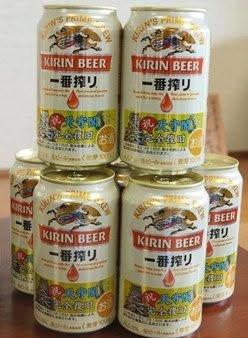
William. Kirin is selling beer featuring an image of Kumamoto castle, with proceeds going towards its reconstruction. Keep an eye out for it and give a kanpai knowing it's going to a good purpose.
https://kumanichi.com/articles/367728
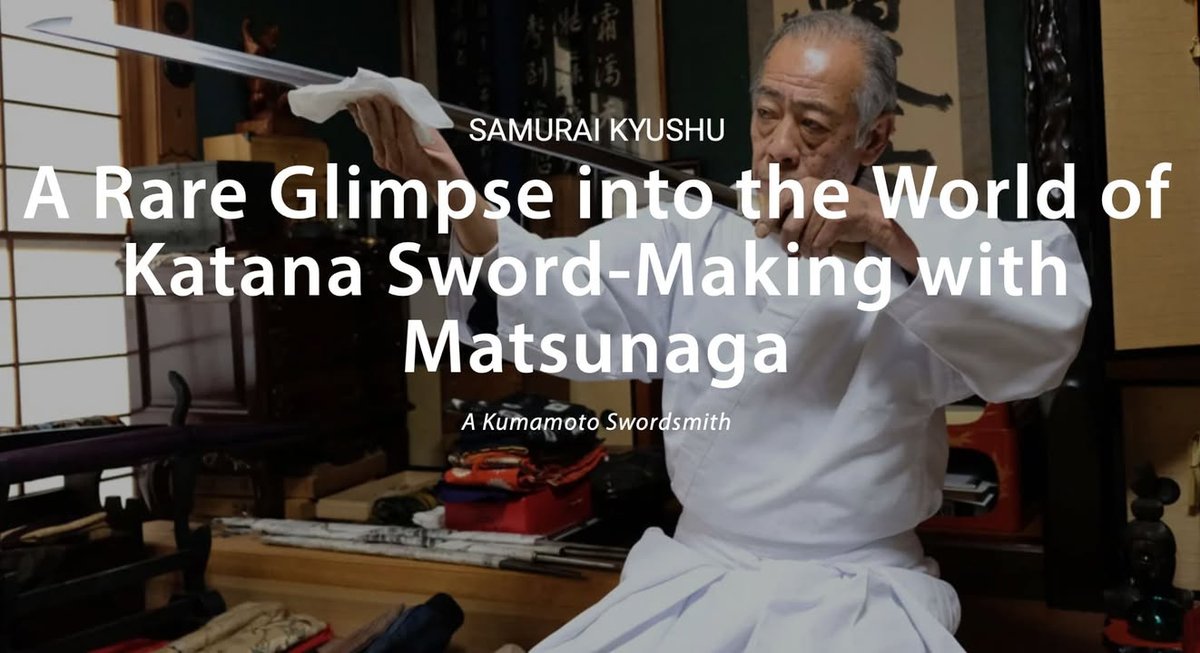
Kirk here. I am one of a large number of people in Kumamoto to have had the pleasure and honor of visiting Matsunaga-sensei's smithy (kajiya; the place where he actually makes Japanese swords). When I visited, he allowed us to experience tameshigiri, using a real sword to cut through pieces of rolled up goza (the top layer of a tatami mat). I think many readers of this page know Matsunaga-sensei much better than I do. I'm only writing about him today because he came up in a conversation with my wife and that conversation led me to the following article:
https://www.visit-kyushu.com/en/discover/blogs/world-katana-sword-making-kumamoto/
If you're interested in Matsunaga-sensei, you may be interested in learning about Colin Young, a man who studied with Matsunaga-sensei and then started his own dojo in the UK:
https://www.thenorthernecho.co.uk/news/1221404.swordsman-point-make-traditional-values/
P.S. Until today I thought "smithy" as a nickname for someone named "Smith." Today I learned for the first time that it's a real word and refers to the workspace of a blacksmith.
William. Kumanichi reports a record-breaking number of corona virus patients in Kumamoto, with 179 newly diagnosed on 8/23, and that hospital occupancy has reached 80%. This presents a challenge for those who must be hospitalized for other reasons. The phone number at the link is to call if you feel you've come down with corona.
熊本県内179人が新規感染、月曜で最多 熊本市の病床使用率8割超す | 熊本日日新聞社
熊本県と熊本市は23日、新たに179人の新型コロナウイルス感染を発表した。前週の152人を27人上回り、月曜日としては過去最多。熊本市の病床使用率は前日から4・3ポイント上昇し81・4%となった。8...

Hi friends, Atsuko here.
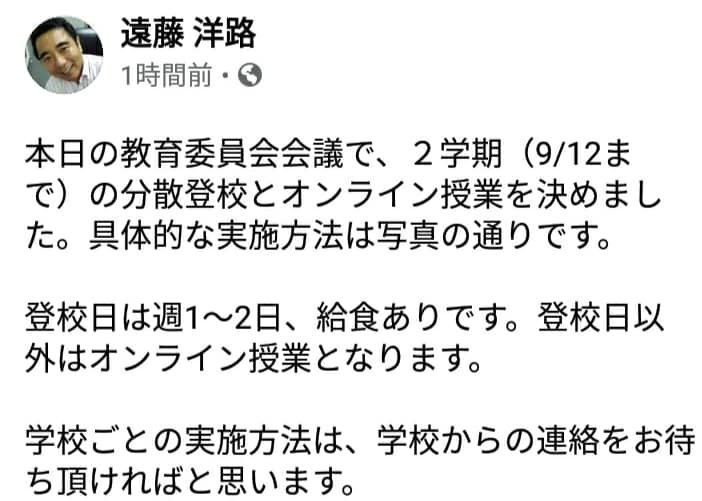
This is an announcement from Mr.Endo,Kumamoto city Superintendent of Education.
Schools might tell parents the details later.
Please wait your school's announcement and mails.
I took some screenshots and used google lens to translate. It's not perfect but useful.
https://m.facebook.com/story.php?story_fbid=4382427921808785&id=100001248625511
Atsuko lens (*Ü*)=
Mr. Endo Hiromichi.
We dicided students separated attendance and online lessons until 9/12, at today's Board of education meeting. The details are written in these photos.
Students might have to go to school 1-2 days a week with lunch. On the other days, they have online lessons.
Please want your school's announcement, notification about the details.
ーーーーーーーーーーーーーーーーーーーー
Google lens=
Endo Hiroji
At today's Board of Education meeting, we decided on decentralized school attendance and online lessons for the second semester (until 9/12). The specific implementation method is as shown in the photo.
School lunch is provided 1-2 days a week. Online classes will be held after the day of school.
Please wait for the school to contact you regarding the implementation method for each school.
ーーーーーーーーーー
Reiwa 3rd semester 2nd semester response policy
1 Elementary and junior high school
(1) Distributed school attendance
A. Implement decentralized school attendance in which "school attendance days" and "online class days" are set for each grade.
The principal decides the grade to go to school in the sun as the second grade for elementary school and the first grade for junior high school.
* Examples of "school day" and "online class day" will be shown separately by the Board of Education. C. At least one school day per week should be set for the health management of children and students.
However, the school year must be separated by at least two days. D. As a general rule, classes are held in the morning on "school day".
E. Children who are in the third grade of elementary school or younger due to medical care, etc., and children who need to go to school due to abuse or neglect (hereinafter referred to as "people who need to go to school") are basically going to school every day.
You can go to school.
For special needs classes, the correspondence of regular classes will be applied, but it is possible to take measures according to the situation of the school.
If parents are worried about having their child go to school on the “school day”, they may refrain from going to school, and even in that case, they will not be treated as “absent”.
(2) Online class
A. The number of hours of online lessons is based on the number of hours conducted at the time of distributed school attendance.
conduct.
B. The details of the online lessons will be announced separately by the Board of Education. C. Those who need to attend school for grades that are not on the “school day” will only be kept in custody and will take online classes at the school.
(3) Preparation date
A. In order to prepare for distributed school attendance and online lessons, the second semester
The first day of school and the day after that can be set as the preparation day.
B. All grades can be attended on the preparation day. However, in consideration of the purpose of preventing the spread of infection, we will devise measures such as staggered school attendance according to the scale of each school.
(4) School lunch
Regular school lunch will be provided during the decentralized school attendance period and the grades of school attendance. Regular school meals will be provided to those who need to attend school during the decentralized school attendance period and in grades other than the school day.
(5) Ministry activities
A. The decentralized school attendance period will be cancelled.
B. In club activities that participate in official competitions and competitions sponsored by physical education groups, club activities can be carried out only on one of the school year and weekly holidays.
However, refrain from morning practice and long-term activities. C. During the period of distributed school attendance, you must not be forced to participate in club activities.
ーーーーーーーーーー
(6) Child development club
The decentralized school attendance period will be from 2:00 pm.
B. Even for grades that are not "school day", it will be used from 2:00 pm.
2 High school and vocational school
(1) Implement decentralized school attendance according to the contents of elementary and junior high schools.
(2) Club activities during the decentralized school attendance period shall be based on the activities of elementary and junior high schools.
(3) The content of the online class will be decided by the principal.
3 kindergarten
(1) Implement decentralized school attendance according to the contents of elementary and junior high schools.
(2) Children who are similar to those who need to attend elementary and junior high schools can go to the kindergarten every day, but only childcare is provided.
4 Special support school
Discuss with the Board of Education about the contents of decentralized school attendance, etc. for each school.
Implementation premise
All of the above measures will be covered by "Priority Measures to Prevent Spread" from the first day of school in the second semester.
It will be implemented as a response until September 12 (Sun).
However, if the "Priority Measures to Prevent Spread" are extended after September 13 (Monday), the above measures will also be extended.
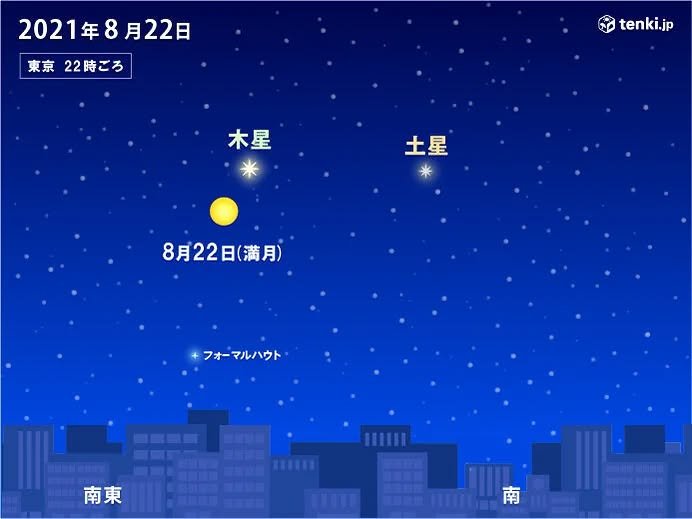
William. If you're an amature astronomist (I'm professional about being amature about everything), now is a good time to gaze at the sky. This is what you will see. 木星 (mokuse) is Jupiter, and 土星 (dose) is Saturn. "Fomalhaut" is something I'd never heard of; apparently, it's one of the brightest stars.
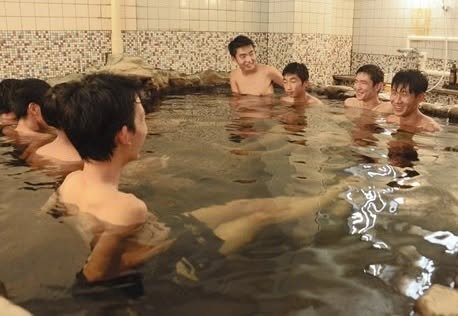
William. When I first set foot on these shores, my residence did not have a bath, so I took my bicycle down the hill to the onsen. Returning was uphill, but at least I was warm. The number of onsen has fallen dramatically as at-home baths have proliferated. Visit one while you can.
https://kumanichi.com/articles/363945Wi
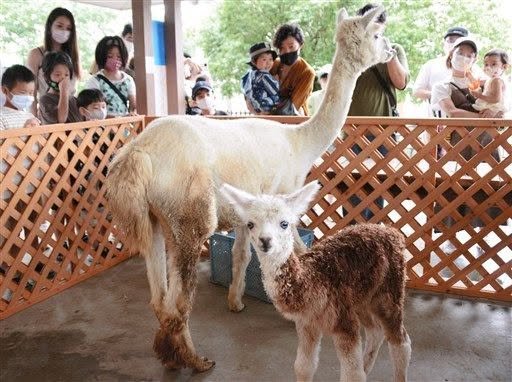
William. An animal reserve called "Cuddly Dominium" actually exists in Aso. They had a llama until a few days ago; now, they have two (or, I suppose, three? Dad)? If you'd like to see a lamette, head on out. https://kumanichi.com/articles/363955
Both of my kids chose the convenient time of 1:30 AM to be born, so I wasn't doing anything except sleeping and suddenly driving. But it was a one-way drive, really quick, and even the doctors were surprised at how fast things came out. However, things seem to have become more complicated. If you're pregnant, behold the labyrinth.
妊婦「ひとごとじゃない」 千葉のコロナ感染者、早産で新生児死亡 熊本県「優先の病床確保」 | 熊本日日新聞社
千葉県柏市で新型コロナウイルスに感染した妊婦の搬送先が見つからず、早産した赤ちゃんが死亡する事案が発生した。熊本県内でも妊婦の感染例が出てきており、心配する声が上がる。県は「妊婦優先の病床を確保する...

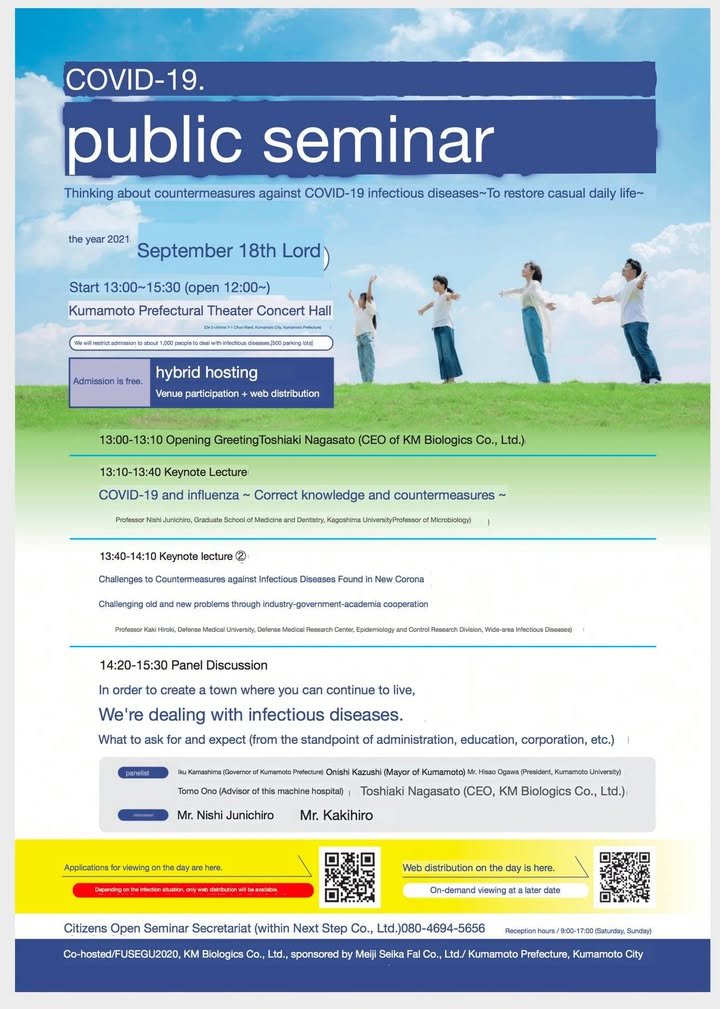
Carlton. For what it's worth, LINE yesterday sent out a notice of a public seminar for Kumamoto city residents to be held on September 18 afternoon at the Kumamoto Prefectural Theater about 'Countermeasures Against Covid-19'.
The poster below is originally in Japanese and I ran it through a translator program and add it here for those who might be interested. This event will be entirely in Japanese I'm sure with no English translation.
I welcome comments about this. I'm not sure how worthwhile it will be and, under present 'quasi state of emergency' protocols, if ultimately a gathering like this can be held.
William. Lotus root (renkon, 蓮根) is a Japanese delicacy, particularly when it's spiced with a piquant mustard-type filling, when it's then called "karashirenkon" (辛子蓮根).. Some 90% of Japanese renkon are grown in Kumamoto due to the fortuitous combination of flat land and abundant water. Ironically, the abundance of water has proven too abundant this year, and renkon farmers are worried that they will not be able to get their crop in. There is a shop on the Kokai shopping street that specializes in renkon which I highly recommend. https://kumanichi.com/articles/361408
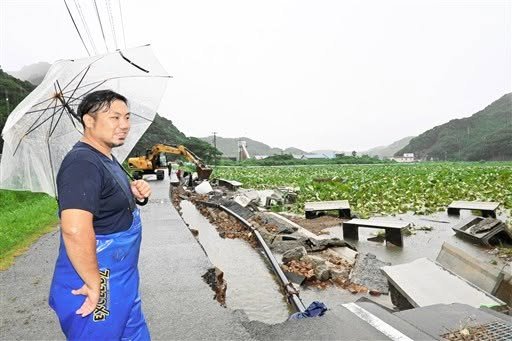
Kirk here with more about COVID-19. Today there were 318 new cases in Kumamoto. This is a new record and part of the national trend. You can check the local statistics on the following page:
https://www.pref.kumamoto.jp/soshiki/30/92000.html?fbclid=IwAR3y0LmXBUUb-7ZlQxagqiL_saAjEJU4-MYAB5L7YnsF2hM56vvPBe-XHAc
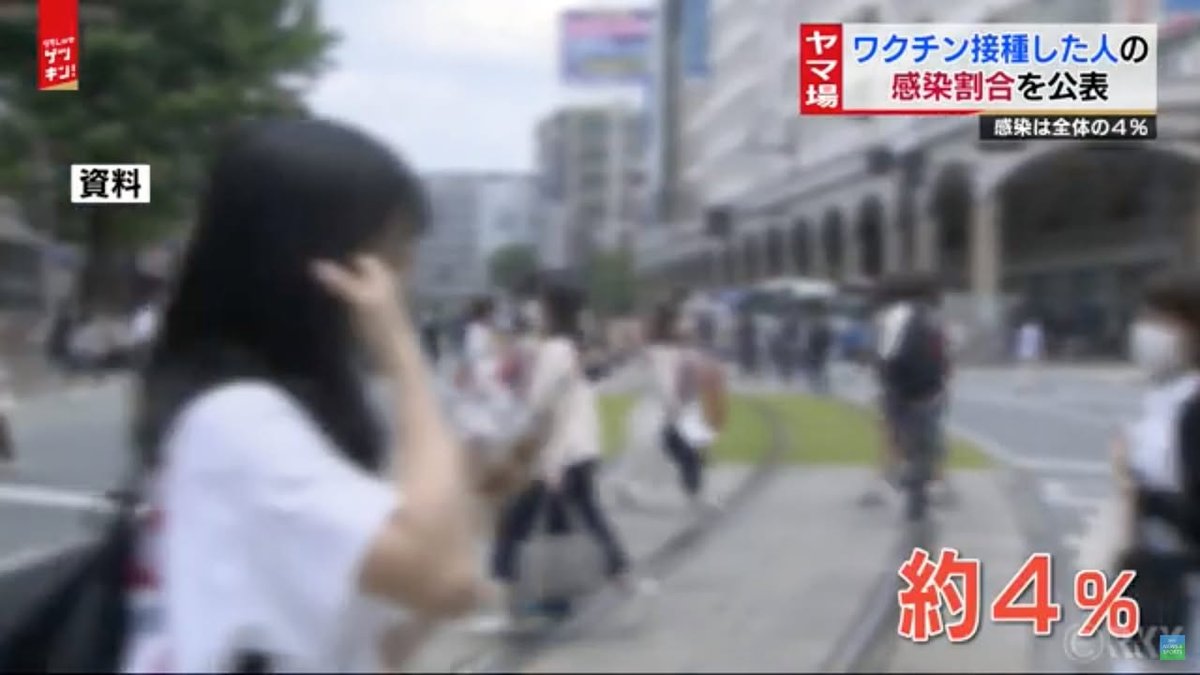
RKK reported on a press conference held by Vice Governor Kimura in which he stressed that the vaccines are effective and that people who haven't been vaccinated yet should get vaccinated as soon as possible. He said that of the 2217 cases of the last 15 day, 90 were so-called breakthrough cases -- cases in which the person who got sick had already gotten both shots more than two weeks ago. The point is that that's only 4% of the total, even though a big chunk of the population has already been vaccinated. So, if more people get vaccinated the over-all numbers should decline.
https://rkk.jp/news/index.php?id=NS003202108201735590111
By the way, one piece of disinformation in the poster that Ruth shared with us (Thanks Ruth! It's good to know what's happening, even when it's crazy), is that COVID-19 is "just a cold." Well, today a 50-something man died at home from his "cold" here in Kumamoto today. Doctors wanted to hospitalize him but he refused because he didn't have someone to take care of his cat. :( This was also reported on the RKK evening news show.
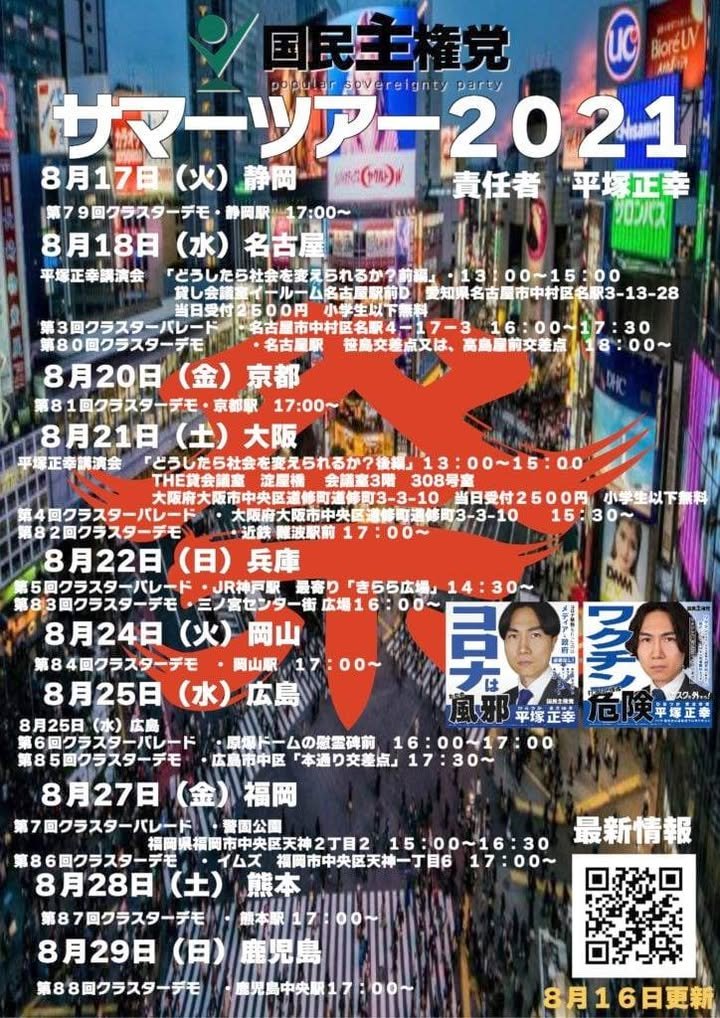
Ruth here! Don't get caught up in the 'cluster parade' at Kumamoto Eki next Saturday, 28th August from 5pm 🔊
Nationwide anti-m*sk demos and parades to avoid this week and next!! You may want to avoid being at the locations mentioned in the poster/link both this and next week as there are anti-m*sk protests scheduled over Japan!! **Tokyo Eki from 5pm today!
Fukuoka - 27th August ・8月27日(金)福岡
第6回クラスターパレード・警固公園 福岡県福岡市中央区天神2丁目2 15:00〜16:30
第86回クラスターデモ・ イムズ 福岡市中央区天神一丁目6 17:00~
Kumamoto - 28th August・8月28日(土) 熊本
第87回クラスターデモ・ 熊本駅 17:00~
Kagoshima - 29th August・8月29日(日)鹿児島
第88回クラスターデモ・鹿児島中央駅 17:00~
Don't get caught up in a “cluster parade”. Check the link for places to avoid if you don’t want to inadvertently become a part of a super spreader.
https://kokuminsyuken.jp/news/8609/?fbclid=IwAR2d-os2GS1HeP5ENOoAk3ht2HZp0xo3dQ7tjUcJtQ4F6YxUDESHbxM3cLAFYI
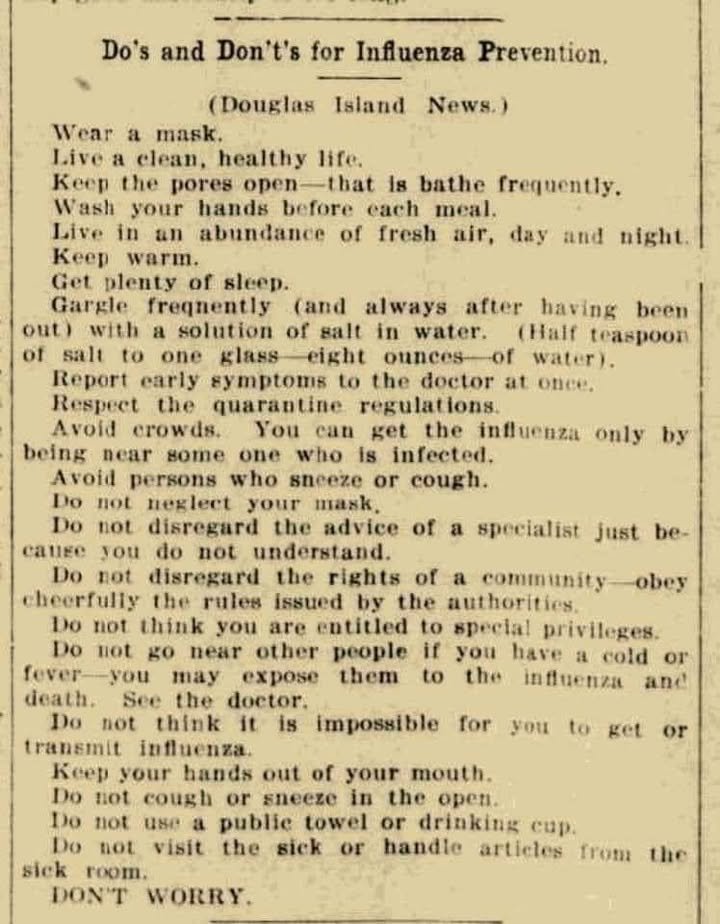
Kirk here was some very old news that seems like it might have been written this year. I can no longer remember where I first saw it but, according to the following site, it was published in the Douglas Island News (Alaska) in 1918:
https://www.snopes.com/fact-check/flu-prevention-1918/
Of course, this isn't specific to Kumamoto but it's certainly as relevant here as anywhere else. (Some items may sound a bit dated but I think most are still spot on.)
It's often said that if you aren't part of the solution you're part of the problem. With COVID-19, I think that statement can be reversed. If you can avoid becoming part of the problem (that is, getting sick or giving the virus to someone else), you're part of the solution. Let's all be part of the solution!
P.S. Apologies to those of you who have already seen this many times on social media.
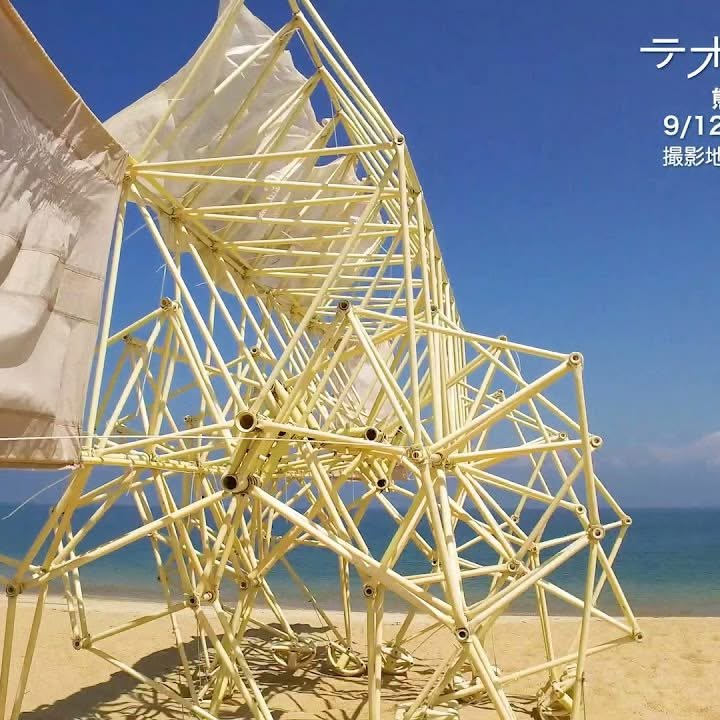
Kirk here with a share from Kuma Visit. I would agree that this is a must-see video. Please do take a look. The fascinating wind-powered contraption is "walking" in Kumamoto. You can see Fugendake (Shimabara) on the other side of the water. And, of course, this is associated with an exhibition and the Contemporary Art Museum, Kumamoto that is still in progress.
https://www.facebook.com/kumavisit/posts/2927862740798686
テオ・ヤンセン展会期:2021年7月3日(土)〜9月12日(日)会場:熊本市現代美術館詳細:https://www.camk.jp/exhibition/theojansen/ロケ地:長部田海床路、天草四郎ヶ浜ビーチ、御輿来海岸(全て熊本県内)製作著作:KKT熊本県民テレ...
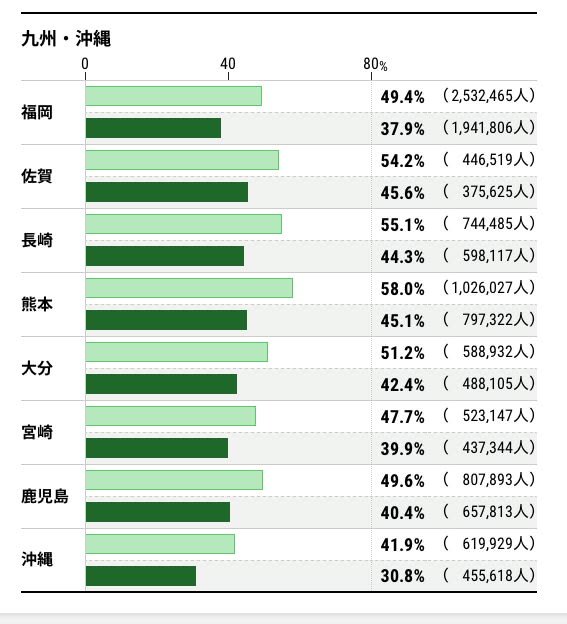
Kirk here with information about Kumamoto's vaccination rates, prospects for getting vaccinated in the near future, and recent COVID-19 infections.
First, in regard to recent infections, rates remain high. Yesterday was 267, just under the high of 271. Source:
https://www.pref.kumamoto.jp/soshiki/30/92000.html?fbclid=IwAR3pM0vWNk_sUtIqdrHATxVjQEUFUyiq927rp2vngsNIi3O1hvihXtvIYoU
On a more positive note, however, vaccination rates in Kumamoto have improved significantly. The percentage of the population that have gotten at least their first shot is 58%. If I'm not mistaken, this would be the 2nd highest in the country after Yamaguchi prefecture, which is 60%. Source:
https://vdata.nikkei.com/newsgraphics/coronavirus-japan-vaccine-status/
This percentage differs slightly from the percentage reported on the prefecture's page, which is 64.81% for having at least the first shot. I think the reason is that the prefecture is presenting the percentage of people who are eligible to receive the vaccine. Children under 12 can't get it so removing them from the statistics raises the percentage. Source:
https://www.pref.kumamoto.jp/soshiki/45/102050.html?fbclid=IwAR2arYQ3arrFM3LZJwHXqM9RDqMuVz5P5rZb44mo2sDYsQFYcJqhMicKNRw
The following news report said that the government's position used to be that areas where vaccination rates were high would get more vaccine (to keep the flow going, I guess) but that that policy has been reversed. Now, areas like Kumamoto will get much less vaccine so that areas with lower vaccination rates (and rising COVID-19 rates) can get more. That has led to what the article calls "vaccine refugees" -- people who got the first shot but who are now "stranded" waiting for a second shot that's no where in sight. Source:
https://news.yahoo.co.jp/articles/76a075aee7c61e78b5e90824cc1fb9ad220364af
If you haven't been vaccinated at all yet, I'm not sure but I think the next round will start in October, at least that's what I remember hearing on the news.
Update: See Megan Pavlak's comment below. She has a good information about upcoming vaccination opportunities.
Thanks to Claire Sezaki for pointing me to the prefecture's pages I cited today. :)
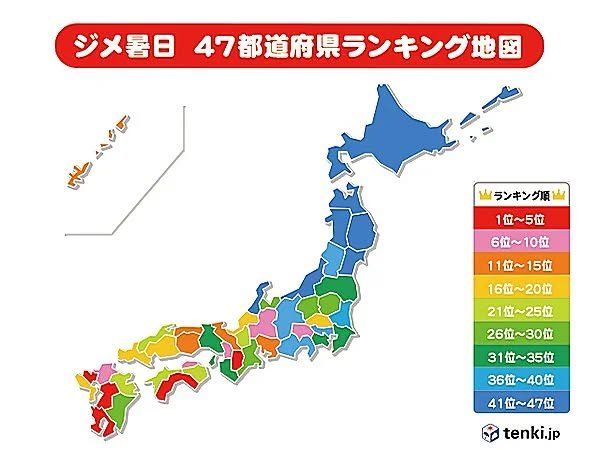
William. If you think it's humid out there, you're right! Checking out the stats, it turns out the Kumamoto ranks as the #1 most humid prefecture in all of Japan. So we've got that going for us.
At the first link is a list of ways to deal with hot and humid weather. Most are, like, "Duh!", but a few are useful. Good luck, everyone!
https://www.wikihow.com/Deal-with-Hot-and-Humid-Weather
https://tenki.jp/suppl/yasukogoto/2015/08/06/5731.html
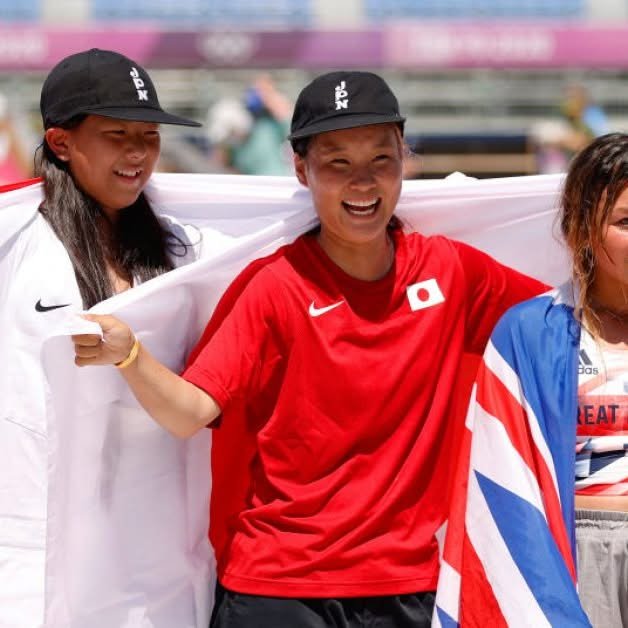
Kirk here. Japan set a new record today for new COVID-19 cases and Kumamoto had almost as many new cases today as yesterday. It's not raining here in Kumamoto City as I write this but warnings are still in effect. Nonetheless, this time I'd like to set rain and COVID-19 aside and write about a different topic: skateboarding. This post doesn't have a Kumamoto connection but it has a clear Kyushu connection as gold medalist Sky Brown was born in Miyazaki.
The Time Magazine article acknowledges Sky Brown's connection to Japan as follows: "Sky Brown, the 13-year-old phenom who skates for the U.K. but was born in Japan, won bronze." Moreover, the second article I'm citing in this post explains that she "still lives in Miyazaki, but spends half of the year in California, United States, hence the American accent."
I was interested and, frankly, disappointed when NHK celebrated the gold and silver medals of Sakura Yosozumi and Kokona Hiraki but didn't even mention that the bronze medalist in the same event had roots in Japan . . . and Japanese citizenship no less (source: Japanese Wikipedia page on her says she has dual citizenship). It's completely true that Sky was skating for Great Britain but I thought the Japanese side of her identity might at least be mentioned. Even for nationalistic NHK, I thought it would be kind of cool to point out that all of the medalists in this event had a connection to Japan.
Those of you, like me, with children of mixed heritage may share my frustration with this sort of all-or-nothing approach to identity. Naomi Osaka is given attention because she's playing for Japan (and, of course, she's great!) but Sky Brown is treated by some media as though she has no connection to Japan whatsoever because she wound up skating for Great Britain. :(
On a more positive note, I read in an article in the Asahi Shimbun that the other Japanese skaters encouraged her and celebrated with her when she did well. The younger generation gives me hope. :)
For an explanation of why Sky competed for Team GB, see the second article.
https://time.com/6087258/womens-park-skateboarding-japan-olympics/
https://www.hitc.com/en-gb/2021/08/04/is-sky-brown-british/
Japanese Skaters Are Now 3-for-3 in the Olympics, Proving Japan Is the Top Skateboarding Nation in the World
Of the nine medals in skateboarding awarded at the Tokyo Summer Olympics so far, five have gone to Japan.
Carlton here..A while back the subject of mandatory bicycle insurance in Kumamoto starting October 1 was raised. I just checked and discovered that my automobile insurance does NOT cover me for 2 wheeled transportation.
So I contacted an ardent cyclist friend of mine in Tokyo and he sent me the following links re: bike insurance to help in searching for and choosing a policy.
I hope these will be of assistance to others like me now in need:
https://tokyocycle.com/threads/accidents-insurance.831/
https://tokyocycle.com/threads/educate-me-on-bicycle-insurance.8208/
https://tokyocycle.com/threads/its-time-again-for-bike-insurance.8592/
https://tokyocycle.com/threads/personal-liability-insurance.8806/
Personal liability insurance
In Gunma from April personal liability insurance for all cyclists is being made compulsory. Firstly, how ‘compulsory’ is compulsory here and where to purchase such insurance whilst getting a good deal? Thanks for any input

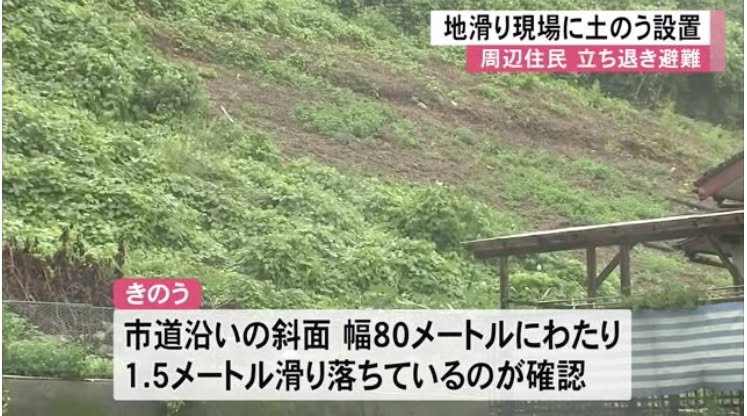
Kirk here. This about a jirsuberi (地滑り; "landslide") in Amakusa. In this case an area about 80 meters wide has slid about 1.5 meters down the hill. Of course, they are worried that this is just the beginning of a more serious event. Still, I thought it was interesting because I hadn't heard of an event quite like this. When I think of "landslide" I think of a more catastrophic event. This is a bit more of a "land sag." Hope it doesn't get worse.
https://www.tku.co.jp/news/?news_id=20210818-00000001