First of all, if you live in the Ushibuka area and are anywhere near a steep incline, don't take the time to read this post -- just move to an area where you are safe from mudslides.
The rest of this message is for people who have more time to think about disaster prevention and problems with how Japan and Kumamoto prefecture disseminate disaster information.
I just posted about a Japanese-language notice I received:
https://www.facebook.com/Kumamotoi/posts/667477256659043
This prompted me to go to the following page
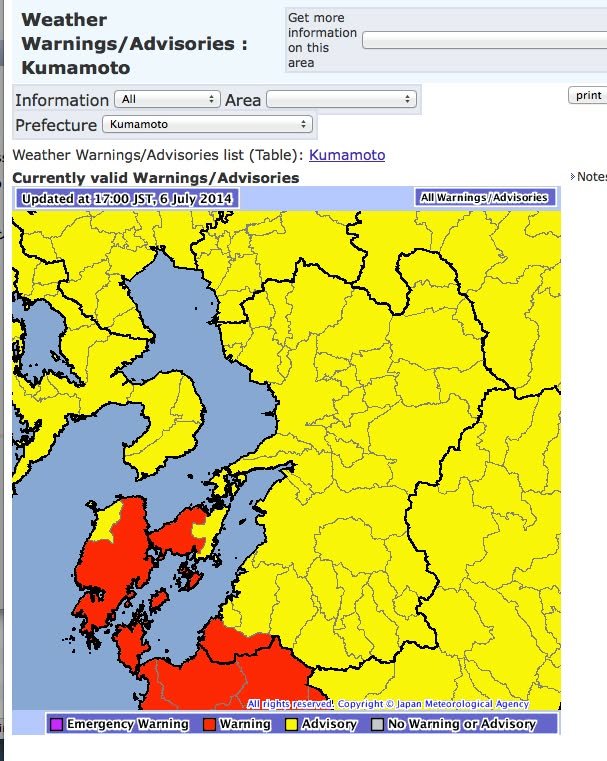
http://www.jma.go.jp/en/warn/349.html
where the map you see with yellow and red can be found. The red indicates that warnings have been issued for those areas. Unfortunately, there are no details as to what kinds of warnings have been issued and what one should do and clicking on the red areas doesn't work.
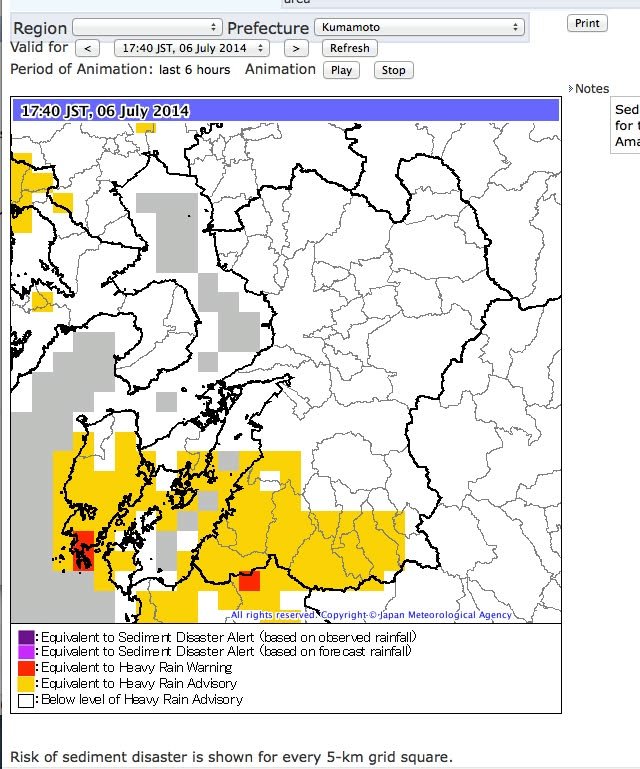
The map with mostly white ares and a few yellow and red can be found at
http://www.jma.go.jp/en/doshamesh/349.html?areaCode=349
It indicates the risk of "sediment disaster." Ushibuka is shown in red which is defined as "Equivalent to Heavy Rain Warning." How is one supposed to know that "Equivalent to Heavy Rain Warning" means "move to an area where you are safe from landslides"?
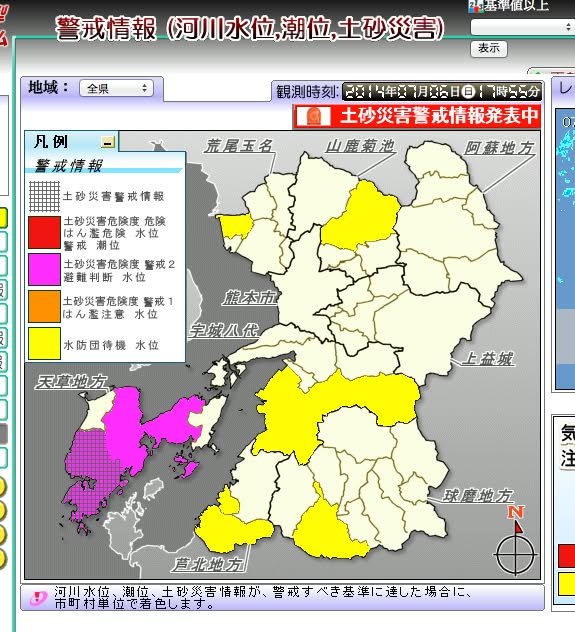
The Japanese map (which includes the purple areas) is better in that it shows the area in which people should consider evacuating (it's the part of the purple area that looks likes it's covered with chicken-wire fencing).
http://www.bousai.pref.kumamoto.jp/GmnDsp.exe?M100A0S0N1P0
One problem is that the overlap between the chicken-wire pattern and the colors is confusing. Also, you can click to find definitions of terms but in many cases what you should do is still unclear.
Thus, disaster information is not only insufficient and confusing in English; Kumamoto Prefecture also needs to improve in how it puts out information in Japanese. In sum, here are four problems:
1. Emergency e-mail messaging is only done in Japanese. If the system were automated properly, evacuation notices could be generated instantaneously and sent to people in the language of their choice. This would involve some preparation, but, when a disaster struck, English, Korean, and Chinese messages would be generated as quickly as messages in Japanese.
2. Web information is not coordinated with e-mail warnings.
3. In both Japanese and English, web pages use words like "warning" without adequately explaining the action that affected persons should be taking.
4. Social media (at least as far as I know) is not being utilized. Social media has the advantage of being a "push" media (new messages are included in news feeds) so, like e-mail, social media posts are more likely to reach people who are not yet aware that there is a danger.