One reader (who shall remain nameless because the message came to me privately) opined thusly:
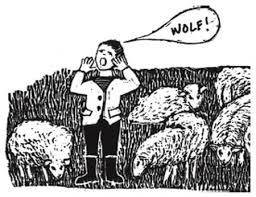
"news from your page are flooding my newsfeed with the Taifoon information. Please remember The Boy Who Cried Wolf story. "
It turns out that the reader didn't intend to imply that I was exaggerating or distorting the information that I was introducing. Still, I didn't appreciate the reference to "crying wolf" because, in the story, the problem was NOT that the boy delivered too many factual reports about actual wolf sightings and argued too often that precautions should be taken. The problem was that the boy lied and claimed that there was a wolf nearby when there wasn't. An important difference, I think.
Nonetheless, the reader was probably not alone in thinking that I posted too often. Perhaps so. But it's hard to know in advance exactly what information will be considered to be useful and what won't. As a matter of fact, a link to an article describing the evacuation of Amakusa earlier this week, something that I posted as an afterthought, not thinking that it was particularly useful, turned out to be the most popular post of the week; several people chose to forward it and it wound up getting over 3,000 views. Though I try to avoid posting junk, I think I'd rather follow a "when in doubt, share on the page" policy and let readers sort out what they do and do not find to be of interest.
Well, if I didn't "cry wolf" perhaps Japanese officials did. There were some comments about last night's evacuation notices being overreactions. Of course, in retrospect, the evacuations were not necessary. On the other hand, given the information available at the time, I think the officials probably made a good call for two reasons. 1. Storm systems are chaotic systems, which means that their course, where and how much water they dump, etc. cannot be predicted with complete accuracy. 2. I know that at least one of the areas that was evacuated, Hitoyoshi, is very flood-prone and has a history of serious (and deadly) floods. Heavy rain can produce very different results in different places.
By the way, one issue that got a good deal of coverage on TV was a premature rescinding of a warning in Okinawa. As I recall from what I saw on TV, the storm system seemed to have passed but after meteorologists rescinded a warning a very narrow band of intense rain appeared over a populated area. I think the point is that when you are dealing with the weather, prediction is a very difficult business. Personally, I would rather that pubic officials err on the side of caution.
I learned a few other lessons in the process of trying to maintain the page this week but I think I'll stop writing for now. Have a nice weekend, everyone!