From the Kumamoto International Desk of Obscure Town Names: Uneno (畝野)*. Let's get back to this in a minute.
Long ago, travel across Kyushu was hindered by rivers which blocked the most convenient valley routes. Today, driving up Rt. 218 as it traipses between ranges before suddenly diving into a valley, you'll come across two parallel bridges crossing Midorikawa, one built rather recently and the other in the mid-1800s called Reidaikyo (霊台橋). Stop your car, get out, and look.
Though the route had been used since time immemorial, the lack of a bridge left crossing to forders and ferries in a narrow cleft on a river with thousands of upstream tributaries. Result = not good, survival-wise; the water could rise meters in seconds even when local conditions were fine. A sequence of smaller wooden bridges having been sequentially washed away, when the government in 1846 proposed a really big bridge made of stone, local enthusiasm was so great that an eventual 44,000 local citizens joined the 72 government masons sent, and the single-arched stone bridge was completed in one year, far earlier than planned. Thus the name etymology: Ancient Chinese texts regarding Confucian morals denote spontaneous acts of labor in support of public gain as 霊台建造 (which could be translated as "spirit-based construction"). So the name is kinda cool if you think about it.
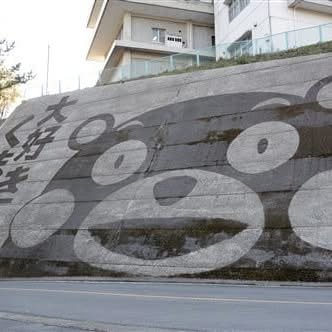
Anyway, crossing whichever bridge will bring you to an extremely steep incline which will not end until you reach the far-away Yabe basin, and to your right, you'll see a large dam which has somewhat tamed the river. This area is a town called Uneno (畝野), which literally means "furrow fields" as the steep slopes only allowed contour farming. The area has degraded to mostly cedar plantation today (though its stone terraces remain), but the dam is still under charge of Uneno, and to beautify its concrete walls after a recent cleaning, they opted to paint a large Kumamon panoramic.
A lot of news about a very small area, but this is, after all, what comprises Kumamoto. - William
*Disclaimer: My father-in-law was from Tomochi, just uphill from Uneno.