That Japan history seems to be a carousel of familiar names is not surprising if one considers 98% of society was peasant, bereft even of family monikers. The Hosokawa clan, a branch of the history-altering Minamoto clan through the Ashikaga clan, reached its pinnacle during the the Muromachi period (1336–1467), when it was one of three families occupying post of Kanrei (Shogun's deputy), due to its literary ability and willingness to play second-string to the more ambitious samurai. A succession struggle later almost spelled its doom, but it was saved by an ancillary branch before being plucked by Tokugawa Ieyasu to head Kumamoto in place of the less-trustworthy Kato clan.
A fascinating incident regarding the clan occurred towards the end of the Sengoku period (1467–1600 - ironically, a period the Hosokawa were partially responsible for triggering - see the Onin War). As the Hosokawa were clawing their way back to power and Oda Nobunaga was on the cusp of reuniting Japan after a century of warfare, the daimyo and Oda's erstwhile ally, Akechi Mitsuhide, burned down a Kyoto pavilion with Oda in it. This didn't go over well for any involved, and it was "Get thee to a (Buddhist) nunnery!" for Akechi's daughter, Hosokawa Tama (細川玉). Her family name is due to the fact that she'd married the contemporary head of the Hosokawa clan, Tadaoki. Apparently, the two were genuinely in love and he was concerned over her safety due to the acts of her father. During her two years in exile, she became interested in spiritual stuff, and when she was finally permitted to return to Osaka, she became one of the most famous Catholic converts in Japanese history, adopting the name Gracia. Sadly, this did little to improve her fate: While her husband was off fighting, the warlord and rival to Tokugawa Ieyasu, Ishida Mitsunari, tried to take her hostage, so she committed suicide at the age of 27 in August, 1600. She and Tadaoki had had six children together.
The Hosokawa clan never forgot about this, and when the ultimately-victorious Ieyasu transferred the Kumamoto fife to them from the Kato clan, Gracia was disinterred and reburied at the former Hosokawa family temple on Tatsudayama. Next to her tomb is a stone basin into which she is said to have gazed while composing her death poem.
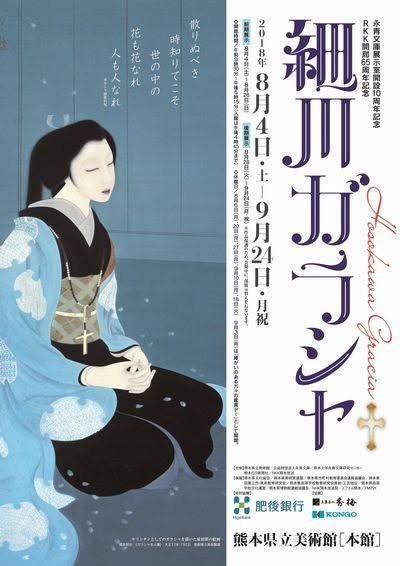
The Kumamoto Museum of Art is currently holding an exhibition of Gracia's artifacts. Information can be found at the link. - William
Addendum: I should have added her death poem to the above post - It's probably the most famous death poem in Japanese history and is written on the poster. Here it is, and my (probably totally lame) translation: 「散りぬべき 時知りてこそ 世の中の 花は花なれ 人は人なれ」- "It is that we are aware of time we are scattered, those in this world, flowers as flowers, humans as humans." She likely was not particularly enamored of humans at the moment.
http://www.museum.pref.kumamoto.jp/event_cal/pub/detail.aspx?c_id=10&id=131&trk_kbn=A