Editor's note: Our friend Jordan Tanaka had written an engaging reaction to the recent post on Minamata Byo, and, encouraged to expand on it, provided us with this beautiful piece. I urge all to read it. Thank you, Jordan-san. - William
(main post)
Self-intro: I’ve lived in Minamata for the past 11 years. My husband and I met when he said he wanted to study English... 11 years and 4 kids later, he still can’t speak English.
I`ve had the chance to talk to several people, my in laws and neighbors included, who remember being told about that time and many who lived through it. The area right outside my house used to be a large marina and beach, where big ships would port on one end, and on the other where kids could swim. One day, as they recall, the water turned this strange but pretty color. They all wanted to swim in it. But since so many people were getting sick the swimming areas were soon closed off. That area is now covered over with rocks and dirt, with old apartments and empty parking lots on top. The main area that was poisoned was covered over and turned into a park, the Eco Park. There are memorials and a museum dedicated to those who died and to telling the stories about Minamata disease. I really recommend the trip down to Minamata to go through the museum and walk along the seaside path towards the large bell memorial.
My husband is a care worker at Meisuien, a hospital/care center/old folks home all rolled in to one. It’s where those affected by Minamata disease were placed for most of their lives. One gentleman, Onitsuka Yuji, who had his photograph taken by Mr. Smith, the photographer mentioned earlier, has stayed in Meisuien since that time. My husband spoke with him this morning and Onitsuka-san said that while he hadn’t heard that they were making it into a movie, he’s glad to hear that their stories will be told. He also said he remembers Mr. Smith and his wife, and that they were very nice.
The following is about Ueno Eiko-san.
After getting married, she and her husband tried for three years to get pregnant. They were both so excited when it finally happened, after all that time spent dreaming together of their future family. They did the best they could with what they had, but unfortunately ate much of the infected fish that was so easily found. Of course, at the time, no one knew there was anything wrong with the fish, only the cats, birds, and other animals around seemed to be going crazy.
One night, her husband suddenly fell ill. He was in great pain, writhing about on the floor, muscles contracting and spasms going throughout his whole body. 13 says later, in a final painful fit, he repeatedly hit the walls of their home so violently that his hands were covered in blood. He then collapsed on the floor, dead. Six days later, their beautiful baby girl was born, Ueno Ryoko-san. As the days went by, Eiko-san noticed something wasn’t right with her daughter. Her leg and arm muscles remained straight, she couldn’t see, she couldn’t hear, she couldn’t talk, she couldn’t even lift her head. Eiko-san took Ryoko-san to see the doctor as soon as she could. The doctor dismissed the child easily, saying it was clearly a case of infantile paralysis. Afterwards, upon arriving home at her mother`s house, her mother refused to let her in, saying there was something wrong with that child, and that they were no longer welcome there. Eiko-san then moved into a hut, and again, did the very best she could to take care of her baby girl. But soon, people around them started to gossip. Whispers of what she must have done to cause her husband to die and her daughter to be so cursed soon grew louder. Cashiers began to refuse to take her money for fear of catching the disease that her daughter had.
By and by the effects of the disease had taken its toll on little Ryoko-san, and she passed away. At the time, this was the very first child born with this disease. No one had seen anything like it. But soon, others began to fall ill and die. Other children were brought into this world with their precious little bodies as full of the poison as little Ryoko-san was. The doctor who had seen Ryoko-san pass, wanted claim on her body. He pressured Eiko-san to give her daughter`s body to him, so that he could find out what the problem really was. She finally relented. But later, she went back to the hospital to ask for her daughter back and walked in on a horror scene: her sweet little two year old girl, on top of a cutting board, in pieces. Her eyes were taken out and placed on the counter. Her limbs in pieces. She screamed, これ何ですか先生!and then while gathering up her daughter as best she could in her arms, cried, my daughter was a person... you are not!! She carefully carried her daughter on her back and tried to make her way home but was later overtaken. Word soon spread about what she had done, and she was labeled as the crazy woman. Later, she said she would always remember how much lighter her daughter was that day, and even now, just thinking about it brings immediate tears. She said that she wonders if people really understand the true horror of that time, if people could even begin to understand the heavy grief of losing your husband and only child in that way.
They recently found something she wrote over 50 years ago. A letter telling about how she felt after discovering that the company Chisso had been dumping chemicals into the ocean. Eiki-san was furious. Overwhelmed with a desire to get revenge for her husband, (at the time, she still believed that her daughter had died from infantile paralysis) she fought for the truth. She swore she would always tell others about it, so we could all learn and make sure it never happened again. Though the local doctors called it the strange disease it was later named Minamata disease. In her letter it says that now she understood that both her husband and her daughter were murdered by Chisso. But even though she found out and was able to prove that it was Chisso, she said it never brought her peace because her family was gone, so her heart would never heal.
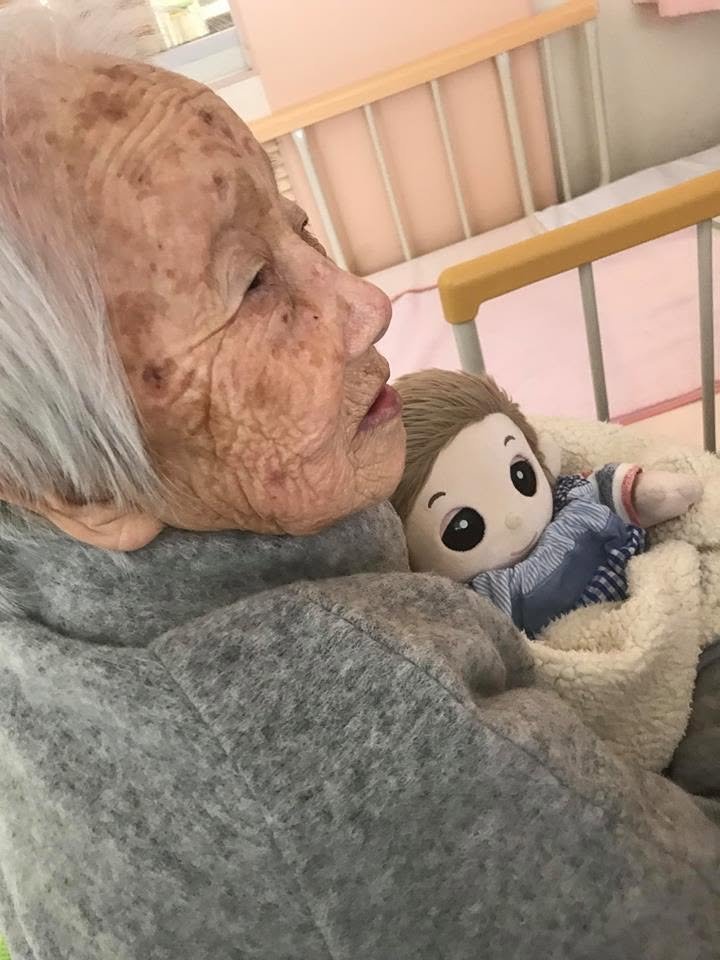
Now, she is a baachan at Meisuien. She saw another baachan with a doll and was quickly drawn to it. She was then given a similar one by a nurse, and has since not left it’s side. She brings it everywhere with her, sits it up and has conversations with it, has made a makeshift bed next to hers, sings it lullabies while rubbing the dolls back. When other baachans comment on how cute it is, Eiko-san will pat the dolls head and say, よかったね!She refuses any nurse that tries to take it away.
Since her daughter and husband died, she spent her whole life fighting for their story to be heard. Fighting for what Chisso did, lied about and then tried to cover up, to be brought to light. I really recommend a trip to the Minamata disease museum for those who are interested. Here is their site in English: http://www.minamata195651.jp/list_en.html
If driving, follow san go sen all the way down until you come to the end of Minamata, Hirai bento on the left, Minamata Eco Park on the right. Turn right and follow the signs. Walking from the train station will take maybe 20-30 minutes.
Below is a photograph of Eiko-san.