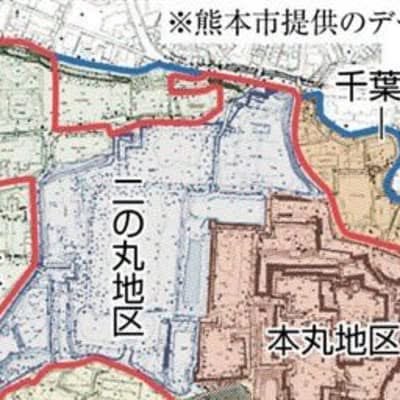
Important to understand Kumamoto Castle is its evolution. When Kato Kiomasa was gifted the fief, a castle already existed called Chiba-Jo. This was a much smaller fortification built during the Onin Era (a decade of violence from around 1467 to 1477, when two claiments for emperor ripped the country apart). At that time, the center of power was in Kikuchi, and the Kikuchi clan ordered that a fortificaton be built to protect Fujisaki Shrine, which was then where the baseball stadium is currently located. Kato built on this to create what we consider the castle today.
During the Seinan War, the area of the Chiba Castle began to be used for administrative purposes; it was later handed off for facilities of NHK and JT (Japan Tabacco). However, as Kumanichi points out, only 56 of the casle's maximum extant of 98 hectares are recognized. As these companies have vacated their premises,Kumamoto is intent on restoring this ancient section of the castle. The first step is to obtain reckognition of national historic significance; the second is to obtain funding from the central government for restoration.
I often jog around the more far-flung edges of the castle and enjoy their primitive state and quietness. Both my children were born on rainy spring mornings alongside ancient castle walls which remain unprotected. The maximum extent of the castle, indicated by blue lines and including Chiba Jo, can be seen at the link. This project, though quite long-term, is of great historical importance. - William