South-eastern Kyushu was a convenient place for Europeans to surreptitously slip into Japan at a time when entering in an obvious manner would ensure you'd never leave. The Amakusa archipelago was an obvious place for such landings, and in the mid-16th century, a Portuguese doctor by the name of Luís de Almeida arrived to bring what what was then modern medicine and along with it Christianity. One might imagine how the locals conflated the scientific method and this new religion.
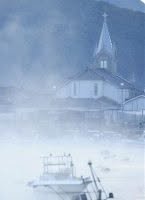
Time went on, and the Christians were driven underground in the mid 17th c., and then they were allowed to practice openly again in from 1873, and the locals immediately erected a small church which was later enlarged with the help of some French guys in 1880 to become the present Sakitsu Church (崎津教会). The area surrounding the church is called the Sakitsu Shuraku (﨑津集落), which in its entirety is a World Heritage Site. "Shuraku" is an interesting term as it is similar to "village"(村) but might be better translated as "commune." Most locals' ancestry traces back to time immemorial, and they tend not to be shy in sharing this.
Kumanichi reports that the commune received their first snowfall of the season today. The article also reports that the weather is cold, a fact I can judge by how far out of the futon my dog thrusts his nose. I would recommend waiting til spring for a visit - but visit you must. - William