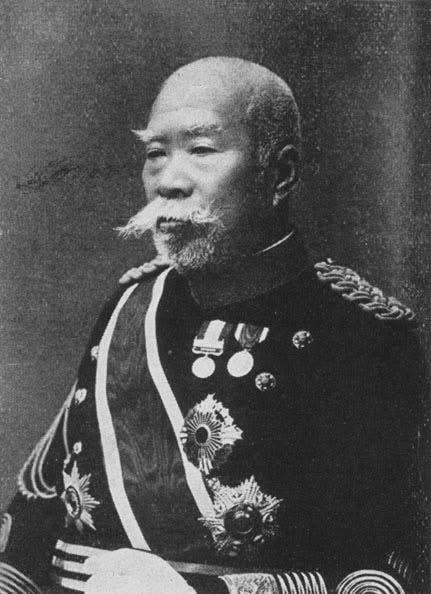
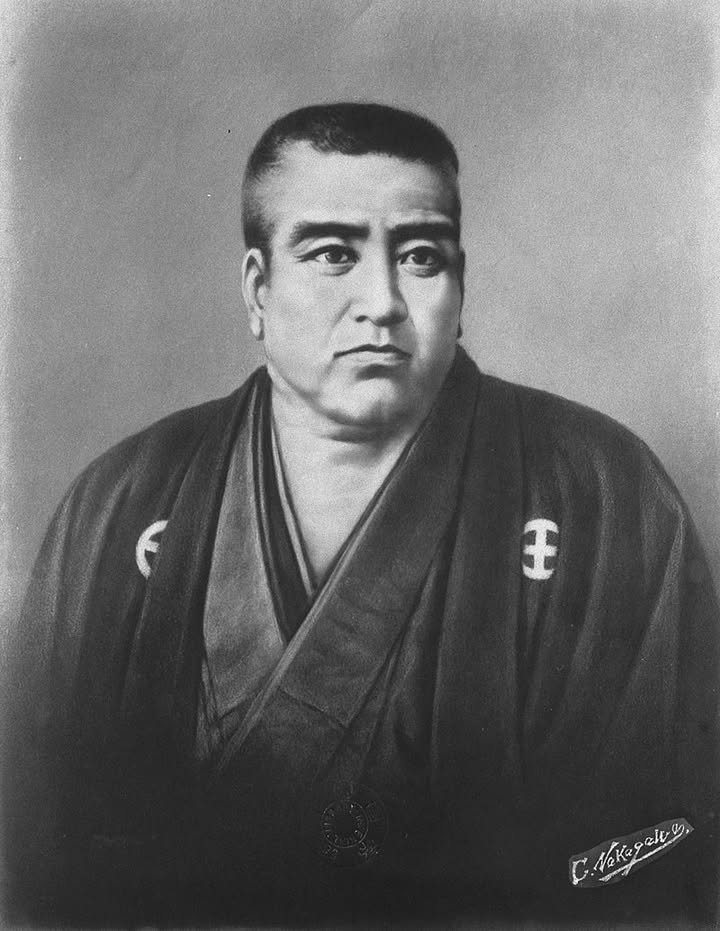
Tani Tateki (谷干城, 1837-1911) was born a samurai in Tosa (now Kochi). Saigo Takamori (西郷 隆盛, 1828-1877) was also born a samurai in Satsuma (now Kagoshima). Those two domains were instrumental in overthrowing the shogunate to establish Meiji rule, and as such, they cooperated in their early days. Their paths later split over the course of modernization: Tani was more intent on industrialization, while Saigo distrusted the West and urged military conquest of Korea. The two eventually clashed in 1877 during the Seinan War in Kumamoto, Saigo heading his Satsuma army north and Taki commander of Meiji forces rushed in from Tokyo. After a 52-day siege of the castle and a clash at Tabarazaka, Saigo's remaining forces retreated south, where they were all eventually cut down by Tani's forces. Saigo committed seppuku and his secondary beheaded him. The head was taken as a war prize but was eventually reunited with the body for internment, though doubt remains whether it was actually his head (heads being aplenty in those days). Tani, ironically, later led Japan's conquest of Taiwan and died of old age.
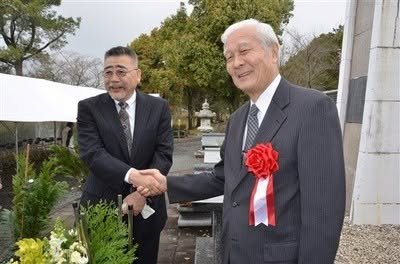
At an event in Tabaruzaka to commemorate the battle, Tani Tateki's great-grandson, Tani Tadaaki (75), and Saigo Takamori's great-great grandson, Saigo Takafumi (71), met for the first time, 142 years after the war's end. Tani was quoted: "He's physically imposing and shares features of Saigo Takamori," while Saigo said, "I felt a hint of sharpness behind his gentle expression." Both issued a statement: "That the peace we enjoy now is a result of the sacrifices of the youth of that time must never be forgotten."
That it has taken so long for the two families to have buried the hatchet illustrates how alive history is.
The first photo below is of the descendents; second, Tani Tateki; third, Saigo Takamori. - William