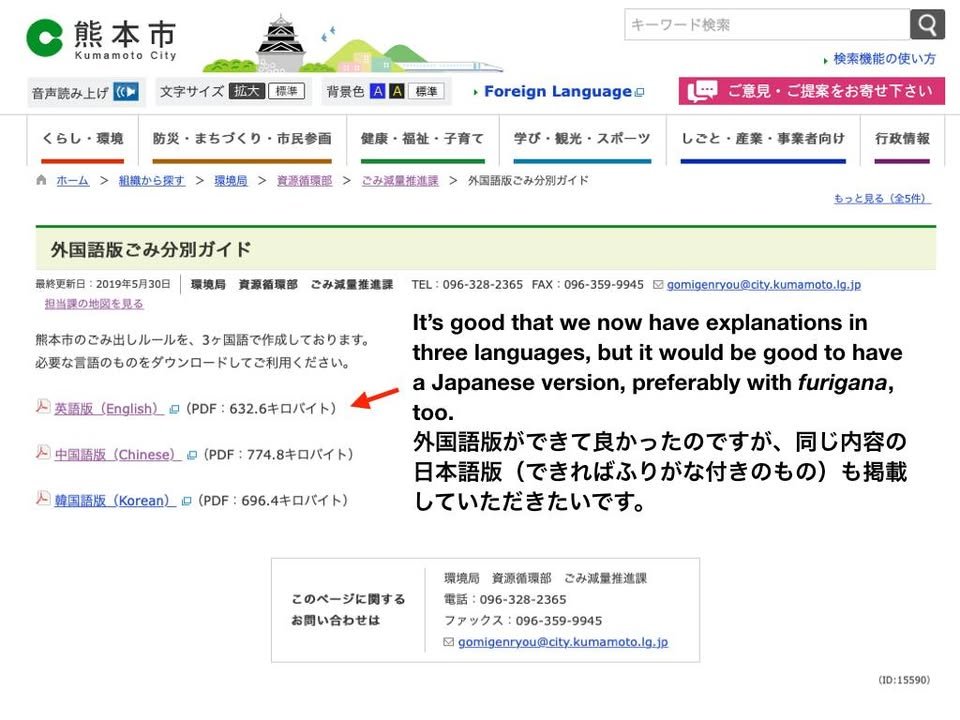
Kirk here. The other day, Atsuko posted an image of a pdf document that Kumamoto City has made to help non-Japanese residents understand how to dispose of trash properly. (Thanks again, Atsuko!)
https://www.facebook.com/Kumamotoi/posts/2839866092753471?__tn__=-R
I think the City's publication of this information in English, Chinese, and Korean is a very positive step forward. It would have been even better, however, if they had published a Japanese version, preferable a "simple" Japanese version (furigana added, simple phrases added to improve clarity for non-native readers, etc.), with the foreign-language versions. Here are some reasons why I think it's a good idea to publish Japanese versions with translations.
1. Makes it possible to check the original
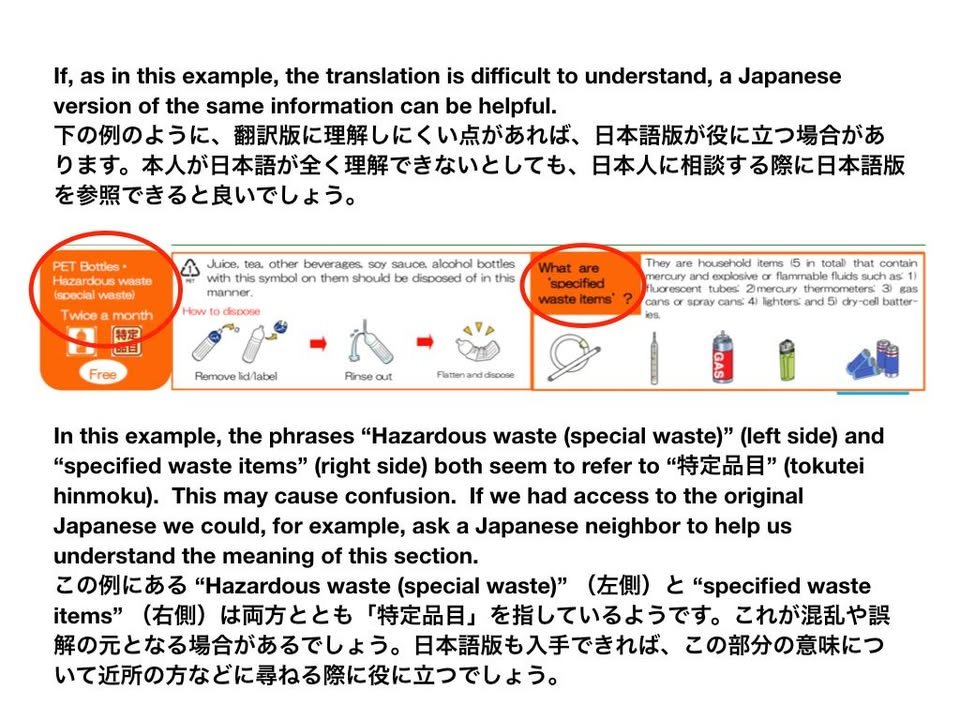
Even if one does one's best to produce a clear, readable translation that is faithful to the original, some things can be lost or garbled in the translation process. So, it's good to be able to check the original Japanese version when one has a question about the meaning of a term or phrase. Even if a foreign resident doesn't understand Japanese, it's nice to have a Japanese version to show to Japanese friends and family.
2. Facilitates communication with neighbors, etc.
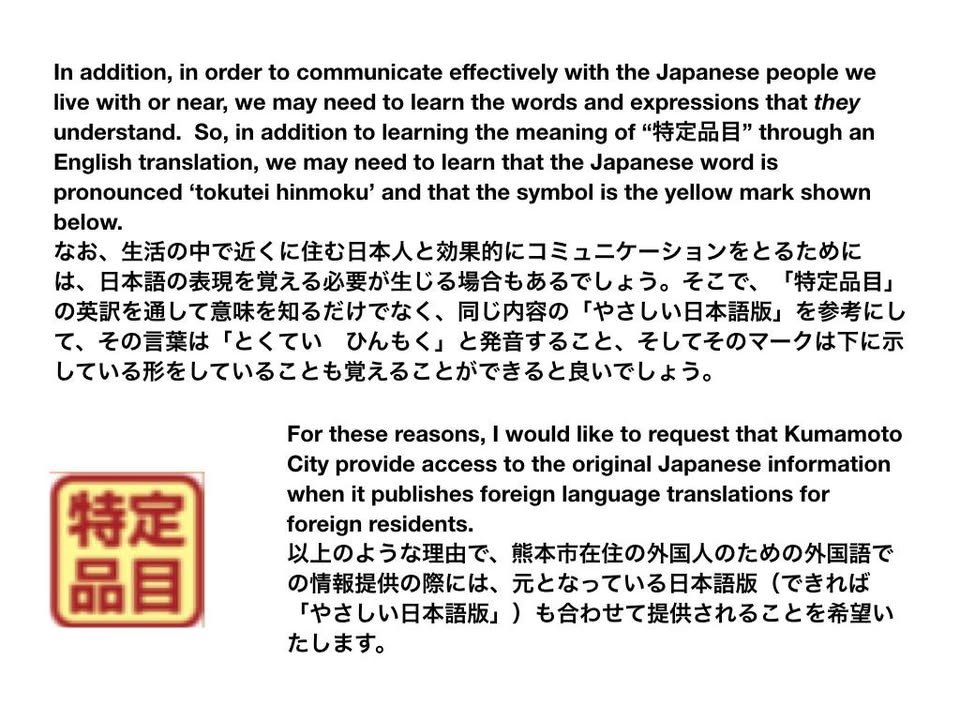
An English translation may be sufficient to help one understand the meaning of the original. If, however, one wishes to communicate with ordinary Japanese people about the same content it is usually necessary to know the Japanese terminology. Providing an English translation without the Japanese original can leave a foreigner understanding the basic content but unable to communicate effectively with neighbors about that topic.
3. Facilitates Japanese language study
This year, a new law was passed that holds the government responsible for teaching Japanese to all foreign residents:
Providing Japanese versions of all information deemed important enough to translate into English is a very inexpensive way of facilitating the practical study of Japanese. It is no substitute for formal, classroom instruction and tutoring but may be an important way in which to augment such study. Moreover, providing simple Japanese to foreign residents conveys the expectation that foreign residents should apply themselves to the study of Japanese. Conversely, not publishing simple Japanese with foreign language translations seems to say "we decided not to waste your time with the original, which we don't really think you're capable of understanding anyway."
I'm planning to write up a proposal, formally asking the mayor to make publishing Japanese texts with translations city policy. I hope to incorporate any feedback that I get to this post in that proposal. Thanks in advance!