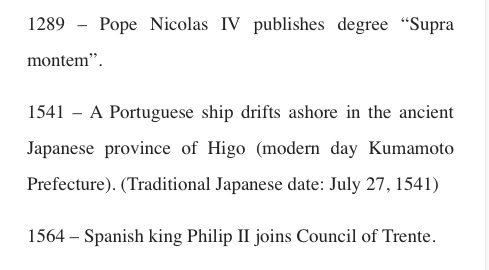
Kirk here. It's interesting to me how misinformation gets repeated on the internet. Today, I did a little search for "Kumamoto" in Google's "news" category and found this completely wrong bit of news:
https://english.khabarhub.com/2019/18/38151/
Portuguese ships didn't arrive here in 1541; it was in Tanegashima (part of what is now Kagoshima Prefecture) in 1543.
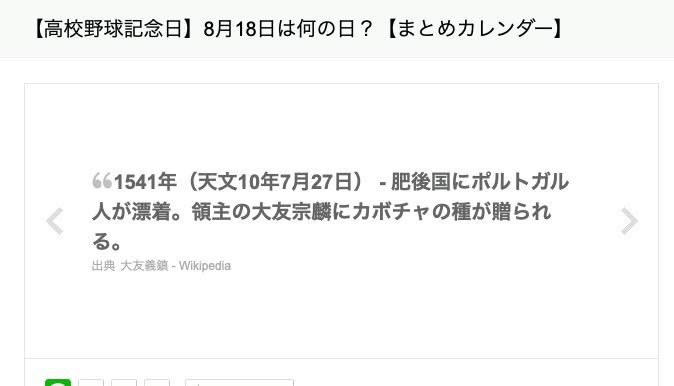
One thing about this misinformation that I find to be interesting is that there is a Japanese version as well:
https://matome.naver.jp/odai/2140498336494551501/2140498716497234203
I'm not sure whether this spread from Japanese to English or vice versa, but misinformation seems to translate reasonably well.
Here are some quotes with verifiably correct information about the arrival of the Portuguese in this part of the world and the associated introduction of Christianity:
"The first three Europeans to arrive in Japan in 1543 were Portuguese traders António Mota, Francisco Zeimoto and António Peixoto (also presumably Fernão Mendes Pinto). They arrived at the southern tip of Tanegashima, where they would introduce firearms to the local population."
https://en.wikipedia.org/wiki/Japan–Portugal_relations
"Francis Xavier reached Japan on 27 July 1549, with Anjiro and three other Jesuits, but he was not permitted to enter any port his ship arrived at until 15 August,[42] when he went ashore at Kagoshima, the principal port of Satsuma Province on the island of Kyūshū."
https://en.wikipedia.org/wiki/Francis_Xavier#Japan_and_China
In regard to Amakusa . . .
"In 1566, a gōzoku asked Cosme de Torrès to send a Catholic missionary. Luís de Almeida was dispatched in the same year. He built a church with the permission of the rulers."
https://en.wikipedia.org/wiki/History_of_Kumamoto_Prefecture
Gozoku is "a Japanese term used to refer to powerful and wealthy families."
https://en.wikipedia.org/wiki/Gōzoku