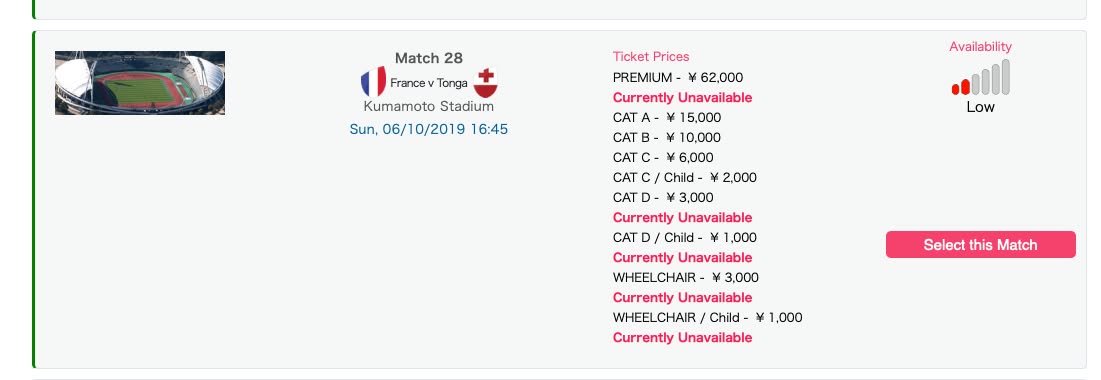

Kumamoto's first rugby match in the World Cup Series will be held here tomorrow. Apparently, there are some seats left but the most inexpensive seats have sold out. If you want to buy a ticket, you need to do it online:
https://tickets.rugbyworldcup.com
Note that you will need to create an ID and login before you can find the ticket information you are looking for -- a system I am not particularly happy with.
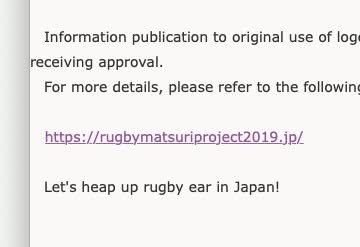
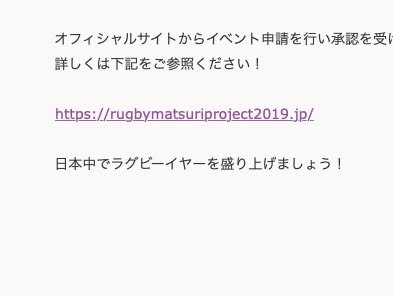
By the way, I thought I'd introduce this machine translation about rugby in Kumamoto that I found to be rather amusing. The English is "Let's heap up rugby ear in Japan!" I happened to find it through a search and, though I knew it was a problematic machine translation from the Japanese, I couldn't imagine what it meant. I even looked up "rugby ear" on the web and got lots of pictures rugby players with misshaped ears (an occupational hazard, I'm afraid). Well, it turns out that the original Japanese was "日本中でラグビーイヤーを盛り上げましょう!" -- Let's have a great rugby year -- not ear.
This would be merely amusing if it weren't for one rather annoying fact. We foreigners, when we come across an enigmatic translation such as this one, are not given a link to the original Japanese that might help us (perhaps with the help of someone else who understands Japanese better than we do) figure out what the post actually means. This is true, even though it would be extremely easy to provide a link to the original Japanese. In this case, for example, the address of the machine translation is
https://www.pref.kumamoto.jp.e.qp.hp.transer.com/kiji_27965.html
and one can get to the Japanese by removing ".e.qp.hp.transer.com" which gives us
https://www.pref.kumamoto.jp/kiji_27965.html
As I have mentioned before, Kumamoto Prefecture and Kumamoto City do provide a disclaimer about the possibility that a machine translation might not be "100% accurate." It did not seem to occur to the folks who put the machine translation system in place, however, that, in addition to pointing out that there may be problem, it might also be a good idea to help the foreigners who come across the weird English to find the original Japanese.
I imagined that this might have been a mere oversight (you know, the possibility that dumb foreigners might benefit from access to the original text not occurring to people), so I wrote a formal three-page letter (in Japanese of course) to the mayor of Kumamoto asking that the automatic machine translation system be revised so that a link to the original Japanese is also generated automatically for each page. I imagined that when city officials (who vet such letters before consulting the mayor) read my letter they would have a sort of "hand to forehead" sort of moment (Of course! Why didn't WE think of this?!). Instead, however, I was told informally when I was chatting with a city official (who had read the letter) later that week that he thought links to original texts were omitted intentionally. My jaw hit the floor and I tried to find out what the thought process behind this policy was but didn't get far.
As of this writing, I haven't received a formal, written response to my formal, written proposal. I'm not sure if it just takes time for a big bureaucracy like the city government to respond or if the officials who read the letter don't think it deserved a response. I'll try to check into this fairly soon.
In the meantime, if you come across enigmatic English in an automatically generated web page on a local government site, remember that you can get to the original by removing ".e.qp.hp.transer.com" from the URL -- but that the local government may prefer that you not do so.
-- Kirk