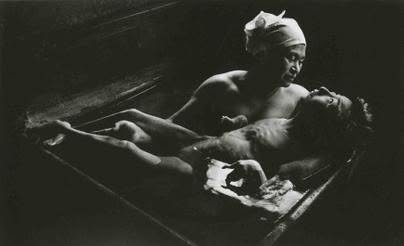
Allan Sutherland provided a very detailed response to my rather snarky previous post on Minamata disease. It deserves to be reposted verbatim. Please see his writing below, and a Wikipedia link to the Minamata disease. - William
https://en.wikipedia.org/wiki/Minamata_disease
The photographer was W. Eugene Smith, and he used a wide range of cameras, ranging from Rollieflex mid-frame, Nikons, Leicas, and so on. There are photographs of him sporting an array of cameras, although as Liz points out, they would often be fitted with an array of lenses; zoom lenses were not as refined then as now. Some would also have different films installed, to accommodate lighting conditions, slow, mid- or high-speed films. (I commonly carried two film cameras, one for B&W, the other for colour slide, and had two lenses.) In Minamata Smith' camera(s) of choice was the rather unimpressive Minolta SRT-101, not the more commonly used 35 mm Leicas or Nikons, at the time. In the 5 or so years preceding going to Minamata he spent a lot of time in his loft in New York City, where he photographed incessantly, inside and outside of the window: inside was of many jazz musicians who hung out there, performed there, rehearsed there; outside the subject was the views and the passersby on the street 5-floors below. When he went to Minamata his health was not good, he had suffered severe injury as a war photographer during the Battle of Okinawa. In Minamata he was severely beaten up by 'employees' of Chisso, which severely damaged his eyesight. His wife was Japanese-American. One of these pictures is of his photo-equipment from Minamata. I will watch this bio, but expect it will be a typical Hollywood biopic of cinematic and verbal cliche.
No photo description available.