
When English is used in the context of Japanese is it English or Japanese? This may sound like an odd question but recently I've begun to think that, in Japan, there seems to be an assumption that English used in the context of Japanese isn't really English and as such is not subject to the rules and conventions of the language.
One example, would be the "Go To トラべル" expression. If the kanatana is converted to English (as it often was) this becomes "Go To Travel" which is, of course, weird English. But, perhaps the idea was that, originally at least, "Go To トラべル" was just a borrowing of English into the Japanese language and as such didn't have to be "correct". Of course, even if this was the original notion, it quickly became "Go To Travel" and "Go To Eat," further exacerbating confusion about what constitutes good English (including proper capitalization).
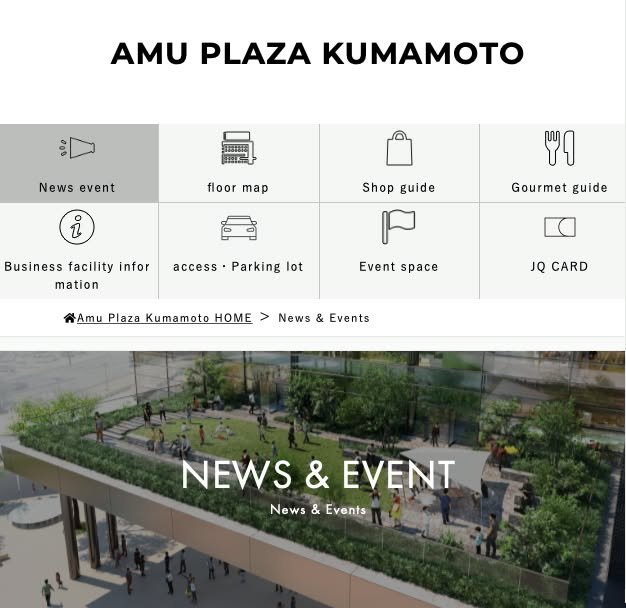
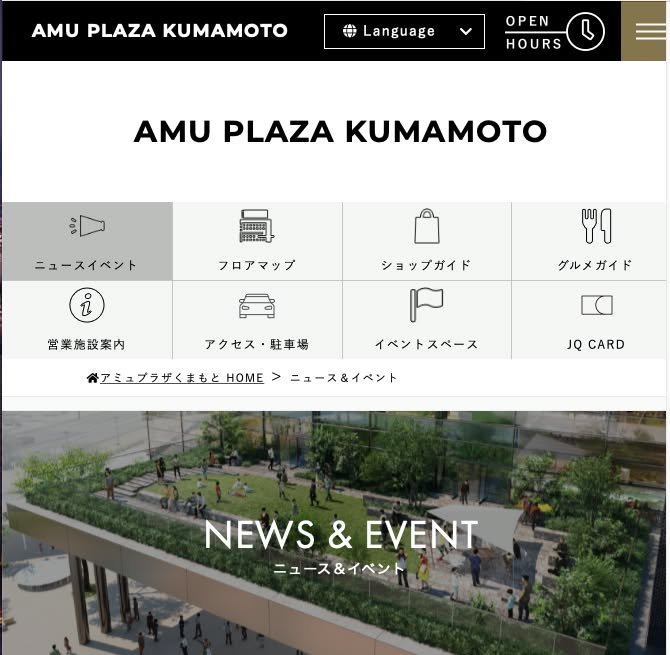
The "Go To" issue is rather old but I recently found myself thinking about this issue when looking at the images I've shared in this post. Perhaps "NEWS & EVENT" was considered to be OK in Japanese because, as loanwords, that's how Japanese people use them: ニュース、イベント. The problem occurs, however, when the same graphic is used on the English part of the page. There you have this weird situation of the heading being "NEWS & EVENT" and the "translation" being "News & Events".
The use of spaces presents a similar issue. Spaces are not part of the Japanese language. So, if they are used in Japanese, it's merely to improve the appearance, not because they are required in order to be "correct." Of course, the situation in English is different. A word or name is usually either written with a space or it isn't -- it's not something that can go either way depending on the context. So, as Japanese, it doesn't really matter if something is "AMU PLAZA" or "AMUPLAZA." As someone who looks at these letters as English, however, my sense is that either one is possible but "decide on one and stick to it."
Any little irritation I feel about these matters isn't really important. I'll survive. But, I do worry about what impact this "devil-may-care" (いいじゃないですか) approach to public English may have on young people who want to learn English. I think it's natural for such young people to pay attention to the examples of English they see around them and I worry that this approach to English just causes more confusion.
So, to answer my own question, I would recommend that "News & Event" be viewed as English and that as such, it should be checked and corrected. I'll be interested to read any thoughts any of you may have.
-- Kirk