Kirk here with some news and thoughts about the near exclusion of newly arriving foreigners from Japan. This is not an issue that is specific to Kumamoto, but it is certainly affecting Kumamoto as it affects the nation as a whole.
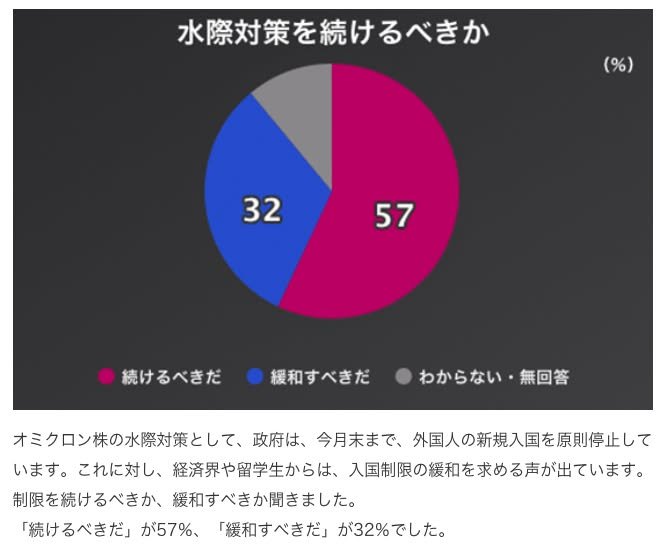
First, the news. Last night, I saw the following survey results on NHK's evening news. Asked if restrictions should be relaxed or kept the same, 57% of those surveyed said "kept things as they are."
I have some problems with this survey that I'd like to lay out here. First, the wording "mizugiwa taisaku" (水際対策; "measures to defend the coastline") tends to reinforce the impression that non-Japanese are a threat to public health. My Japanese-Japanese dictionary defines a similar mizugiwa expression, "mizugiwa sakusen" (水際作戦; coastline strategy) as "defending the coastline against enemies attempting to land" (上陸してくる敵を水際で防ぎ守ること). During the past year, I suspect that the constant repetition of the "mizugiwa taisaku" phrase and other characteristics of media coverage have ingrained an association of "foreigner" with "threat to public health" in the minds of typical media consumers. This kind of mentality was, in my view, deeply related to the exclusion of non-Japanese permanent residents of Japan who happened to be caught outside of the country when all of this started.
My second problem is with a lack of thoughtful consideration of the effectiveness of such measures. Back in November when Omicron was starting to spread, NPR (public radio in the U.S.) published the following:
As omicron spreads, studies suggest that travel bans alone don't do much good
https://www.npr.org/sections/coronavirus-live-updates/2021/11/28/1059619823/omicron-travel-bans-covid
Here's another related article:
Are travel bans effective?
https://deohs.washington.edu/edge/blog/are-travel-bans-effective
"Some of the evidence suggests that a travel ban may delay the arrival of an infectious disease in a country by days or weeks. However, there is very little evidence to suggest that a travel ban eliminates the risk of the disease crossing borders in the long term."
Still, at the time I thought "Omicron isn't here in Japan yet. Travel restrictions may help to delay spread in Japan." But what is the value of such a ban now? Omicron has taken root and we don't know of a new variant from which Japan needs to be defended. I have not heard this issue discussed on NHK. It may be getting some attention in some media I'm unaware of but my impression is that most Japanese people aren't getting much expossure to thoughtful considerations of the limited value of travel bans. NHK's asking for opinions in a survey without bothing to present both sides of the issue really rubbed me the wrong way.
The third problem I have with this is the lack of consideration of the circumstances and value of longterm foreign students in Japan. Even with concerns about the spread of COVID-19, students planning to study here for a year or more could be let into the country under a strict quarantine protocol. This way, they would not begin to interact with the general population until it's clear that they are not harboring disease. From that point, their presence in Japan should pose no more risk than that of any Japanese person studying and living in Japan. Moreover, the losses suffered by students and Japan as a whole by pursuing an irrational mizugiwa policy are significant. The letter described in the following article outlines some of those loses:
US academics pen letter to Japan PM Kishida calling for border reopening to int. students
https://mainichi.jp/english/articles/20220121/p2a/00m/0na/049000c
The survey that got my dander up was occasioned by Kishida's talk of loosening restrictions. That would be a move in the right direction. But so far, the proposed increases have been mere token measures as far as I can see. Politicans are surely afraid of backlack from the public and unless the media back off the "foreigners = healthrisk" theme and help the public understand that the current mizugiwa measures are not in the interests of the country (not to mention young scholars of Japan), I suspect that politicians will continue to be circumspect.
P.S. Here's an article from the Asahi that is just the kind of thing I would like NHK to present to its viewers. Even though we get the Asahi at home, I missed the vernacular article. So, some people in the media are saying what I think needs to be said. I think Japan needs more such discussion to make the poll numbers change.
VOX POPULI: Cut foreign students some slack and ease border controls
https://www.asahi.com/ajw/articles/14535082