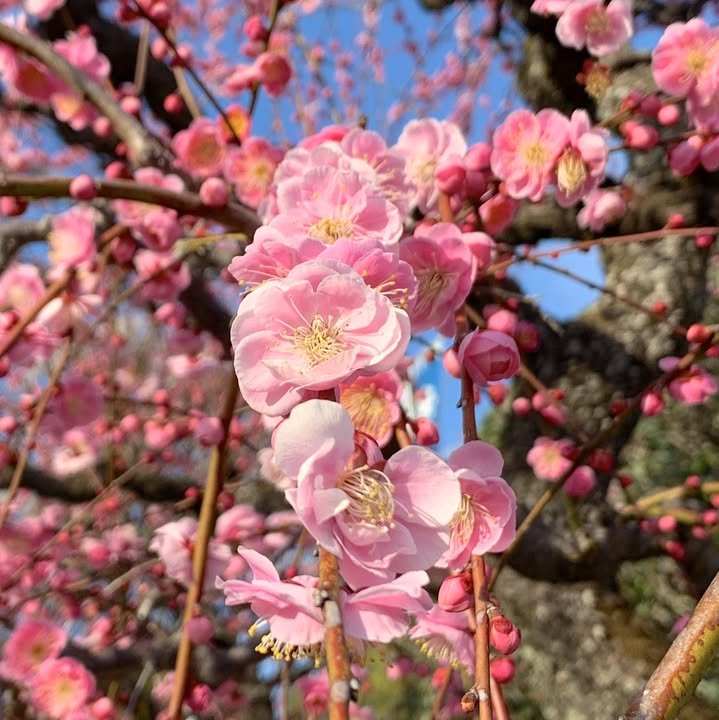
Kirk here with a little photo I took of the "shidare ume" (weeping plum blossoms) in Suizenji Jojuen today. My wife and I paid a thousand yen each to get free entry for a whole year -- a pretty good deal, I think, if you live in the area. It was cold today but still worth visiting.
Reading signs here and there and then following that with some reading on the web after I got home, I learned the following:
-
There was a temple called "Suizenji" ("temple before the water") in the same location in the Heian Period (794 - 1185) but it burned down toward the end of that era. I'm not sure, but I'm guessing that "Suizenji" may have survived as a place name even after the original temple had been destroyed.
-
In 1636 when Hosokawa Tadatoshi built "Suizenji Tea House" (Suizenji Ochaya) at the site of the current garden, he invited the zen monk Gentaku to come and build a temple on there. That was called "Suizenji" (Suizen Temple) but it didn't last long.
-
Tadatoshi's grandson, Tsunatoshi is the guy who put the Japanese garden in the form we know today with the enlarged pond, the artificial mountain (tsukiyama), and the path that encircles the pond. It seems that the temple would get in the way of the planned expansion of the garden so it was moved to its current location (near the bowling alley -- which probably wasn't there at the time ;) ) and renamed Gentakuji (Gentaku Temple) for the zen monk who had come a generation or two earlier.
-
Jojuen (as in "Suizenji Jojuen," the formal name for the garden) was taken from an ancient Chinese poem.
This little summary is what I have been able to cobble together from a number of sources about how it is that "Suizenji" is a major place name and the name of Kumamoto's most famous garden, even though we no longer have a temple of that name. If I've gotten something wrong, please let me know.