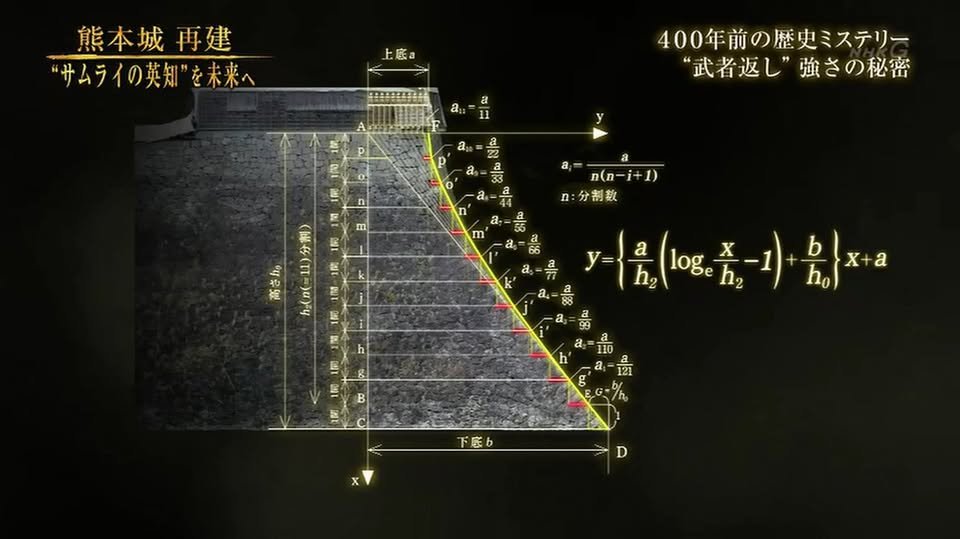
Kirk here. Yesterday Atsuko wrote about a confection with the name "Musha Gaeshi" (武者返し). William has explained the meaning of this term in the past but I'd like to review it for anyone who may not know or may have forgotten and add a bit of information that I suspect will be new to most of you.
The image you see is from the following post by William:
https://www.facebook.com/Kumamotoi/posts/2230097940396959
As William has explained in other posts, the term "mushagaeshi" means "warrior repelling" (武者 [musha] is an old term for warrior and the verb 返す [kaesu] means to "repel" or "throw back"). The idea is that the increasingly steep incline would tend to repel any warriors that might try to scale the walls in an attack.
The image, however, tells a different story. In short, the idea is that the design was really intended to make the castle walls earthquake resistant. The image is from a documentary aired by NHK that I happen to have recorded and used in a class about Kumamoto that I teach to foreign students.
According to the program, curved castle walls were a new thing for KATO Kiyomasa. The walls of another castle Kato made a few years before he built Kumamoto castle are straight, not curved. That castle was Ulson Castle (built during Kato's invasion of Korea beginning in 1593). You can see the straight walls here:
https://en.wikipedia.org/wiki/Ulsan_Castle
The change in Kato's approach came as a result of the Keicho-Fushimi earthquake of 1596, which occurred in the Kyoto area. This quake devastated the recently constructed Fushimi Castle and, according to the program, Kato saw the devastation with his own eyes. This led him to begin experiments with different methods of stacking stones to make them more resistant to shaking. I'm not sure how he might have done this, perhaps with smaller models, but, at any rate, the program indicated that the curved design was the result of such research.
In 2016 many castle walls fell but the walls that suffered the worst damage were those put up AFTER Kato's death; on the whole, his original walls have stood up to earthquakes quite well.
Given this understanding of the original intent of the curved design, the walls might as well be called "jishingaeshi" (地震返し; earthquake repellent). But, of course, no one says that. As Atsuko indicated, Musha Gaeshi is now the name of at least two kinds of sweets, a brand of shochu (distilled rice liquor), and has been made part of the design of Kumamoto Station (the point of William's original post). The phrase is more-or-less synonymous with Kumamoto. But, now you know the REAL reason for that lovely shape! ;)