Kirk here with mollusks (shellfish) on my mind. The so-called "clam scam" (asari mislabled as "harvested in Kumamoto") got me thinking about what caused the precipitous decline of asari that forced people to rely on imported clams in the first place. And that got me thinking about why it was that the numbers of so-called "Kumamotos" (oysters that are now popular in the U.S.) fell to the point that they had to be reintroduced from the States. Looking for information about oysters in the Ariake Sea led to what I'm writing about today: carmel candies. I'll write about Kumamoto oysters and reasons for the decline of asari clams some other day. What I'm writing about today is of no great consequence but I hope you enjoy this bit of Ariake Sea mollusk trivia. ;)
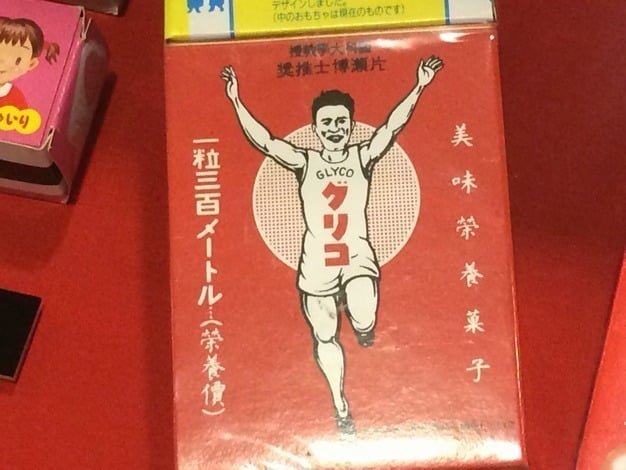
If you've been in Japan for a while, you're probably familiar with Glico (グリコ), a brand of candies. I think the box you see in the image must be from about 1929:
https://goldenyokocho.jp/articles/1138
https://www.glico.com/assets/files/201703-NL-glicohistory-2.pdf
If you can read the Japanese on the box, you can see that it's being promoted as healthy, not just tasty. If fact, it says you can run 300 meters on just one carmel -- good mileage! ;) The candy could be sold as a sort of nutritional supplement because it contained glycogen, which is abundent in mullusks such as oysters. In fact, the company name, Glico (グリコ; Glyco on the 1929 box -- not sure when the spelling changed), is an abbreviation of the Japanese word for this substance (グリコーゲン). The company founder, Riichi Ezaki got the idea in 1919 when he was in Saga and sampled glycogen-rich oyster broth given to him by local fisherman.
I'm not sure if the candies really had oyster juice in them or not but the article I read indicated that they did indeed contain glycogen. And, although I wouldn't normally recommend eating carmels to improve one's health, they certainly didn't seem to hurt Mr. Ezaki; he lived to the ripe old age of 98.
The place name "Kumamoto" doesn't come up in this story but Saga and Kumamoto are neighbors on the Ariake Sea and I don't doubt that oysters being consumed in Saga would have been eaten in Kumamoto at the time too.
Personally, I find it interesting that some modern snacks in both Japan and my own country, the U.S., got their start as healthfood. I think there are probably many examples but Dr. Pepper in the U.S. comes to mind. Today, Dr. Pepper is generally regarded as junkfood -- caffeinated sugar water -- but it got its start as an elixir that was supposed to "cure what ails ya," as they used to say.
Maybe Americans and Japanese aren't so different after all. ;)
Sources:
THE MEDICINAL HISTORY OF SODAS EXPLAINED
https://www.grunge.com/248371/the-medicinal-history-of-sodas-explained/
グリコ 有明海にヒント 創業者・江崎利一 カキ栄養素から考案 佐賀県
https://www.nishinippon.co.jp/item/o/278328/